Personal

Deed of Variation UK: Change a Will or Intestacy After Death (Template)

Redirect all or part of an inheritance under a will or the intestacy rules in England and Wales, within two years of the death, with the inheritance tax and capital gains tax statements HMRC expects and the personal representatives' agreement.
4.6/5— 14 reviews50 000+ downloadsInstant download
Share

A deed of variation lets someone who inherits under a will, or under the intestacy rules, pass all or part of that inheritance to another person after the death, as if the person who died had made the gift. Families use it to skip a generation, help a surviving spouse, even out shares or give to charity. Our deed of variation UK template is drafted for estates governed by the law of England and Wales and contains the statements HMRC expects for inheritance tax and capital gains tax, so the redirection is read back to the date of death. It suits executors and families who want a clear, signed record before the two-year window closes.

Compliant

2026 Legislation

50,000+ clients

trust us

Affordable

From $4.90 / doc

Secure payment

Instant download

Deed of Variation UK: Change a Will or Intestacy After Death (Template)

Secure payment

Fill in the template

What is a deed of variation in the UK?

A deed of variation (HMRC calls it an instrument of variation) is a written document by which a beneficiary changes the destination of property they received, or were entitled to receive, on a death. The person who gives something up is the original beneficiary; the person who receives it is the new beneficiary. The deed does not rewrite the will. It changes the effect of the will, or of the intestacy rules, and the personal representatives then administer the estate as varied.

Three documents are often confused. A codicil to a will changes a will while its maker is alive and must be signed with the formality of the Wills Act 1837. A disclaimer simply refuses a gift: the beneficiary cannot choose who takes instead, and the right is lost once any benefit has been accepted. A deed of variation is made after the death, lets the original beneficiary decide where the property goes, and remains possible even after the estate has been distributed. Section 142 applies across the UK, but this template is drafted for estates administered under the law of England and Wales; Scottish estates need different wording. If you are still planning your own affairs, a last will for England and Wales is the better tool.

When do you need a deed of variation?

The classic case is a parent who inherits from their own parent and does not need the money. Redirecting it to their children keeps it out of their own estate without starting the seven-year clock of an ordinary lifetime gift, and a home passed to children or grandchildren can still count towards the residence nil rate band under sections 8J and 8K of the 1984 Act. A surviving spouse who was left little under an old will sees the opposite pattern: adult children redirect part of their share to the survivor, and that share then qualifies for the spouse exemption.

Charitable giving is the third common reason. Where gifts to charity reach at least 10% of the baseline amount of a component of the estate, Schedule 1A charges that component at 36% instead of 40%, and a modest variation can tip an estate over the line. Charity trustees on the receiving end will find matching paperwork among our templates for charities and nonprofits.

Joint property and a second death are the two traps. A home owned as joint tenants passes automatically to the survivor outside the will, yet HMRC accepts that the deceased's share can be redirected if the deed says so expressly. And where a beneficiary has died since the first death, their own personal representatives can vary the earlier inheritance, although that needs bespoke wording.

Key clauses included in our template

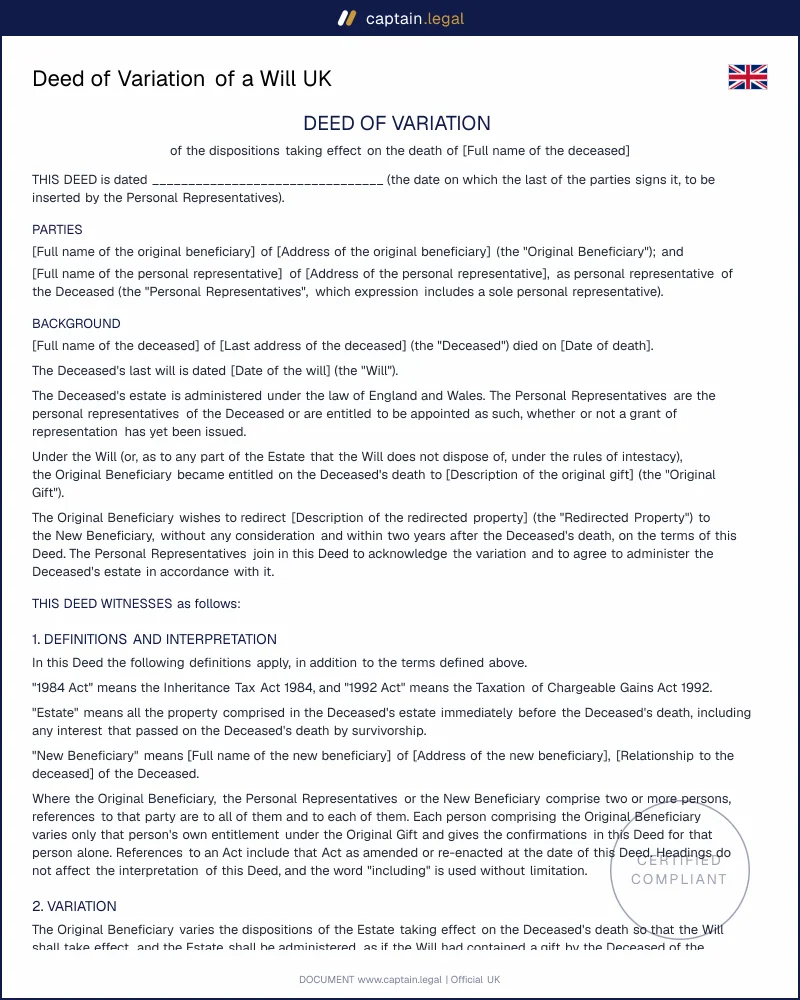
The template follows the order a solicitor reviewing the estate file expects. The parts that do the legal work are these:

  • A recital of the original gift with its clause number or intestacy entitlement, because HMRC rejects a deed that does not identify the disposition being varied.
  • Where the redirected property includes a jointly owned asset, the deed recites that it passed by survivorship. Without that recital the share may be treated as a lifetime gift.
  • Tax incidence is settled once: any additional inheritance tax is borne by the redirected property alone, so the extra tax does not fall on beneficiaries who are not parties.
  • Separate inheritance tax and capital gains tax statements, each optional, sit beside the stamp duty category M certificate and a confirmation that no outside consideration was given.
  • If a new beneficiary is under 18, the personal representatives hold the property on a bare trust until that child turns 18, with the powers in sections 31 and 32 of the Trustee Act 1925.

Further clauses cover land (assent or transfer at HM Land Registry, the exemption from stamp duty land tax or Welsh land transaction tax, any mortgage), notice to a charity, the six-month reporting duty, the original beneficiary's confirmations of age, capacity and solvency, and signature blocks for every party and witness. Related succession paperwork sits in our personal legal documents for England and Wales.

How to fill out this deed of variation

You start with the person who has died: full name, last address and date of death, written in words. The questionnaire then asks whether there was a will, a will with codicils or no will at all, and the recitals switch between the language of a will and that of the intestacy rules. The personal representatives and the people giving something up follow.

The central step describes the original gift and what is being redirected: the whole gift, a fixed sum, a specific asset or a fraction. You then choose one person, two people in equal shares, or a charity with its registered number. Questions on minors, land and income since the death adjust the operative clauses, and the last screen asks whether to include each tax statement. The preview updates as you type, so the deed of variation UK template on screen is the one that will be signed.

Each original beneficiary and each personal representative then signs in the physical presence of an independent adult witness, and the personal representatives date the deed once the last party has signed. The full catalogue of UK legal templates covers other estate paperwork.

Common mistakes to avoid

Whatever the estate, the costliest error on a deed of variation UK form is timing. A deed that one beneficiary signs the day after the second anniversary of the death falls outside section 142 and is taxed as the original beneficiary's own gift, and HMRC has no discretion to extend the period. Another frequent problem is a missing or garbled statement of intent: the wording must refer to section 142(1) and, for capital gains, section 62(6), and a deed that says the family simply "agree to change the will" is a gift by the original beneficiary. Families also forget that the personal representatives must sign when the variation increases the tax.

People cause the other set of problems. A parent cannot sign away a benefit on behalf of a child, and an attorney acting under a lasting power of attorney for property and financial affairs, like a deputy, needs the authority of the Court of Protection to give away the inheritance of someone who lacks capacity; where a minor or unborn beneficiary loses out, court approval under the Variation of Trusts Act 1958 is the usual route. A second variation of the same property cannot be read back, as Russell v IRC confirmed. Check means-tested benefits and care funding before signing, because a local authority may treat a redirected inheritance as deliberate deprivation of capital.

Key takeaways

TWO-YEAR LIMIT

Every party must sign within two years of death

A variation is read back to the date of death only if it is made in writing within two years, and HMRC counts the anniversary as the last day, with no extension. The law asks only for writing, but this template is signed as a deed, before a witness, by everyone who gives something up. A parent cannot sign away a child's share, an adult lacking capacity needs the Court of Protection, and a minor who would lose out needs court approval.

TAX STATEMENTS

Statements that treat the gift as the deceased's

To be read back for inheritance tax, the deed must state that section 142(1) of the Inheritance Tax Act 1984 applies, and a separate statement that section 62(6) of the Taxation of Chargeable Gains Act 1992 applies does the same for capital gains. When the variation increases the tax, the personal representatives must join in the statement and a copy must reach HMRC within six months, with the amount of extra tax. Income tax is never backdated.

TITLE AND TRANSFERS

The deed changes entitlement, not legal title

The deed decides who is entitled, but land and shares still have to be transferred. The personal representatives sign an assent or transfer (the original beneficiary does so where title passed by survivorship), then the change is registered at HM Land Registry. Made within two years and for no consideration, the variation is exempt from stamp duty land tax, and from land transaction tax in Wales. Pension death benefits stay outside the deed.

Frequently Asked Questions

It is, once every original beneficiary has signed it as a deed, each signature witnessed, and it has been delivered. The general law gives effect to the redirection from the date of the deed, and the tax statements make HMRC treat it as made by the deceased. A template cannot bind people who have not signed: anyone who loses out must be a party, and a child or a person lacking capacity cannot give up a benefit without a court order. Independent advice is wise where the sums are large or the tax effect uncertain.

All the original beneficiaries must sign within two years after the death, and HMRC counts the anniversary itself as the last day. There is no extension. A grant of probate is not needed first, so the deed can be signed early in the administration. If the variation increases the inheritance tax, a copy must reach HMRC within six months after the date of the deed, with the amount of extra tax. Where it reduces the tax or leaves it unchanged, nothing has to be sent, although the personal representatives include the deed with any repayment claim.

Both formats are available once the questionnaire is complete and the order confirmed. The PDF is ready to print and sign, which suits most families because the signatures must be witnessed on paper. The Word file lets a solicitor add a clause or a title number later. Keep the wording of the tax statements intact whichever file you use, because HMRC checks that the statement cites section 142(1) and section 62(6). You can return to the questionnaire to correct a name or a figure and produce a fresh copy before anyone signs.

Only in one situation: the deed contains the inheritance tax statement and the variation results in additional tax. Section 218A then obliges the relevant persons to send a copy within six months and to state the extra tax, and late delivery can attract a penalty. Form IOV2 is a voluntary checklist that HMRC asks for with the copy, but it does not replace the deed. When the variation produces a refund, the personal representatives send the deed with the repayment claim. Otherwise the deed stays with the estate records.

Usually not through this deed. Death benefits from most pension schemes, and life policies written in trust, are paid by the scheme or the trustees under their own rules, so they never pass under the will. For deaths on or after 6 April 2027 most unused pension funds count towards the estate for inheritance tax under the Finance Act 2026, yet the money is still paid by the scheme, and redirecting it raises questions a standard deed does not answer. Speak to the scheme administrator and an adviser first.

A child under 18 cannot give a valid receipt, so the template has the personal representatives hold the redirected property on a bare trust until the child turns 18, using income and capital for the child's maintenance, education or benefit under the Trustee Act 1925. There is one tax trap. If a parent redirects to their own unmarried minor child and the income from that gift, added to income from any other gift by the same parent, comes to more than one hundred pounds in a tax year, all of it is taxed as the parent's income under section 629 ITTOIA 2005. A grandparent redirecting to grandchildren is outside that rule.

4.6/5

14 verified reviews · 50 000+ downloads

Deed of Variation UK: Change a Will or Intestacy After Death (Template)
  • Immediate access to the document
  • PDF + Word download
  • Compliant with 2026 legislation
  • Reviewed by lawyers
Fill in the template
Secure payment
Updated on November 7, 2026

You might also like

UK Will Template
Letter of Authority