Personal

Letter of Authority Template UK: Authorise Someone to Act for You

Authorise a person you trust to collect items, deal with an account or service, or follow a complaint for you: information only or acting on your behalf, clear exclusions, duration, withdrawal and UK GDPR consent to share your personal information.
4.8/5— 12 reviews50 000+ downloadsInstant download
Share

A letter of authority is a short signed letter in which you name a person you trust and allow them to deal with an organisation on your behalf: collecting a parcel or keys, sorting out a utility account, chasing a complaint or getting information about your affairs. It suits anyone who is abroad or unwell, and the relatives who help them. Our template follows the law of England and Wales and can be used anywhere in the UK. It fixes what your authorised person may do, what they may not do, how long the authority lasts and how you withdraw it, and it records your consent to share personal information.

Compliant

2026 Legislation

50,000+ clients

trust us

Affordable

From $4.90 / doc

Secure payment

Instant download

Letter of Authority Template UK: Authorise Someone to Act for You

Secure payment

Fill in the template

What is a letter of authority?

In legal terms, the letter creates an agency: you are the principal, the person you name is your agent, and the organisation is the third party that relies on the letter. The agent can only do what the letter allows, which is why the wording matters more than the length. A vague line such as "please deal with my son" leaves the bank to guess the limits, and many refuse rather than guess. A good letter names the matter, separates the right to receive information from the right to give instructions, and lists what stays excluded, such as closing an account, borrowing or signing a contract in your name.

People often confuse it with a power of attorney. An ordinary power of attorney must be executed as a deed. A lasting power of attorney keeps working after you lose mental capacity, but only once registered. This letter is neither: it is an informal written authority for a defined task, quick to prepare and easy to end. For long term planning of your money and property, you need a property and financial affairs LPA; no letter can do that job.

When do you need this document?

The most common use of a letter of authority is a simple collection: a parcel held at a delivery office, documents at a solicitor's reception, or keys at a letting agent while you are at work. A letter naming the items, the collector and the identity document they will show gives the counter staff what they need to check.

Adult children use the letter to talk to a parent's water company or council tax team, a student lets a parent deal with a university query, and someone working overseas leaves a friend in charge of meter readings. Banks and building societies usually want their own third-party mandate before anyone else operates an account, so the letter is mostly useful there for information. Complaints, such as an energy bill dispute or a cancelled hospital appointment, can drag on for months; the template lets your relative either follow the complaint or actually pursue it.

Two edge cases deserve a warning. HMRC accepts a signed letter naming a friend or relative as an intermediary if it gives your name, address, date of birth and tax reference, plus the helper's name and address; the helper can talk to HMRC and help with forms but gets no access to your online tax account, and form 64-8 is the route for paid agents such as accountants. For benefits, someone who cannot manage their own affairs needs an appointee, not a letter.

Key clauses included in our template

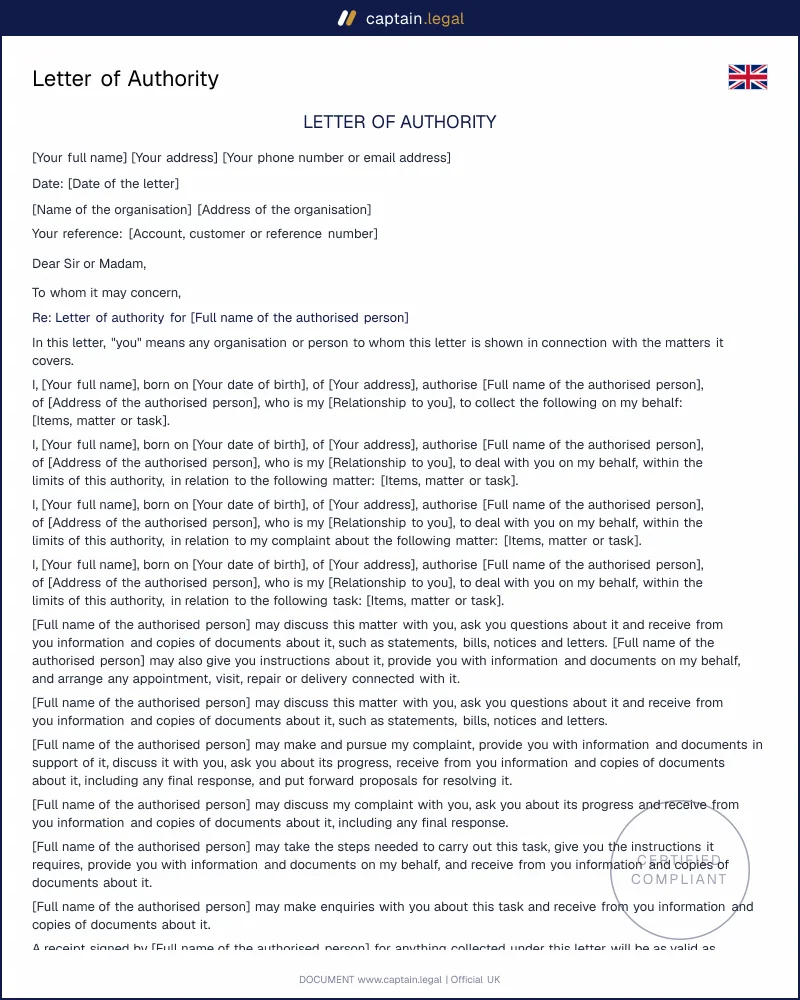
Our letter of authority opens with your name, address and a phone number or email, identifies you by date of birth, then names your authorised person, their address and their relationship to you. A letter to one organisation can quote your account or reference number; a general letter "To whom it may concern" defines "you" as any organisation to which it is shown. The matter is described in your own words, and the authority covers only what you write there.

The core depends on the purpose you select. For a collection, a receipt signed by your authorised person is as valid as one signed by you, and nothing else is authorised. For an account, a complaint or another task, you choose between information only (they can discuss the matter and receive documents) and acting on your behalf (they can also give instructions). In the second case the organisation may treat their instructions as if they came from you, while fixed exclusions apply: no opening or closing of accounts, no borrowing, no moving money, no change of contact or security details, no settlement, no new charge and no contract. You can add one precise extra power, with an amount limit where money is involved.

Several closing clauses protect you. Except for a collection, correspondence keeps going to your own address; the letter also states how your authorised person proves their identity, sets the duration and explains that a withdrawal takes effect as soon as the organisation is told. Optional blocks add a specimen signature, a witness and a note of enclosed identity documents.

Scotland and Northern Ireland

The letter contains no clause that depends on English law, and the UK GDPR applies across the UK, so the same letter can be shown in Edinburgh or Belfast. Differences appear only when you need more than a letter. A lasting power of attorney is binding only in England and Wales. Scotland uses a continuing power of attorney for money and property or a welfare power of attorney, both registered with the Office of the Public Guardian (Scotland) before they take effect. Northern Ireland uses the enduring power of attorney, which covers financial matters only and is registered with the High Court (Office of Care and Protection) once the attorney believes you can no longer manage your finances.

How to fill out this letter of authority

You start with your own details, including the phone number or email address the organisation can use to check that the letter is genuine. The form then asks for the person you are authorising and the identity document they will show, and whether the letter goes to one named organisation or to anyone concerned. Choosing a collection removes the questions about instructions, which make no sense for a parcel. For the other purposes you pick information only or acting for you, plus any extra power. You then set the duration and the date, typed as DD/MM/YYYY, and the optional blocks. The preview on the right changes with each answer. Download the result in Word or PDF, sign it by hand on the date shown in the letter, and give the original to your authorised person or post it to the organisation. The other UK personal legal documents cover wills and LPAs.

Common mistakes to avoid

The mistake we see most often is the open ended letter: "my daughter may deal with all my affairs". Organisations read it as a power of attorney without the formalities and refuse it; if one accepted it, you would give away far more than you meant to. Name the account or the complaint. The second mistake is ignoring the organisation's own process: banks want a third-party mandate, and some councils, landlords and letting agents (see our tenancy and letting documents) have their own consent form. Ask the organisation first and attach the letter to its form if it has one.

A single collection needs a short window, not an open ended authority. A name that does not match the authorised person's passport or driving licence gets them turned away at the counter. Finally, families often keep a letter alive for a relative whose memory is failing. Once capacity is going, your relative should make an LPA while still able to, or, in England and Wales, the family may need a Court of Protection deputy; the catalogue of UK legal templates includes both types of LPA.

Key takeaways

POWER OF ATTORNEY

A letter cannot stand in for a power of attorney

Under section 1(1) of the Powers of Attorney Act 1971, a power of attorney must be executed as a deed, and a lasting power of attorney only exists once it is registered with the Office of the Public Guardian under section 9 of the Mental Capacity Act 2005. A letter of authority is an informal written authority for one defined task. It cannot be used to sign a deed for you, and it is not the right tool for handing over all your affairs.

MENTAL CAPACITY

The authority ends if you can no longer decide

Government guidance states that an ordinary power of attorney stops being legal authority if the donor loses mental capacity, and the same principle of agency ends a letter of authority. It also ends on death. For a parent whose memory is failing, the durable solution is an LPA in England and Wales, a continuing power of attorney in Scotland or an enduring power of attorney in Northern Ireland, made while they can still understand it.

DATA PROTECTION

Consent lets the organisation talk to your helper

The letter records your consent, under its own heading, to the organisation sharing with your authorised person the personal information needed for the task, in line with Article 7(2) of the UK GDPR, under which a request for consent must stand apart from other matters. It is limited to that task and period, and Article 7(3) lets you withdraw it at any time. Banks, councils and benefit offices may still apply their own forms or identity checks.

Frequently Asked Questions

It is a valid written authority under the law of agency. Within its limits, the organisation can rely on what your authorised person says and does, and if you choose acting on your behalf, the template states that their instructions may be treated as yours. It does not oblige the organisation to accept it: a bank or council may insist on its own form, ask for proof of identity or refuse a request outside its policy. The letter is not a deed either, so it cannot be used to sign one or to replace a power of attorney. A clear, specific letter is the one most likely to be accepted.

You choose the period: until you withdraw it, until an end date, or between a start date and an end date. You can withdraw it at any time by telling the organisation, and the withdrawal takes effect as soon as the organisation is told; you then confirm it in writing. The authority also ends on your death or if you lose the mental capacity to make the decisions it covers. Some organisations hesitate over an old letter, so a fresh, dated letter for each new task is the safer practice.

Yes. Once the form is complete, you can download the letter in Word, to adjust the layout or add your own letterhead, or in PDF, ready to print. The preview shows the exact text of both versions. Sign it by hand on the date shown and keep a copy. A scan may be enough for an organisation that accepts email, but a counter handling a collection will usually want the signed paper original.

No witness is needed for the authority to work, and no solicitor needs to draft, sign or certify it either. A witness still helps: it gives extra evidence that you signed the letter, which reassures a cautious organisation. Choose an independent adult who is not your authorised person, sign in front of them, and let them add their signature, full name and address straight away. If an organisation wants a formal statement of facts made before a solicitor or commissioner rather than an authority, a statutory declaration is what they are asking for.

Only while your parent can still decide the matter covered by the letter. Capacity is assessed decision by decision under section 2(1) of the Mental Capacity Act 2005, so someone in the early stages of dementia may still be able to let a daughter handle a phone contract. Once that capacity is lost, the letter stops working and organisations should not rely on it. The lasting answer is an LPA made while your parent understands it, including a health and welfare lasting power of attorney for care decisions. Without one, the family may need to apply to the Court of Protection for a deputy, or in Scotland to the court for a guardianship order.

The letter records your consent to the organisation sharing with your authorised person the personal information needed for the matters it covers, under its own heading. That consent is limited to those matters and to the period of the authority, and you can withdraw it at any time. The organisation still decides how to check the request, for example by calling you, and medical files and other sensitive records can involve extra checks.

4.8/5

12 verified reviews · 50 000+ downloads

Letter of Authority Template UK: Authorise Someone to Act for You
  • Immediate access to the document
  • PDF + Word download
  • Compliant with 2026 legislation
  • Reviewed by lawyers
Fill in the template
Secure payment
Updated on November 4, 2026

You might also like

Cohabitation Agreement UK
Health and Welfare LPA UK