Personal

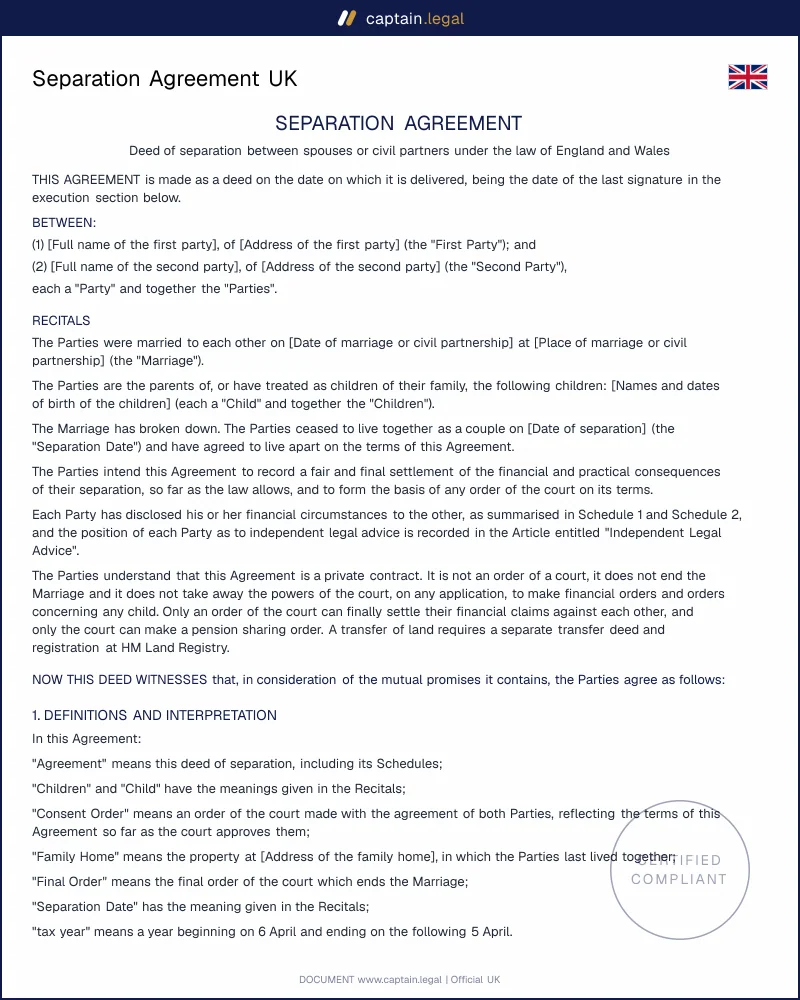
Separation Agreement UK: Template for Married Couples and Civil Partners

Deed of separation for spouses and civil partners in England and Wales: family home, children, child and spousal maintenance, pensions, tax and wills, with disclosure schedules and legal advice certificates.
4.7/5— 24 reviews50 000+ downloadsInstant download
Share

This separation agreement UK template records how a married couple or civil partners will split the home, savings, debts, pensions and the care of their children once they live apart. It suits people who want certainty now, whether they plan to divorce soon, prefer to wait, or have no intention of ending the marriage. It covers England and Wales only and is signed as a deed, with disclosure schedules and legal advice certificates built in, so that a court looking at it later has good reason to give it weight.

Compliant

2026 Legislation

50,000+ clients

trust us

Affordable

From $4.90 / doc

Secure payment

Instant download

Separation Agreement UK: Template for Married Couples and Civil Partners

Secure payment

Fill in the template

What is a separation agreement in the UK?

A separation agreement is a written contract between spouses or civil partners who have decided to live apart. It does not end the marriage and it is not a court order. Instead it fixes the arrangements both of you have accepted: who stays in the family home and on what terms, who pays the mortgage, how much child maintenance changes hands, whether either of you pays maintenance to the other, and what happens to pensions and joint debts. Signed as a deed, as ours is, it is often called a deed of separation.

A judicial separation is a court order that leaves the marriage in place; a separation agreement needs no court at all. A prenuptial agreement is signed before the wedding and looks ahead to a breakdown that may never happen; a separation agreement deals with a breakdown that already has. A consent order is different again: the court's own order, made during the divorce, and the usual route to a final financial settlement. In practice couples sign the separation agreement first, live by it, and later ask the court to turn its terms into a consent order once the conditional order has been made.

When do you need a separation agreement?

The classic case is a couple who have agreed the essentials but are not ready to divorce. Some want to see whether the separation holds, others have religious reasons, and others cannot yet apply because the marriage is less than a year old. Without a written agreement, the spouse who moves out often keeps paying a mortgage on a house he or she no longer lives in, with no record of how those payments will count.

Couples who will divorce soon still need rules for the months in between, since the divorce alone takes at least 26 weeks. The agreement covers who lives where, who pays which bill and how the children divide their time, and later becomes the draft for the consent order.

Some couples never intend to divorce, and the agreement then stands on its own for years. Where one spouse will stay in the home with the children until the youngest finishes school, a deferred sale (often called a Mesher arrangement) needs careful drafting. If the home is rented, the tenancy may need a deed of assignment of tenancy to the partner who stays, with the landlord's agreement. And where a parent plans a holiday abroad with the children, a signed consent letter for a child travelling abroad avoids problems at the border.

Key clauses included in our template

The deed opens with recitals on the relationship, the separation date and the children, then states plainly that it is a contract, not a court order. Your intention about divorce is recorded in one of three ways (apply now, apply later, or no present intention), because it changes the stamp duty land tax clause.

  • Disclosure is set out in two schedules: each of you lists income, savings, pensions and debts, and confirms that the other relies on it.
  • For the home, you choose between a buy-out with a completion date and a fallback sale, an immediate sale, a deferred sale, keeping it in joint names for now, or no property at all. Any beneficial joint tenancy is severed, so a death before the sale does not hand the whole house to the survivor.
  • Children get their own article on living arrangements, holidays, joint decisions and travel abroad, plus child maintenance with an annual review.
  • If maintenance between you is agreed, it can run for a fixed term, until an event, or without a fixed end, with optional inflation indexation and automatic termination on remarriage or death.

Closing articles cover pensions, tax, wills, the Inheritance (Provision for Family and Dependants) Act 1975, reconciliation, mediation and execution as a deed. You can browse related deeds in our family and personal legal templates.

How to fill out this separation agreement

You start by saying whether you are married or civil partners, then give the date and place of the ceremony and the date you stopped living together as a couple. That separation date is not a formality: it sets the capital gains tax window. The questionnaire behind this separation agreement UK template then asks about your divorce plans, your children and maintenance, and hides any question that does not apply.

The home has its own branch. Choose a buy-out and you give the sum and the completion date; choose a deferred sale and you describe the event that triggers it and how the proceeds are split. Accounts, cars, pets and debts are described in your own words, and the last steps record legal advice and each person's finances. Every statutory reference switches automatically between the Matrimonial Causes Act and the Civil Partnership Act. When you finish, you download the deed, each take it to your own solicitor, and sign in front of an independent adult witness. If you need other documents at the same time, the full catalogue of UK legal documents lists them by subject.

Common mistakes to avoid

The most expensive mistake is thin disclosure. A spouse who leaves out a pension or a bonus hands the other a ready argument for setting the agreement aside, sometimes years later. Pension values are the usual gap: quote the cash equivalent value, not what you paid in. Close behind comes signing without advice. Courts may give less weight to an agreement where one party had no solicitor, and one solicitor cannot act for you both.

Couples also agree a buy-out without checking that the lender will release the departing spouse from the mortgage. Spouses with no plan to divorce sometimes transfer the house expecting the stamp duty land tax exemption, which may not apply; take tax advice first. Others assume the agreement transfers the house, when the transfer needs a separate deed and registration at HM Land Registry. Many forget that separation does not change a will: an estranged spouse can still inherit under an old will or on intestacy until the divorce is final, so updating your last will and testament after separation belongs on the same to-do list. Finally, if you divorce, ask the court for a consent order so that the deal becomes final.

Key takeaways

COURT WEIGHT

A contract the court weighs, not a court order

A separation agreement binds both spouses as a contract, but it cannot stop either of them asking the court for financial orders. Judges usually uphold a fair agreement made with full disclosure, independent legal advice for each party and no pressure, as Edgar v Edgar and Radmacher v Granatino show. Hidden assets, unmet needs of a child or a major unforeseen change can still lead the court to depart from it.

CONSENT ORDER

Only a consent order makes the settlement final

Divorce and dissolution are no-fault in England and Wales: at least 20 weeks pass before the conditional order and 6 more before the final order. Once the conditional order is made, the parties ask the court to turn the agreement into a consent order. Only a court order settles financial claims for good, and only the court can make a pension sharing order. The Child Maintenance Service also stays available to either parent.

HOME AND TAX

Moving the home needs a transfer deed as well

The agreement records who keeps the home but does not transfer it: that needs a separate transfer deed, usually form TR1, registration at HM Land Registry and the lender's release of the leaving spouse. Transfers between separated spouses are no gain, no loss for capital gains tax until the end of the third tax year after the tax year of separation, and exempt from stamp duty land tax, or land transaction tax in Wales, when linked to a divorce.

Frequently Asked Questions

It is a binding contract once both of you sign it as a deed, and either of you can enforce the payments and other financial obligations it contains. What it cannot do is remove the court's power to make financial orders on divorce. A judge will usually uphold a fair agreement signed after full disclosure and independent advice (Edgar v Edgar, Radmacher v Granatino), but can depart from it if it would be unfair. To make the financial terms final, ask the court to turn them into a consent order during the divorce or dissolution.

No. Under section 9 of the Child Support Act 1991, a private agreement never prevents either parent from applying to the Child Maintenance Service, and any clause trying to stop it is void. If the Service makes a calculation, its figure replaces the amount you agreed. The position is slightly different once child maintenance is included in a consent order: neither of you can then apply to the Service until the order has been in force for one year.

Completing the questionnaire usually takes around 30 minutes if you have your figures to hand. The real timetable depends on disclosure and legal advice: gathering pension valuations can take several weeks, and each solicitor will want time to review the draft with you. Once you both agree, signing takes one meeting, with a witness for each signature. If you then divorce, the court cannot make the conditional order until 20 weeks after the application, and the final order follows at least 6 weeks later.

It is strongly advised, and the template records who took advice. Independent advice for each of you is one of the main safeguards a court looks for when deciding how much weight to give the agreement, alongside full disclosure and the absence of pressure. One solicitor cannot advise both spouses, because your interests conflict. If one of you chooses not to take advice, the deed records that he or she was told to and had the chance, but that does not fully cure the risk.

Yes. Once the questionnaire is complete, you can download the separation agreement in Word, which lets your solicitors propose amendments in tracked changes, or in PDF, which suits a final version ready to print and sign. Both versions keep the numbered articles, the disclosure schedules and, where advice was taken, the solicitor certificates. Because a witness must see each signature, print the deed and sign it by hand, then keep one signed original each in a safe place with your disclosure documents.

Then this document is the wrong tool. Unmarried couples have no claims under the divorce legislation, so their property and money are sorted out under the ordinary law of trusts and contract. A cohabitation agreement for unmarried couples is designed for that situation, including when the relationship ends. Child maintenance and court orders about children work the same way whether or not the parents were married, so those parts of the law still apply in the usual way.

No. It is drafted under the law of England and Wales and says so expressly. Scotland has its own family law and its own courts, and Northern Ireland has separate legislation, so a separation agreement UK spouses sign under English law will not fit a Glasgow or Belfast case. If either of you lives in Scotland or Northern Ireland, or the marriage has strong links there, take local advice before signing anything.

4.7/5

24 verified reviews · 50 000+ downloads

Separation Agreement UK: Template for Married Couples and Civil Partners
  • Immediate access to the document
  • PDF + Word download
  • Compliant with 2026 legislation
  • Reviewed by lawyers
Fill in the template
Secure payment
Updated on November 7, 2026

You might also like

Statutory Declaration Form UK
UK Private Loan Agreement