Personal

Private Car Sale Agreement UK: Vehicle Sale Contract and Receipt

Record the private sale of a used car, van or motorcycle in England and Wales: vehicle details, price and payment, the seller's declarations on finance, mileage and write-offs, a lawful sold as seen clause, receipts for both parties and the DVLA, tax and insurance steps.
4.8/5— 32 reviews50 000+ downloadsInstant download
Share

A car sale agreement UK sellers and buyers sign at handover is a short contract that records who sold which vehicle, for what price, in what condition and with which declarations about its history. This template covers the private sale of a used car, van or motorcycle between two individuals in England and Wales. It is also a receipt for the price and for the vehicle, it records the mileage, the MOT position, any finance and any insurance write-off category, and it reminds both sides what DVLA, vehicle tax and insurance require once the keys change hands.

Compliant

2026 Legislation

50,000+ clients

trust us

Affordable

From $4.90 / doc

Secure payment

Instant download

Private Car Sale Agreement UK: Vehicle Sale Contract and Receipt

Secure payment

Fill in the template

What is a car sale agreement UK buyers and sellers can rely on?

In legal terms this private car sale contract is a contract for the sale of goods, governed by the Sale of Goods Act 1979, between two people who are not in the motor trade. The paper does not transfer ownership by itself: the contract does, at the moment the parties intend, and this template fixes that moment at full payment and handover. What the document adds is proof. It pins down the registration number and VIN, the odometer reading, the faults the seller disclosed and the answers given about finance and write-offs, which are the facts a County Court judge asks about first.

People often search for a "bill of sale" for a car. In English law that phrase has a technical meaning under the Bills of Sale Acts 1878 and 1882: it is the instrument behind logbook loans, where a borrower keeps the vehicle but gives a lender security over it. A sale where the buyer drives away with the car is something else, so the template avoids the term. It also sits apart from the V5C, which shows the registered keeper, not necessarily the legal owner. The wider range of UK personal legal documents covers the loans and declarations that often go with a vehicle sale.

When do you need this document?

The obvious case is a sale arranged through an online listing, where buyer and seller meet once and part company an hour later. A signed car sale agreement UK buyers keep turns a doorstep conversation into a record of the price, the mileage and the faults mentioned. Family sales come next. Selling a first car to a nephew feels informal, yet memories diverge later about whether the clutch "was fine".

A deposit is another trigger. When a buyer has paid something to hold the car, the agreement credits it against the price and, if the buyer then refuses to complete without good reason, limits what the seller may keep to the loss actually suffered. Where the buyer will pay the rest over several months, a separate private loan agreement between individuals is the cleaner way to document the instalments.

Two edge cases come up regularly. A car that was on hire purchase or PCP needs the finance settled, with the lender's written confirmation, before anyone signs. A non-runner sold for repair or for parts should be recorded as unroadworthy and collected on a trailer, which is what keeps the seller on the right side of section 75.

Key clauses included in our template

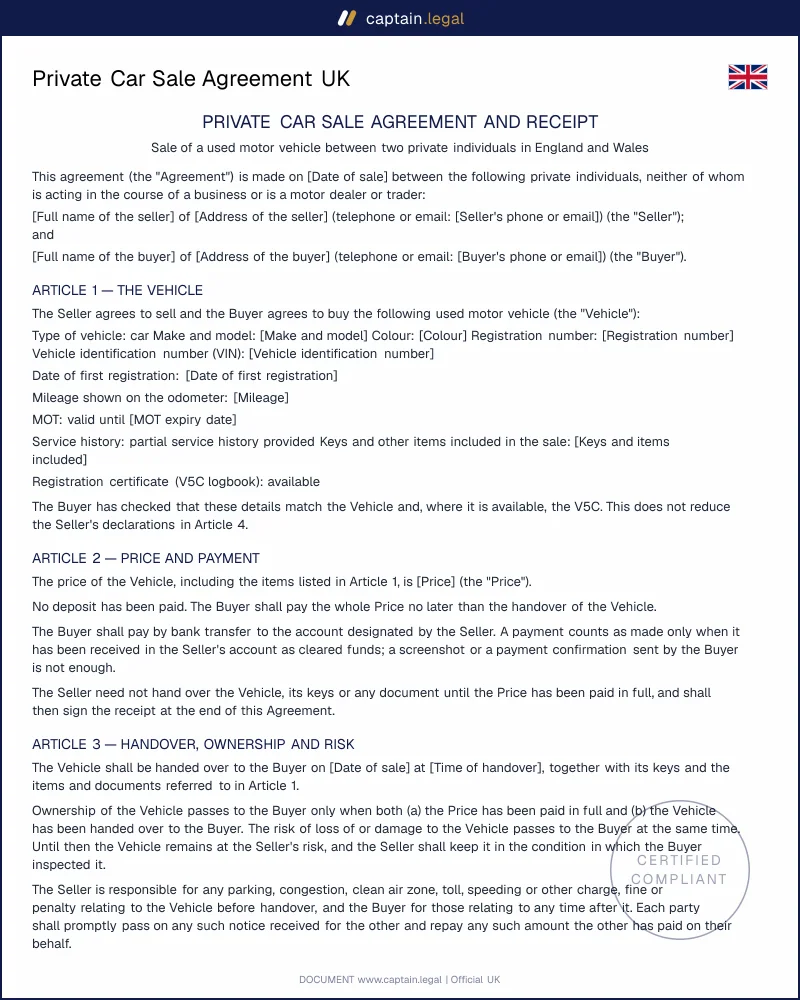
The opening describes the vehicle the way a court would want it: type, make and model, colour, registration number and VIN, date of first registration where known, odometer reading, MOT expiry date or the lack of a current MOT, service history, keys and extras, and whether the V5C is available. The buyer confirms having checked them, which reduces none of the seller's declarations. Payment follows, by bank transfer, cash or both. A transfer counts only once cleared funds reach the seller's account, which deals with the faked screenshot problem, and the seller need not hand anything over before full payment.

Most disputes turn on the seller's declarations, which are the core of the agreement. The seller confirms ownership and the right to sell, that to their knowledge it was never stolen or altered in identity, that it is free from finance, and gives a mileage statement that is either believed correct or expressly not guaranteed. Write-off history is recorded by category (S, N, the older C and D, or unknown), and known faults and modifications are listed in the seller's own words. If the buyer loses the vehicle because the seller had no right to sell it, the seller repays the price and compensates the buyer.

Under the condition clause, the vehicle is sold as seen after the buyer could inspect it, have it checked and test drive it, and the clause says plainly what it leaves untouched: section 12, section 13, fraud and misrepresentation. Ownership and risk pass together at full payment and handover, and fines split at the handover time. Article 6 covers DVLA, vehicle tax, insurance and private number plates, and Article 7 places the agreement under the law of England and Wales.

How to fill out this car sale agreement UK template

The questionnaire on Captain.Legal follows the order in which a sale actually happens, so it takes minutes with the V5C at hand. You start with the seller and buyer, using the names and addresses DVLA will need. The vehicle steps come next: type, make and model, registration number, VIN, first registration date and the mileage read on the day. The MOT answer controls what the agreement says about driving, and a valid MOT brings up its expiry date.

You then deal with the logbook and the number plate, the price and any deposit, how the money will move, the date of sale and the handover time. The last steps cover the seller's declarations: finance, mileage, write-off category, known faults, modifications and roadworthiness. Each answer rewrites the matching clause in the preview. Download the agreement in Word and PDF, print two copies and sign both at handover. If the sale raises another need, the catalogue of UK legal documents lists the other ready templates.

Common mistakes to avoid

The most expensive mistake is handing over the keys on the strength of a banking app screenshot. Fake confirmations are easy to produce, which is why the agreement treats a transfer as made only when cleared funds arrive. Buyers, for their part, pay for cars that still carry finance. A history check takes minutes, and the Hire Purchase Act 1964 is no help against a logbook loan. Sellers tend to over-promise: "full service history" with two stamps missing, or "never been in an accident" on a car bought with a respray, creates liability that no sold as seen wording removes.

Paperwork after the sale causes the rest. The seller must tell DVLA about the sale and give the buyer the green new keeper slip; until DVLA knows, parking charges keep landing on the seller's doormat. Buyers forget that vehicle tax does not transfer and that the seller's insurance does not cover them, so driving home uninsured is a common way to collect a fine on day one. Sellers who want to keep a private number often start too late: the retention document and the new V5C must be in hand before the sale, otherwise the right to the number is lost.

Key takeaways

SOLD AS SEEN

What a sold as seen clause cannot exclude

In a private sale, the satisfactory quality and fitness terms in section 14 of the Sale of Goods Act 1979 do not apply, because they bind only business sellers. Sold as seen still has limits. The seller must have the right to sell, which section 6(1) of the Unfair Contract Terms Act 1977 forbids excluding. The vehicle must match its description, and a false statement about mileage or history is still misrepresentation.

FINANCE CHECK

Outstanding finance must be settled before signing

A car on hire purchase or PCP belongs to the finance company until the last payment. The seller should pay it off and hand the buyer the lender's written confirmation before anyone signs. Part III of the Hire Purchase Act 1964 can protect a private buyer who buys in good faith without notice of the agreement, but it does not cover logbook loans or stolen cars, so a vehicle history check before paying is worth the few minutes it takes.

AFTER HANDOVER

DVLA, tax and insurance on the day of sale

The seller gives the buyer the green new keeper slip from the V5C and tells DVLA about the sale, online or by post; until then, fines keep reaching the seller. Vehicle tax does not pass with the car, so the buyer must tax it before driving, while the seller is refunded any full months left. The seller's insurance does not cover the buyer either, and a seller keeping a private number needs the V778 and new V5C before the sale.

Frequently Asked Questions

Yes. Once both parties sign, it binds them like any contract for the sale of goods, and section 4 of the Sale of Goods Act 1979 requires no special form: no witness, no deed and no registration. Signing gives you a clear record of the price, the description and the seller's declarations, which is what a court relies on if a dispute reaches the small claims track. The seller's duty to have the right to sell under section 12 of the Sale of Goods Act 1979 and liability for misrepresentation remain whatever the paper says, and the template reflects that.

Both formats are available once the questionnaire is complete. The PDF is the version to print and sign at handover. The Word file helps if you want to adjust a detail before the meeting, such as a second set of keys or a new handover time agreed by message. If you edit it, keep the clauses on title, description and misrepresentation intact, since title can never be excluded and the other two only by a term a court finds reasonable. Print two identical copies, have both signed, and keep one each with the new keeper slip or the DVLA confirmation.

Straight away: the agreement commits the seller to do it on the day of handover or as soon as possible after it. The online service runs seven days a week and asks for details from the V5C and the buyer's full name and address. Until DVLA is told, the seller stays on record as keeper, so fines incurred by the new owner go to the seller first. Vehicle tax is cancelled automatically, and the refund for any full months left is calculated from the date DVLA receives the information, so delay costs the seller money.

In a private sale the buyer has no right to return a car simply because it develops a fault, since the satisfactory quality term in section 14 binds only business sellers. Things change if the seller misdescribed the vehicle or made a false statement: a wrong model year, a mileage presented as correct when the seller knew otherwise, a write-off history denied. Those give the buyer a claim for misrepresentation or breach of section 13. Start with a written complaint quoting the agreement, then consider a claim on the small claims track of the County Court, where a clear witness statement for the County Court carries real weight.

Not until the finance is settled. Under hire purchase or PCP the finance company owns the car until the final payment, so the seller has no title of their own; only Part III of the Hire Purchase Act 1964 may give one to a private buyer in good faith, and the seller stays liable to the lender. Ask the lender for a settlement figure, pay it off and obtain written confirmation that the lender has no further interest in the vehicle; only then sign. Buyers should still run a vehicle history check, because a logbook loan secured on the car falls outside the statutory protection and a car on personal contract hire is not the user's to sell.

Usually, yes. The template assumes the balance is paid no later than handover and that nothing leaves the seller's drive until the money is there. A deposit paid earlier is credited against the price, and the agreement says what happens to it if the sale does not go ahead. When the buyer cannot pay in full and the seller agrees to wait, keep that arrangement separate and specific. A signed debt acknowledgement letter recording the unpaid balance states the sum still owed and avoids later arguments.

4.8/5

32 verified reviews · 50 000+ downloads

Private Car Sale Agreement UK: Vehicle Sale Contract and Receipt
  • Immediate access to the document
  • PDF + Word download
  • Compliant with 2026 legislation
  • Reviewed by lawyers
Fill in the template
Secure payment
Updated on November 8, 2026

You might also like

General Power of Attorney UK
Letter of Authority