Personal

General Power of Attorney UK: General or Limited Deed Template, Word and PDF

Appoint one or two attorneys to act for you in England and Wales while you are abroad, in hospital or unavailable and still have capacity: a general power under section 10 of the Powers of Attorney Act 1971 or a limited power for chosen acts, signed as a deed.
4.7/5— 19 reviews50 000+ downloadsInstant download
Share

A general power of attorney UK deed lets you appoint one or two people you trust to act for you while you are abroad, in hospital or tied up elsewhere. Made under the law of England and Wales and signed as a deed, it allows your attorney to sell or let a property, run a bank account, sign a contract or collect money in your name. Homeowners working overseas and landlords who cannot be on site use it most. It is an ordinary power of attorney, so it works only while you can still make your own decisions.

The template covers both forms: the short statutory general power and a limited power restricted to the acts you choose.

Compliant

2026 Legislation

50,000+ clients

trust us

Affordable

From $4.90 / doc

Secure payment

Instant download

General Power of Attorney UK: General or Limited Deed Template, Word and PDF

Secure payment

Fill in the template

What is a general power of attorney UK?

It is a deed by which one person, the donor, gives another, the attorney, authority to act for them in legal and financial matters. The general version follows the short form set out in Schedule 1 to the Powers of Attorney Act 1971. Under section 10 of that Act, a power in that form gives the attorney authority to do anything the donor can lawfully do through an attorney. A limited power lists the specific acts allowed, such as the sale of one house or the running of one account, and nothing else. Both are executed as a deed, and neither is registered anywhere. You keep full control and can revoke the deed whenever you like.

Neighbouring documents cause most of the confusion. A letter of authority for dealing with one organisation lets a relative speak to your energy supplier or collect a parcel, but cannot be used to sign a deed such as a property transfer. A lasting power of attorney is the opposite case. It is made under the Mental Capacity Act 2005, must be registered with the Office of the Public Guardian, and keeps working after you lose capacity. The ordinary power sits between them: stronger than a letter, but it ends automatically if you lose mental capacity.

When do you need this document?

The classic case is a sale while the owner is abroad. A seller who has moved to Dubai cannot easily sign a contract and a TR1 transfer on the day a buyer in Leeds is ready, so a sibling signs both under the power. Landlords use it for tenancy renewals and repairs; the property and real estate templates usually sit alongside it in the file.

Hospital stays and long trips are the other everyday reason. A planned operation or a posting overseas leaves bills unpaid, and a general power of attorney UK deed lets a partner or adult child keep things moving. Sole traders use it to keep signing supplier contracts and invoices while they are away, and shareholders use it to deal with their shares, together with the usual company and commercial documents. A director's role is different: the company acts through its board, not a director's personal attorney.

Joint ownership is where sales go wrong. If the property is owned jointly and the attorney is the other owner, the attorney cannot alone receive the sale money for both of you, so the power is not enough to complete the sale. And if the purpose is to plan for dementia or a serious illness, an ordinary power is the wrong tool: it stops working when capacity is lost.

Key clauses included in our template

Our general power of attorney UK template opens by naming the donor and up to two attorneys, says whether two attorneys act jointly (both sign everything) or jointly and severally (either signs alone), and uses the Schedule 1 wording or, for a limited power, a closed list of acts. Each limited act carries the incidental powers that make it workable, such as dealing with the DVLA for a car. A short notice at the top tells every reader that the deed is not a lasting power and does not cover health or care decisions. The limited version can be tied to a single transaction, after which it ends by itself.

The core clauses deal with what the attorney may and may not do. Health, personal welfare, making a will, voting in elections, swearing statements of your own knowledge and running court cases in person are excluded, although the attorney can instruct a solicitor within the scope of the power. A land held on trust clause applies the Trustee Delegation Act 1999 and spells out the two-trustee rule, and a signing clause applies section 7 of the Powers of Attorney Act 1971. The attorney's duties are set out as between you and them: keep your money separate, keep accounts, make no gifts and take no personal benefit without your written agreement. Readers who also need cover for care decisions should look at the health and welfare lasting power of attorney, which no ordinary power can replace.

The closing clauses cover expenses, any fee, duration, revocation, ratification and the section 5 protection. For use abroad, the deed names the country and warns that a notary or an apostille may be required. Practical notes on witnessing and certified copies follow the signature block.

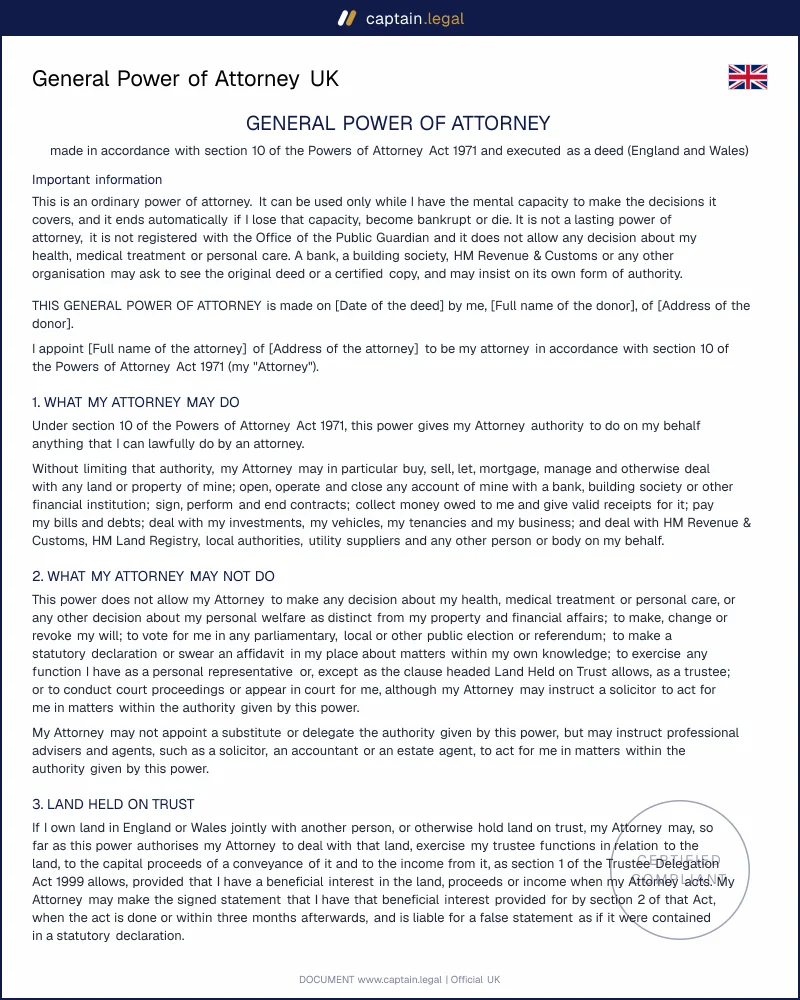
How to fill out this general power of attorney

You start with your name and address, then choose one or two attorneys and how two of them act. The next question decides the scope. The general power keeps the questionnaire short, because the statutory wording does the work; the limited power opens a few steps where you choose the acts, from selling, letting or buying a property to operating named accounts, signing a contract, dealing with a vehicle or collecting a debt. With a limited power, you can then tie the whole deed to one transaction.

You then choose how long the power lasts: until you revoke it, or until an end date picked from the calendar. After that you say whether the attorney is paid and whether the deed will be used outside the United Kingdom, in which case you name the country. The final step asks for the date you will sign and how you will sign, personally in front of one witness or by someone signing for you in front of two. The preview on the right updates with every answer. You then print the deed, sign it in front of your witness and hand the original to your attorney, keeping a certified copy for yourself.

Common mistakes to avoid

The most damaging mistake is signing without a witness actually in the room. A document that is not properly attested is not a deed. Choose an independent adult who is not an attorney or an attorney's partner, so that nobody can later question the signature. Elderly parents are the next trap. Families reach for an ordinary power when a parent's memory is already failing, yet incapacity revokes it by law. The parent should make a lasting power while still able to; once capacity has gone, the family usually has to apply to the Court of Protection, typically for a deputyship.

Banks are where most attorneys first hit a wall. Many have their own third-party mandate and some refuse an ordinary power for certain services, so ask before the trip, not after. Jointly owned homes catch couples out at completion: when both appoint the same relative, one person cannot receive the sale money for two trustees. Vague wording in a limited power is quieter trouble: a bank refuses any act the deed does not name. And people forget to revoke properly. Tell the attorney in writing, ideally by deed, write to each organisation that holds a copy and ask for the original back.

Key takeaways

MENTAL CAPACITY

It stops working if you lose capacity

An ordinary power of attorney, general or limited, is revoked automatically if the donor loses the mental capacity to make the decisions it covers, even for a short time, and also on death or bankruptcy. It never covers health, medical or care decisions. To plan for dementia or a serious illness, the donor needs a lasting power of attorney under the Mental Capacity Act 2005, registered with the Office of the Public Guardian before use.

JOINT OWNERS

Selling a jointly owned home needs two signers

Co-owners hold land on trust. Section 1 of the Trustee Delegation Act 1999 lets the attorney deal with the home while the donor keeps a beneficial interest in it. Under section 7, though, one person acting both for themselves and for the donor, or as attorney for two or more owners, cannot alone receive the sale money: another owner or a different attorney must sign too. Ask a conveyancer early.

DEED FORMALITIES

Signed as a deed in front of a witness

The power must be executed as a deed: the donor signs in front of a witness who attests the signature, ideally an independent adult who is not an attorney, or someone signs at the donor's direction before two witnesses. Nothing is registered and it takes effect on delivery. A certified copy proves its contents under section 3 of the Powers of Attorney Act 1971, yet banks and HMRC may still want their own forms.

Frequently Asked Questions

Once it is validly executed as a deed, it is. The donor must be an adult with capacity and must sign in the presence of a witness who attests the signature, as section 1(3) of the Law of Property (Miscellaneous Provisions) Act 1989 requires. A power in the Schedule 1 form gives authority under section 10 of the Powers of Attorney Act 1971. Banks are not obliged to deal with an attorney, but the deed itself is fully effective in England and Wales.

No. An ordinary power, general or limited, is revoked automatically when the donor loses the capacity to make the decisions it covers, even temporarily, and it also ends on death or bankruptcy. To keep someone able to act if you develop dementia, you need a lasting power of attorney under the Mental Capacity Act 2005, registered with the Office of the Public Guardian before use. Many people sign both for different purposes.

Usually, with one limit. Co-owners hold land on trust, so the attorney relies on section 1 of the Trustee Delegation Act 1999, which works while you keep a beneficial interest in the home. Under section 7, the sale money must be received by two trustees, and one person acting alone for two owners counts as one. If your spouse is the attorney, another person must sign too, so raise it with the conveyancer early.

Some will and some will not, and they decide case by case. Banks and building societies set their own rules, and many prefer their third-party mandate or a registered lasting power, so show a certified copy and ask before you leave. HM Revenue & Customs has its own routes (an agent, a trusted helper or an intermediary letter) and may ask for the original deed or a certified copy before discussing your tax with anyone.

There is no waiting period. The deed takes effect on the date you sign and deliver it, and nothing is registered, unlike a lasting power, which takes several weeks to register. Your attorney has authority from that moment; in practice, banks and conveyancers will ask to see the original or a certified copy. HM Land Registry may occasionally ask for evidence of non-revocation when a sale completes more than 12 months after the power came into operation.

Both formats are available as soon as you finish the questionnaire. The PDF is ready to print and sign by hand in front of your witness, which is how the deed has to be executed. The Word file lets a conveyancer adjust the description of a property or an account before signature. Other deeds and letters for family and personal matters are grouped among the personal legal documents for England and Wales.

Write to your attorney stating that the power is revoked, ideally by a short deed signed before a witness, and keep a copy. Then tell every organisation holding a copy and ask for the original and the certified copies back. Until a third party learns of the revocation, section 5 of the Powers of Attorney Act 1971 protects it when it deals with the attorney without knowing, so prompt notice matters.

4.7/5

19 verified reviews · 50 000+ downloads

General Power of Attorney UK: General or Limited Deed Template, Word and PDF
  • Immediate access to the document
  • PDF + Word download
  • Compliant with 2026 legislation
  • Reviewed by lawyers
Fill in the template
Secure payment
Updated on November 8, 2026

You might also like

Living Will Template UK
CPR Part 32 Witness Statement