Real Estate

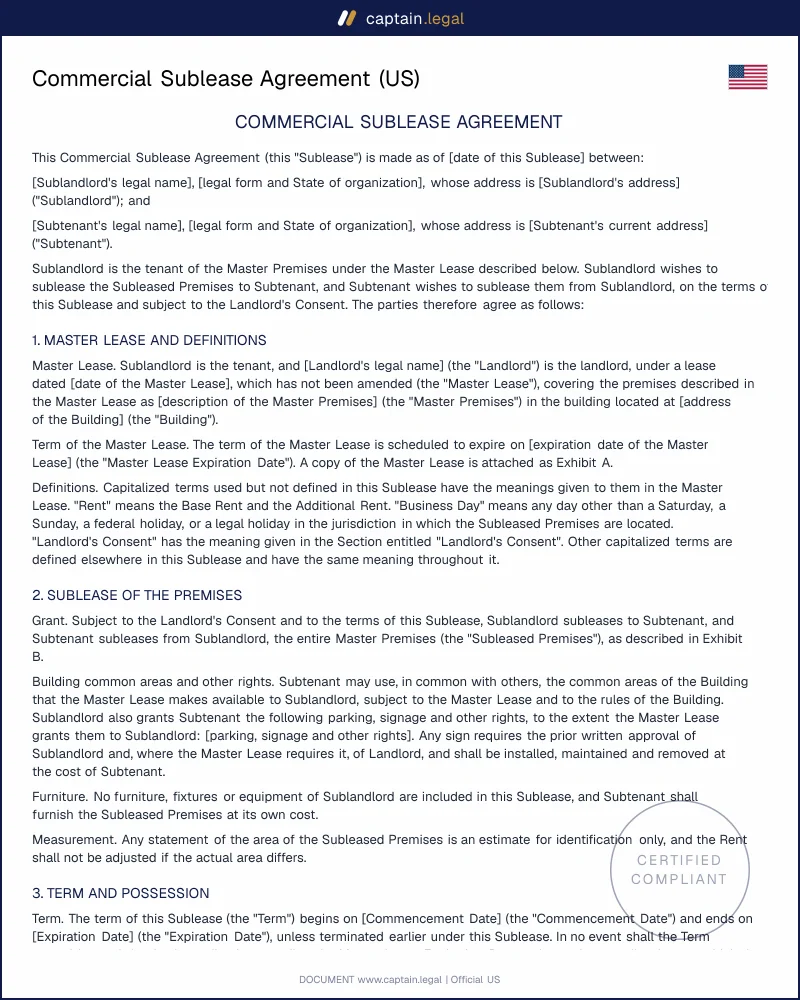
Commercial Sublease Agreement Template | Office, Retail, Warehouse | Word & PDF

Sublease all or part of your office, retail, warehouse or industrial space to another business. Master lease incorporated with exclusions, shared areas, rent and expense share, deposit, optional guaranty and a landlord consent exhibit.
4.5/5— 25 reviewsUS law 2026Instant download
Share

A commercial sublease agreement lets a business that rents office, retail, warehouse or industrial space hand all or part of that space to another business for part of the remaining lease term. The original tenant becomes the sublandlord, the newcomer is the subtenant, and the building owner stays in the background as the landlord under the master lease. Companies use it when they hold more space than they need while the lease still runs for years. Done well, the sublease turns dead rent into income. Done carelessly, it puts the sublandlord in default with its own landlord, because almost every commercial lease restricts subletting without the landlord's written consent.

Compliant

2026 Legislation

50,000+ clients

trust us

Affordable

From $4.90 / doc

Secure payment

Instant download

Commercial Sublease Agreement Template | Office, Retail, Warehouse | Word & PDF

Secure payment

Fill in the template

What is a commercial sublease agreement?

Under US law, a commercial sublease agreement is a contract between the tenant under an existing lease and a third party, under which the tenant rents out space it already leases. The tenant remains fully liable to the landlord for rent and every other covenant of the master lease, while collecting rent from the subtenant under a separate contract. There is no privity of contract or estate between the landlord and the subtenant, beyond whatever direct undertakings the landlord's consent creates: the subtenant's rights exist only because the sublandlord holds a lease, and they fall with it. That single point explains most of the drafting of a commercial sublease agreement, from the automatic termination clause to the attornment option given to the landlord.

The sublease must also be distinguished from an assignment. In an assignment, the tenant transfers its entire remaining interest and the assignee steps into its shoes; a lease assignment agreement is the right tool when the business wants out for the full remaining term. In most states, a transfer of the whole remaining term is treated as an assignment whatever the parties call it, which is why a sublease ends at least one day before the master lease. Owners leasing space directly need a full commercial lease agreement for office, retail or industrial space instead.

When do you need this document?

The classic case is a company that signed a ten-year lease and now uses half the floor. Hybrid work emptied desks, not the rent bill, so the tenant carves out a wing and subleases it to a smaller firm, keeping the reception area and conference rooms as shared areas. A second scenario is the relocation: the business has moved and wants someone to carry the old space until the master lease ends, or a retailer lets a complementary brand take over an underperforming store.

Growth works the other way. A startup that needs space quickly often finds a sublease faster than a direct lease, and it can move in with the existing furniture listed in a schedule. Warehouses see subleases when a logistics contract ends and the tenant has excess dock doors, and professional practices sublease single offices or treatment rooms to colleagues.

One edge case deserves attention. If the master lease gives the landlord a recapture right, asking for consent may let the landlord take the space back, which is sometimes the best outcome for a tenant that only wants to stop paying.

Key clauses included in our template

The template identifies the master lease and attaches a copy as Exhibit A, with rent and other financial terms that do not affect the subtenant redacted if the sublandlord prefers. The premises clause covers the entire master premises, or a defined portion with shared areas, access rules and a floor plan in Exhibit B. The term cannot run past the day before the master lease expires, even if a wrong date is typed. Rent combines a monthly base rent, fixed or increased by a percentage each year, with either a percentage share of the operating expenses, taxes and insurance charged under the master lease or a gross rent that already includes them.

At its core, the document incorporates the master lease: the subtenant takes on the tenant's obligations for its space, minus a list of excluded provisions (rent, deposit, options, allowances, brokers). The sublandlord does not answer for the landlord's failures; the subtenant's remedy is limited to the sublandlord's reasonable efforts to enforce the landlord's obligations at the subtenant's cost, plus any rent abatement the sublandlord actually receives. In exchange, the sublandlord promises to keep paying the master rent, to forward the landlord's notices and not to amend or surrender the master lease against the subtenant. If the sublandlord stops paying the master rent, the subtenant may, after giving it five business days' written notice to cure, pay the landlord directly and credit those payments against its rent.

The subtenant's liability insurance names both the sublandlord and the landlord as additional insureds, indemnities run both ways, and the space is delivered as is. Alterations need the sublandlord's consent and, where the master lease requires it, the landlord's. The subtenant cannot assign or sublet again without the sublandlord's consent, which it may refuse at its sole discretion, and its cure periods run out before the sublandlord's own deadlines under the master lease. Holdover costs 150 percent of the last month's daily rent. An optional personal guaranty for one or two guarantors works like a stand-alone personal guaranty agreement for business obligations, and Exhibit C is a ready-to-sign landlord's consent.


How to fill out this commercial sublease agreement

You start with the date of the sublease and the identity of both businesses: legal name, legal form and state of organization, notice address and signatory. The next steps collect the landlord's details, the dates of the master lease and any amendments, plus the master lease sections that should bind only the sublandlord, such as roof rights.

The premises come next. You enter the building address, select the state or the District of Columbia, then choose whether the whole space or only part of it is subleased; a partial sublease opens a step for the shared areas. The form then asks for the use, parking, furniture, dates, base rent and increases, expense structure, deposit, insurance limits, guarantors and brokers. Every choice updates the preview immediately, and the sections renumber themselves when an optional one drops out. Once you click Finish, you download the agreement in Word or PDF, attach the master lease and a floor plan, and send the signed sublease with Exhibit C to the landlord. The rest of the paperwork for the move, from leases to business forms, sits in our catalog of US legal document templates.

Common mistakes to avoid

The most expensive mistake is letting the subtenant move in before the landlord signs the consent. Under most commercial leases, an unauthorized sublease is a default, and some forms make it void. The template makes the consent a condition precedent and gives both parties a way out after 30 days, but the keys should stay with the sublandlord until the consent is signed. A close second is a sublease term ending on the same day as the master lease, which can turn the deal into an assignment.

Expense pass-throughs cause the next round of disputes. A subtenant that agrees to pay its share of charges should know whether the master lease is triple net or gross; the differences are explained in our guide to commercial lease rent structures. Late fees, profit sharing and allowance repayments owed to the landlord stay with the sublandlord, and the template excludes them from the subtenant's share. Holdover is the trap on the other side: when the sublease runs to the end of the master lease, a subtenant that stays one extra week can trigger holdover rent on the entire master premises, so the holdover indemnity sits outside the waiver of consequential damages. Finally, read the master lease: its limits on signage, hours or use bind the subtenant.

Key takeaways

Landlord consent

Landlord consent comes before the keys change hands

Most commercial leases forbid subletting without the landlord's prior written consent, and Texas requires that consent by statute even when the lease is silent (Tex. Prop. Code § 91.005). The sublease is therefore conditional on the landlord signing Exhibit C or its own form. If consent is not obtained within thirty days, either party may walk away and the sublandlord refunds the advance rent and any deposit.

Master lease

The master lease sets the outer limits of the deal

The subtenant takes on the tenant's obligations for its space, while rent, deposit, options, allowances and broker clauses stay out. The term always ends at least one day before the master lease, so the deal is not recast as an assignment. The sublandlord is not liable for the landlord's failures: the subtenant gets enforcement efforts at its cost and any rent abatement actually received.

Early termination

If the master lease falls, the sublease falls too

A subtenant's rights come entirely from the sublandlord's lease, so the sublease ends automatically with the master lease. The party at fault pays: the sublandlord owes damages, relocation costs included, if its own default ended the lease, and the subtenant answers for defaults it caused. The landlord may also require the subtenant to attorn and stay on the same terms, and pending that choice the subtenant pays its rent to the landlord.

Frequently Asked Questions

It is a binding contract once both businesses sign it and the landlord gives its written consent, which the template makes a condition precedent. Some clauses, such as the obligation to seek consent, the deposit and the dispute resolution terms, apply from signature. Enforceability still depends on the law of the state where the premises are located and on the master lease. Where a state requires notarization, witnesses or recording for a lease of this length, the parties must complete that formality, and a large deal deserves review by a local attorney.

Rarely. Most commercial leases require the landlord's prior written consent, and some states require it by statute even when the lease says nothing; Texas does so in § 91.005 of the Property Code. Subletting without consent usually puts the tenant in default and can allow the landlord to terminate the master lease, which would end the sublease too. The template assumes that consent is needed and includes a landlord's consent form as Exhibit C. If your lease truly allows subletting without consent, getting the landlord's signature still protects both businesses.

Start with the consent clause of the master lease: it usually sets the landlord's response period and lists what a complete request must include, such as the subtenant's financial statements. A silent lease leaves the landlord without a fixed deadline, which is why the template adds its own: if the consent is not obtained within 30 days after the sublease is signed, either party may walk away and the sublandlord refunds the advance rent and any deposit. When consent arrives late, the start dates move back day for day.

Its sublease ends on the same date, because the subtenant's rights depend on the master lease. If the sublandlord caused the termination by its own default or an unauthorized surrender, it owes the subtenant damages, including reasonable relocation costs. If the subtenant caused it, the subtenant answers for the sublandlord's losses. The landlord may also choose to keep the subtenant by requiring it to attorn, on the terms of the sublease, within the period stated in the consent. Until the landlord decides, the subtenant may stay and pays its rent to the landlord.

Both formats are available once you finish the questionnaire. The PDF is ready to print or send for electronic signature, which federal law recognizes for commercial contracts. The Word file lets you adjust a clause after negotiation, add the landlord's own consent language, or insert the master lease and floor plan as exhibits. Keep one signed original with the master lease, because the two documents are read together in any dispute.

No, it is written for businesses occupying commercial premises. Residential subleases follow tenant protection statutes, deposit rules and notice procedures that commercial parties do not get, and a commercial form would miss them. For a home, an apartment or a single room, use our sublease agreement for an apartment or a room, which handles the residential consent and roommate situations. In a mixed-use building, a ground-floor shop is commercial even with apartments above.

4.5/5

25 verified reviews · US law 2026

Commercial Sublease Agreement Template | Office, Retail, Warehouse | Word & PDF
  • Immediate access to the document
  • PDF + Word download
  • Compliant with 2026 legislation
  • Reviewed by lawyers
Fill in the template
Secure payment
Updated on November 26, 2026

You might also like

Notice of Intent to Vacate
Co-Ownership Agreement Template