Charity

Nonprofit Governance Policies: Conflict of Interest, Whistleblower and Document Retention

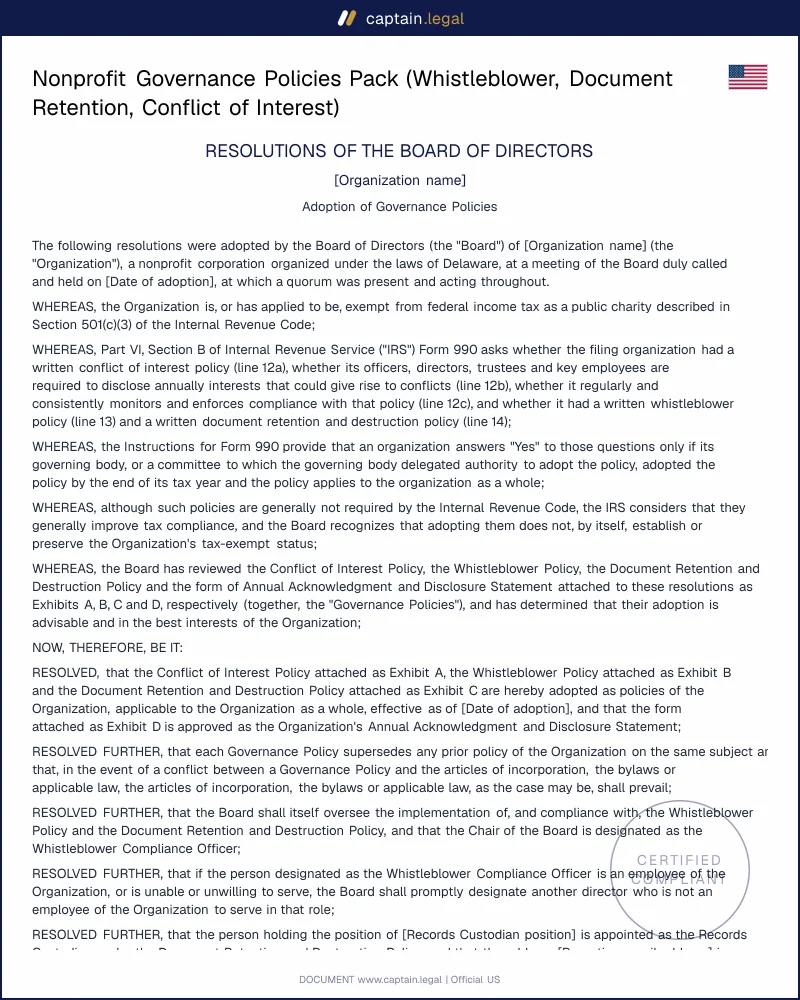
Board resolution adopting a conflict of interest policy, a whistleblower policy and a document retention and destruction policy, with an annual disclosure statement, for a US nonprofit corporation (501(c)(3), private foundation, 501(c)(4) or other 501(c)), with New York provisions.
4.6/5— 22 reviewsUS law 2026Instant download
Share

A set of nonprofit governance policies is the written answer a board gives to three questions on IRS Form 990: does the organization have a conflict of interest policy, a whistleblower policy and a document retention and destruction policy? This pack puts all three in one file, with the board resolution that adopts them and the annual disclosure statement that directors and officers sign each year. It is built for US nonprofit corporations, whether a 501(c)(3) public charity, a private foundation, a 501(c)(4) social welfare group or another 501(c) organization, with added clauses for New York and a state-law precedence rule everywhere else. Executive directors, board secretaries and the accountants who prepare the annual return are the usual readers.

Compliant

2026 Legislation

50,000+ clients

trust us

Affordable

From $4.90 / doc

Secure payment

Instant download

Nonprofit Governance Policies: Conflict of Interest, Whistleblower and Document Retention

Secure payment

Fill in the template

What is a nonprofit governance policies pack?

It is a bundle of internal rules that the board adopts by resolution and applies to the organization as a whole. Under the conflict of interest policy, directors, officers and key employees learn when to disclose a financial interest, when to leave the room and how the disinterested members decide. Staff and volunteers get a safe channel for reporting fraud or violations of adopted policies through the whistleblower policy, which protects anyone who reports in good faith. How long each category of records is kept, who authorizes destruction and when destruction of relevant records must stop is the job of the document retention and destruction policy. None of these documents is filed with a government office. They live in the minute book, and their value depends on the board following them.

A pack differs from the nonprofit bylaws template in scope. Bylaws set the structure of the corporation (board size, officers, quorum) and are harder to amend. Nonprofit governance policies sit one level below, and the board can update them at an ordinary meeting. Many boards adopt the bylaws at formation and the remaining policies later, often when the preparer of the first full Form 990 asks how to answer Part VI.

When do you need this document?

In practice, the first full Form 990 is what pushes most boards to act. Smaller organizations may file Form 990-N or 990-EZ for a few years, and the Part VI governance questions belong to the full return they file once they grow. Three "No" answers there tend to draw questions from donors and grantmakers who read the return, and adopting these nonprofit governance policies before year end turns them into "Yes" for the current year.

Grant applications come next. Many funders ask applicants to attach their conflict and whistleblower policies, and a federal award brings retention duties of its own under 2 CFR § 200.334. Hiring the first employees is a third occasion, because payroll, tax and Form I-9 records then carry federal minimum retention periods. Boards also adopt a pack after a scare, such as an undisclosed insider contract or a bookkeeper who deleted files on the way out. Private foundations are a special case: they file Form 990-PF rather than Form 990, yet their boards still benefit from written rules on self-dealing and records.

Key clauses included in our template

The pack opens with a board resolution that adopts the three policies as exhibits, names the Records Custodian, designates the Whistleblower Compliance Officer and orders distribution within thirty days, followed by a Secretary's certificate worded for a meeting or a unanimous written consent.

  • Most disputes over insider deals start with a missing disclosure, so the conflict policy defines Interested Person, Financial Interest and Family Member broadly and requires recusal before the vote.
  • Compensation of the chief executive and other officers goes through independent approval, comparability data and concurrent documentation, mirroring Treas. Reg. § 53.4958-6.
  • Reports under the whistleblower policy can go by email, by confidential letter or orally, anonymously if needed.
  • Each category of records gets its own period, from permanent retention for the articles, bylaws, minutes, exemption application and annual returns to seven years for most financial and donor records.
  • Destruction of relevant records stops as soon as a lawsuit, subpoena or audit is reasonably anticipated, and a written hold notice follows.

An annual acknowledgment form closes the pack, where signers list their interests and those of their family members. The nonprofit compliance documents category groups the formation and fundraising papers that usually sit next to these policies.

State-specific considerations

New York gets the most adjustments. When you select it, the conflict policy adds the related party procedure of N-PCL § 715: the board must find the transaction fair, reasonable and in the corporation's best interest, and where a related party has a substantial financial interest in a deal with a charitable corporation, it must consider alternatives, approve by a majority of those present and document the basis in writing. Each director also files a written statement before initial election and every year after. The whistleblower policy states that it carries the § 715-b provisions, extends to key persons and keeps board oversight in place even below the twenty-employee threshold.

Other states are handled through a rule of precedence rather than fifty versions. The conflict policy says that the nonprofit corporation law of the chosen state applies on top of the policy and prevails where stricter, which matters where a state sets its own rules for interested director transactions. Some states protect whistleblowers by statute, and the policy preserves the right to report directly to any government agency.

How to fill out this governance policies pack

The questionnaire opens with the corporation's legal name and its federal tax status, which rewrites the tax section of the conflict policy: excess benefit rules for public charities and 501(c)(4) groups, self-dealing rules for private foundations, private inurement for other 501(c) organizations. The next screen asks for the state of incorporation and the principal office, which becomes the mailing address for confidential reports. You then say whether the organization has paid employees and whether the board has an audit committee; the first answer adds employee channels and payroll, personnel and I-9 retention periods, the second decides who oversees the policies. The last screens ask for the Records Custodian, a reporting email, the adoption method and date, and the Secretary's name. The preview updates as you answer, so you can read the resolution and all four exhibits before clicking Finish. Employers often pair it with an employee handbook for US employers, where the same reporting channels can be repeated for staff.

Common mistakes to avoid

The classic error is adopting nonprofit governance policies and never using them. A conflict policy with no signed annual statements and no recusals in the minutes earns a "Yes" on line 12a but an honest "No" on line 12c, which asks whether the organization monitors and enforces it. In practice, auditors read the minutes, not the policy. Another mistake is dating the resolution after the close of the tax year and still answering "Yes" for that year. A policy adopted in February does not count for the year that ended in December.

Retention schedules fail in quieter ways, usually through a generic table. Some boards copy one that shreds payroll files after three years, forgetting that employment tax records must be kept at least four years under Treas. Reg. § 31.6001-1(e)(2). Others keep everything forever and turn every lawsuit into a costly email search. The worst case is destroying files after a subpoena arrives, exactly what 18 U.S.C. § 1519 targets. On the whistleblower side, the recurring flaw is a single reporting line that ends with the executive director. Finally, a board that buys only a standalone conflict of interest policy for a 501(c)(3) still needs the other two written policies to answer lines 13 and 14 with a "Yes".

Key takeaways

Form 990 Part VI

Adopt the policies before the tax year ends

Lines 12a, 13 and 14 of Part VI, Section B ask whether the organization has a written conflict of interest policy, a whistleblower policy and a document retention and destruction policy. The IRS instructions allow a Yes only if the governing body, or a committee it authorized, adopted the policy by the end of the tax year and the policy applies to the whole organization. The Code does not require them, but the IRS links them to better compliance.

IRC § 4958

Document insider pay to earn the presumption

Excess benefit rules tax a disqualified person who receives more than fair value, and a manager who knowingly participates. Under Treas. Reg. § 53.4958-6, pay is presumed reasonable when a body free of conflicts approves it in advance, relies on comparability data and records its decision before the later of its next meeting or 60 days after final action. Private foundations follow § 4941, where even a fair price does not save a sale.

18 U.S.C. § 1519

Freeze relevant records when a dispute looms

It is a federal crime to destroy or falsify records to obstruct a federal investigation, and 18 U.S.C. § 1513(e) punishes retaliation against people who give truthful information to law enforcement. Both apply to nonprofits. The retention policy therefore suspends deletion of every relevant record, then confirms the hold in writing, and its schedule exceeds federal minimums such as four years for employment tax records and three for payroll.

Frequently Asked Questions

Adopted by a valid board resolution, the policies become binding internal rules of the corporation. Directors, officers and employees must follow them, and a violation can justify removal or other discipline under the bylaws. They are not filed with the IRS or the state, and they do not by themselves create or protect tax exemption. Their weight shows when something goes wrong: minutes recording a recusal and comparability data support the rebuttable presumption under Treas. Reg. § 53.4958-6, and a documented litigation hold answers any suggestion that records were destroyed on purpose.

By the last day of the organization's tax year. The Form 990 instructions allow a "Yes" on lines 12a, 13 and 14 only if the governing body, or a committee it authorized, adopted the policy by the end of the year covered by the return. For a calendar-year charity, a resolution dated December 15 works for that return, while one dated January 10 counts only for the next year. The resolution in this pack also gives covered persons thirty days to sign the annual acknowledgment, so hold the meeting early enough to collect the first statements.

Yes. After you click Finish, the complete pack (resolution, Secretary's certificate, the three policies and the acknowledgment form) is available as an editable Word file and as a PDF. Most boards circulate the PDF with the meeting materials and keep the Word version for later amendments, for example when they create an audit committee or hire a first employee. Each exhibit starts on a new page, so the whistleblower policy can be posted on its own and the acknowledgment form handed to new directors at orientation.

The template requires the Whistleblower Compliance Officer to acknowledge receipt within five business days when the reporter is identified, then to assess the report and direct an investigation promptly. Federal law sets no deadline for internal handling, so this is a policy choice that a board can tighten. What the law does punish is retaliation against someone who gives truthful information to law enforcement, under 18 U.S.C. § 1513(e). The log and files are kept seven years after the matter closes, longer under a litigation hold.

It depends on the record. The exemption application, determination letter, articles, bylaws and minutes should be kept permanently, as IRS guidance for public charities recommends. Annual returns must stay available for public inspection for three years under Treas. Reg. § 301.6104(d)-1, and the template keeps them permanently. Payroll records need at least three years under the FLSA rules, employment tax records four, and Forms I-9 three years after hire or one year after employment ends, whichever is later. Gift instruments stay forever, and the terms on which gifts are accepted belong in a gift acceptance policy.

The Form 990 Part VI questions do not apply to a return on Form 990-PF, but the substance still matters. A private foundation is subject to the self-dealing rules of IRC § 4941, under which a sale or lease of property with a disqualified person is an act of self-dealing even at a fair price, while reasonable pay for necessary personal services is excepted if it is not excessive. Selecting the private foundation option swaps the excess benefit language for these rules. Foundations that want other board documents can browse the catalog of US legal documents.

4.6/5

22 verified reviews · US law 2026

Nonprofit Governance Policies: Conflict of Interest, Whistleblower and Document Retention
  • Immediate access to the document
  • PDF + Word download
  • Compliant with 2026 legislation
  • Reviewed by lawyers
Fill in the template
Secure payment
Updated on November 26, 2026

You might also like

Nonprofit Conflict of Interest Policy
Donation Acknowledgment Letter