Personal

Estate Planning Bundle: Will, Durable Power of Attorney & Living Will | All in One

A Last Will and Testament, a durable financial power of attorney and an advance health care directive with HIPAA authorization, built for one person from a single questionnaire, with signing instructions for your State.
4.6/5— 14 reviewsUS law 2026Instant download
Share

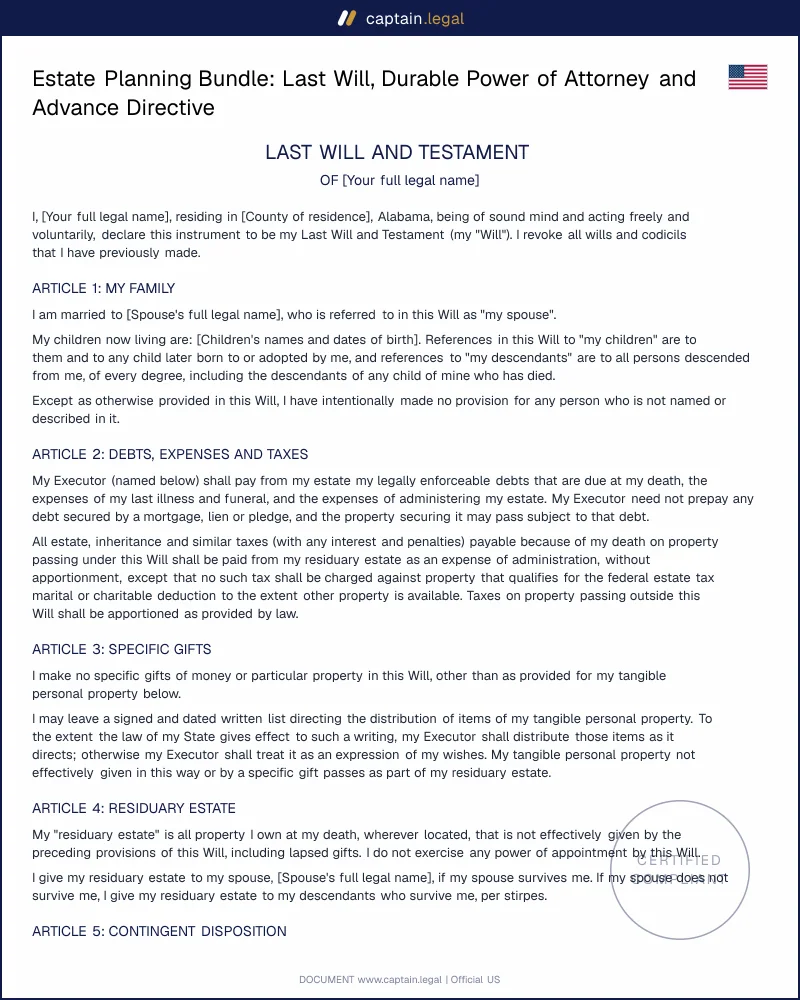
Three estate planning documents do most of the work for an ordinary household: a Last Will and Testament, a durable financial power of attorney and an advance health care directive. This bundle builds all three for one person from a single questionnaire, so your name, address and family details are typed once and carried into each instrument (a New York resident receives a notice pointing to the statutory short form instead of the financial power of attorney). It suits parents of young children and retirees alike. Signing instructions close the bundle, with specific rules for seven States and a careful default ceremony elsewhere, because none of these papers works until it is properly signed.

Compliant

2026 Legislation

50,000+ clients

trust us

Affordable

From $4.90 / doc

Secure payment

Instant download

Estate Planning Bundle: Will, Durable Power of Attorney & Living Will | All in One

Secure payment

Fill in the template

What are the core estate planning documents?

Each piece answers a different question. The will decides who receives your property at death, who settles the estate as executor (a personal representative in many States) and who should raise your minor children. The durable power of attorney names an agent to manage money, property, taxes and accounts while you are alive, including after you lose capacity, which is the whole point of the word durable. The advance health care directive combines a health care power of attorney with living will instructions on life support, tube feeding and organ donation. A separately signed HIPAA authorization lets your health care agents obtain your medical records.

People often confuse these estate planning documents with a trust. A revocable living trust avoids probate for the assets retitled into it, but it does nothing for property left outside it and never appoints a medical decision maker, which is why trust owners still keep a pour-over will and both powers of attorney. The personal legal forms for individuals and families show where each document fits. The bundle covers one adult only: spouses each need their own set.

When do you need these documents?

The classic trigger is a birth. If both parents die without a will that nominates a guardian, a court picks who raises a minor child with no written word from them to guide it. Marriage, divorce or a blended family comes next, since intestacy rules rarely match what people want for a new spouse or stepchildren; couples in that situation often pair this bundle with family law agreements for marriage, separation and custody.

These estate planning documents matter at any age. A stroke can leave a healthy 40-year-old unable to sign a check, and without a durable power of attorney the family must petition for a guardianship or conservatorship, a public court process, often with bonds and annual accountings. Owners of a living trust need the pour-over will so forgotten assets land in the trust. Someone with a large taxable estate, a disabled beneficiary or a family business should treat this bundle as a starting point for a meeting with an attorney.

Key clauses included in our template

The will defines "my descendants" broadly, so a grandchild whose parent has died can still inherit by representation. Specific gifts can each name an alternate, and a clause lets you leave a signed list of personal belongings where your State honors one. You choose where the residue goes: to your spouse and then your descendants, to your descendants per stirpes, to named people or charities in stated shares, or to the trustee of an existing revocable living trust agreement as a pour-over gift. A contingent clause covers the case where every beneficiary fails, and a 30-day survivorship rule avoids double probate.

Administration clauses waive the executor's bond where the law allows, request independent administration where available and grant powers to sell, settle claims, handle digital assets and make tax elections. A guardian and an alternate are nominated when you have a minor child, and a young beneficiary's share can be held by a custodian under the Uniform Transfers to Minors Act.

The power of attorney lists every financial subject the agent may handle, adds durability language, agent duties and a pay choice, and offers hot powers with their own initials lines. Gifts are capped, per recipient and per year, at the federal gift tax annual exclusion, so an agent cannot empty the estate for one relative. The directive covers agent authority, when it begins, end-of-life choices and organ donation.

State-specific considerations

Texas residents sign a will before two credible witnesses at least 14 years old, and the self-proving page follows the affidavit of Tex. Est. Code § 251.104. The power of attorney must be acknowledged before a notary under § 751.0021. Because Texas requires a health care agent to be appointed in substantially the statutory form of Tex. Health & Safety Code § 166.164, the bundle tells a Texan to sign that form as well.

Florida is stricter on the power of attorney: Fla. Stat. § 709.2105 calls for two witnesses and a notary, and § 709.2108 makes a springing power ineffective, so a Floridian who picks "only if I become incapacitated" receives a document effective at signing. Florida also refuses to enforce no-contest clauses under § 732.517, and the will drops that clause there.

In New York, a financial power of attorney must substantially conform to the statutory "Caution to the Principal" and "Important Information for the Agent" wording of Gen. Oblig. Law § 5-1501B, in at least 12-point type. Rather than produce a document that would fail, the bundle replaces it with a notice pointing to the Statutory Short Form.

Arizona and Washington take opposite routes for the power of attorney. An Arizona principal needs one witness, who cannot be the agent, the agent's spouse or child, or the notary, and that witness swears an affidavit before the notary under Ariz. Rev. Stat. § 14-5501. RCW 11.125.050 accepts either a notary or two witnesses who are unrelated to you or your agent and do not provide your care, and since a Washington health care agent is appointed by a power of attorney, the instructions recommend both. Vermont and Virginia get their own signing paragraphs, Louisiana residents are told to have the will reviewed locally, and every other State gets a conservative ceremony plus a reminder to follow its own execution requirements.


How to fill out this estate planning bundle

You start with your name, State, county, address and date of birth. The State drives the governing law, the signing instructions and, for Texas, Florida and Virginia, the self-proving affidavit. Next you describe your family; a guardian step appears only if at least one child is a minor. The will questions cover the executor, gifts, the residue and a backup beneficiary.

The power of attorney asks for an agent, a successor, a start date, pay and special powers. The health care section reuses your financial agents or names others and records your end-of-life choices. The preview updates as you answer; after you click Finish, the files download in Word and PDF. Other forms are in the complete catalog of US legal document templates.

Common mistakes to avoid

The most expensive mistake is a defective signing. Wills run into trouble in probate when a witness left the room before signing, when a witness was also a beneficiary and the State voids the gift to that witness, or when nobody completed the self-proving page before the notary, which sends the court looking for the witnesses. Sign everything in one meeting with two disinterested adult witnesses and a notary, and never staple in extra pages afterward. A close second is naming the same person everywhere with no alternate: if that sibling dies first, every document stalls at once.

Beneficiary designations also override a will. Life insurance, IRAs and payable-on-death accounts go to whoever is named on the account form, so a will leaving everything to your children does nothing if an old form names an ex-spouse. A springing power of attorney brings delay, because the agent needs a doctor's written determination before acting. Finally, keep the originals where someone can find them; a directive locked in a safe deposit box helps no one in an emergency room at night.

Key takeaways

SIGNING FORMALITIES

A will only works when it is properly witnessed

Most States require a will to be signed, or your signature acknowledged, before at least two witnesses who then sign it; New York adds that both must sign within one thirty-day period. A self-proving affidavit, sworn with your witnesses before a notary, spares the probate court from calling them later. Choose adult witnesses who receive nothing under the will, and sign every document of the bundle in the same meeting.

FLA. STAT. § 709.2108

Florida does not allow a springing power

A financial power of attorney that starts only on your incapacity is common in many States, but Florida law makes it ineffective. For a Florida resident the bundle therefore makes the power effective at signing, requires two witnesses and a notary, and asks for your initials next to each sensitive power such as gifts, trust changes or beneficiary designations. Elsewhere, you choose the start date.

45 C.F.R. § 164.508

Medical records need a separate HIPAA release

Your health care agent can only decide well with access to your medical records. Federal privacy rules list what a valid authorization must contain, including an expiration event and your right to revoke it, and bar combining it with another document. The bundle therefore puts the HIPAA authorization on its own page with its own signature, effective immediately, naming your health care agent and alternate.

Frequently Asked Questions

They become legally binding when you sign them with the formalities your State requires. For the will, that usually means two adult witnesses who sign in your presence; for the power of attorney, a notary acknowledgment and often witnesses; for the health care directive, qualified witnesses or a notary. The signing instructions list State-specific rules for seven States and give a conservative ceremony elsewhere. No template can promise acceptance everywhere, so if your situation is unusual, have an attorney licensed in your State review the documents before you sign.

No. Each bundle is drafted for one person, with one testator, one principal and one declarant. Married couples usually sign two sets at the same meeting, often naming each other as executor and agents, with a child or friend as the alternate. Separate documents are deliberate: a joint will can become hard to change after the first death, and a shared directive makes it unclear whose medical wishes apply in an emergency.

You receive the complete bundle in both Word and PDF. Print and sign the PDF, whose layout and page numbering stay fixed. The Word version helps when an attorney reviewing the documents suggests edits, or when a name needs correcting before signing. Any change made after signing has no effect: a signed will is amended only by a new will or a properly executed codicil, never by editing the file.

Most people finish the questionnaire in twenty to thirty minutes with their agents' and guardians' names and addresses at hand. The signing meeting takes about half an hour once the witnesses and notary are together; many banks and shipping stores offer notary services by appointment. Your power of attorney can be effective the day you sign it, while the will has no effect until death and the directive guides decisions only when you cannot make them yourself, although the HIPAA release works from day one.

None of the State rules summarized in the signing instructions requires a lawyer to sign a will, power of attorney or health care directive, although advice is wise for complex estates and Louisiana residents should have the will reviewed locally. Notarization is different. Arizona, Florida and Texas, among others, require it for a durable power of attorney, and a self-proving affidavit is usually sworn before an officer authorized to administer oaths. Even where notarization is optional, banks and title companies rarely accept an unnotarized power of attorney.

Small changes, such as a new alternate executor or an extra gift, can be made with a codicil to amend a signed will, signed with the same formalities as the will itself. Larger changes, like a new marriage or a different residuary beneficiary, call for a new will that revokes the old one. Never write on the signed original or cross out names, because handwritten changes can invalidate a clause or invite a contest. Powers of attorney and directives are replaced by signing new ones.

Moving does not erase your plan: States generally accept a will that was validly executed where it was signed, and most also honor out-of-state powers of attorney and directives. In practice, a bank in your new State may prefer a power of attorney that follows its own local statute. After a permanent move, the safer course is to complete a new bundle with your new State selected and sign it under that State's formalities.

4.6/5

14 verified reviews · US law 2026

Estate Planning Bundle: Will, Durable Power of Attorney & Living Will | All in One
  • Immediate access to the document
  • PDF + Word download
  • Compliant with 2026 legislation
  • Reviewed by lawyers
Fill in the template
Secure payment
Updated on November 26, 2026

You might also like

Living Will & Advance Directive
Prenuptial Agreement