Business

Buy-Sell Agreement Template for LLCs and Corporations | Word & PDF

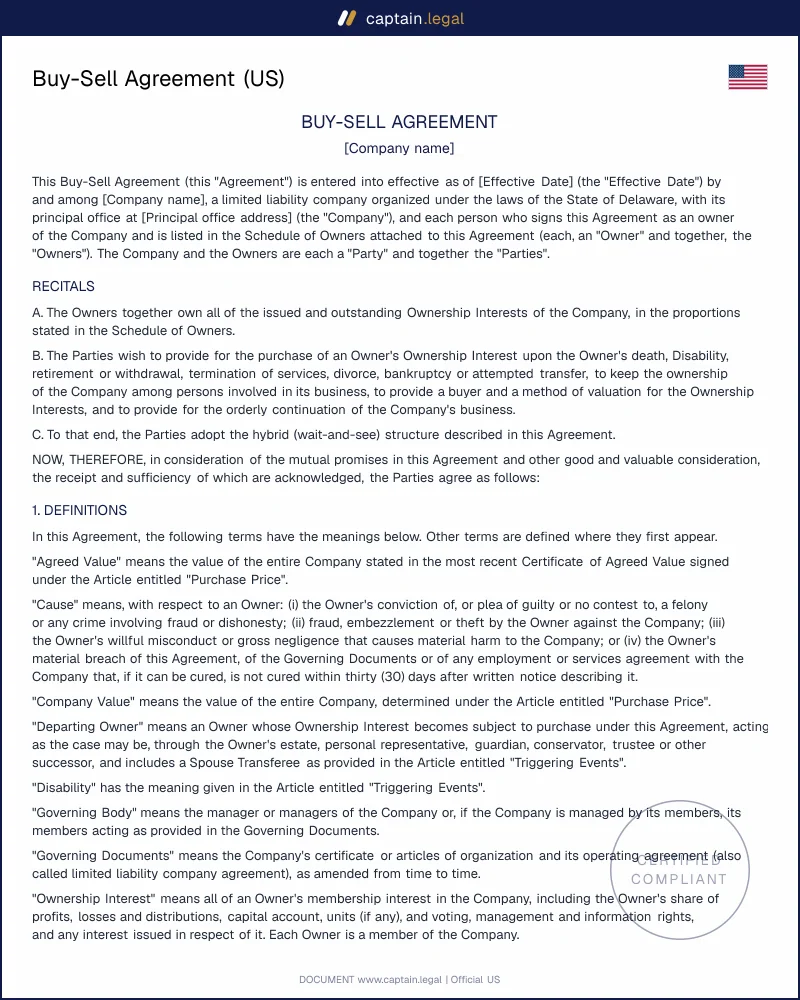
Buy-sell agreement between the company and its two to four owners: buyout on death, disability, retirement, divorce or outside offer, price by agreed value, formula or appraisal, installment note, insurance funding and spousal consent.
4.5/5— 11 reviewsUS law 2026Instant download
Share

A buy-sell agreement is the contract that decides, years in advance, what happens to an owner's stake in a closely held LLC or corporation when that owner dies, becomes disabled, retires, divorces or simply wants out. It names the buyer, fixes how the price is set and spells out how the money is paid. Owners usually sign one when they bring in a partner, buy key person life insurance or face a lender asking about succession. Our template covers two to four owners, works for an LLC or a corporation taxed as a C or S corporation, and produces a complete buyout agreement with the spousal consent and joinder forms attached, plus a valuation certificate and a promissory note when you choose those options.

Compliant

2026 Legislation

50,000+ clients

trust us

Affordable

From $4.90 / doc

Secure payment

Instant download

Buy-Sell Agreement Template for LLCs and Corporations | Word & PDF

Secure payment

Fill in the template

What is a buy-sell agreement?

Legally, it is a binding contract among the owners of a private company, with the company itself as a party, that restricts transfers and creates obligations or options to buy an owner's interest when defined triggering events occur. Practitioners also call it a buyout agreement, or a stock redemption agreement when the corporation itself buys. Nobody should end up co-owning a business with an heir, a creditor or a stranger, so the contract names the buyer and the price method while relations are calm.
The agreement sits next to the company's governing documents without replacing them. An LLC operating agreement governs management, voting and distributions, and a shareholder agreement for C and S corporations covers board seats, drag-along and tag-along rights. A standalone buy-sell agreement goes deeper on one topic: who buys, at what price, on what terms and with what funding. When the documents conflict, our template makes the buy-sell terms control between the parties to the extent the law allows and requires the owners to vote to amend the operating agreement or bylaws.

When do you need this document?

The classic trigger is the death of a co-owner. Without an agreement, the interest passes to the estate, and the surviving owners end up negotiating with heirs who want cash while the company needs its reserves. Disability is the slower version of the same problem: an owner who cannot work for a year still votes, still expects distributions and may block decisions. The template defines disability with a waiting period in months and a physician's certification, so nobody argues about when it started.

Retirement and voluntary withdrawal come next. Senior owners want an exit that does not depend on an outside buyer, while younger owners want time to pay. Divorce matters everywhere and especially in community property states, where a spouse may hold half of an owner's interest; the agreement gives the owner a first option to buy back whatever a court awards to the former spouse. Termination for cause, bankruptcy or a creditor's charging order also qualify, and an outside offer triggers the right of first refusal.

One edge case surprises many owners: a deadlock. Two owners holding 50 percent each can freeze the business for months, and an optional shotgun clause, available once mediation has failed for 60 days, lets one side name a price that the other side must either accept as seller or pay as buyer.

Key clauses included in our template

The agreement opens with the parties, definitions written for both LLCs and corporations, and the structure you choose. In a cross-purchase, the remaining owners buy in proportion to their stakes. In an entity redemption, the company buys. In the hybrid or wait-and-see version, the company holds the first option and the owners the second, and the company must buy any remainder after a mandatory event. Transfer restrictions follow, with permitted transfers to estate planning trusts, admission rules for LLC members, the certificate legend and, with an S election, a clause that voids any transfer to an ineligible shareholder.

Triggering events are the heart of the document. You decide whether death, disability and retirement are mandatory or optional purchase events; termination for cause can carry a discounted price, and divorce, bankruptcy and prohibited transfers create options. The price comes from one of three methods. An agreed value is updated each year in a signed certificate, with an appraisal if none was signed in the prior 24 months. A formula uses an EBITDA multiple or book value. An independent appraisal uses one or two credentialed appraisers, with or without discounts for lack of control and marketability.

The buyer pays in full at closing or makes a down payment and signs a promissory note with monthly installments. The note carries interest at the greater of your rate and the applicable federal rate, a pledge of the purchased interest when an owner is the buyer, and acceleration on default. Insurance proceeds go to the seller first. The rest covers insurance (including the IRC § 101(j) consent), deadlock, confidentiality, an optional non-compete limited by state law, spousal consent, tax matters and mediation followed by arbitration or court.


How to fill out this buy-sell agreement

You start with the company: LLC or corporation, whether an S election is in effect, and the state where it was formed, which also becomes the governing law. The questionnaire then asks for the legal name, principal office, effective date, the person signing for the company and the county for any mediation or case. Next come the owners, two to four, each with a full legal name, home address and ownership interest, followed by a marriage question that adds a signature block for the spouse.

From there, you pick the structure, mark death, disability and retirement as mandatory or optional, enter the disability waiting period and the percentage paid after a termination for cause, and choose whether to add a shotgun clause and a non-compete. The price step asks for the agreed value, the formula or the appraisal rules, and the payment step for the down payment, note term and interest rate. You finish with the insurance policies, the treatment of company-owned insurance proceeds and the dispute forum. Every answer appears in the preview as you type, and the agreement downloads in Word and PDF. If the company still needs its founding documents, our business legal templates cover formation, bylaws and resolutions.

Common mistakes to avoid

The most frequent failure is an agreed value that nobody revisits. Under the template, a figure older than 24 months falls back to an appraisal, which costs fees and months while the family waits. Sign a new certificate within 90 days after each fiscal year, even when the number does not change. The second mistake is insurance that does not match the structure: the company owns the policies while the agreement says the owners buy, or the shareholders of a corporation later swap policies among themselves. That swap can trigger the transfer-for-value rule of IRC § 101(a)(2), which spares transfers to the insured or to a partner of the insured but not to a co-shareholder. Policy ownership has to follow the structure you choose.

Spouses are the third blind spot. In a community property state, a spouse who never signed the consent can argue that half the interest was never bound, so have each spouse sign the consent when the agreement is signed, and any later spouse within 30 days after the marriage. Coordinate the agreement with each owner's estate plan too, since a last will and testament that leaves shares to a child cannot override a mandatory buyout by the company or the surviving owners. Finally, watch a non-compete drafted too broadly for the owner's state, and keep the floor at the applicable federal rate if you edit the note terms in Word.

Key takeaways

Supreme Court

Company-owned insurance can raise estate value

In Connelly v. United States, the Supreme Court held that a corporation's duty to redeem a deceased owner's shares at fair market value did not offset the life insurance proceeds funding it, so those proceeds raised the company's value for federal estate tax. The template lets you choose a cross-purchase, a redemption or a hybrid structure, and decide whether company-owned proceeds count in the price. Review the choice with a tax adviser.

IRC § 1361(b)

One bad transfer can end an S election

An S corporation may have no more than 100 shareholders, all individuals, estates, certain trusts or exempt organizations, none a nonresident alien, and one class of stock. One transfer to a partnership, a corporation or a non-qualifying trust can end the election. With an S election, the agreement voids such transfers where the law allows and makes the owner whose breach ends the election cover the resulting taxes, interest and penalties.

Valuation

A stale agreed value falls back to appraisal

A fixed price is simple, but businesses change. The owners sign a new Certificate of Agreed Value within 90 days after each fiscal year, even when the figure stays the same. If no certificate was signed in the 24 months before a death, disability or other triggering event, an independent appraisal at the valuation date replaces the outdated number, so neither the estate nor the remaining owners are locked into a stale price.

Frequently Asked Questions

Courts generally enforce these contracts when the company and all the owners sign them and they do not conflict with mandatory state law. The buy-sell agreement binds heirs and personal representatives, and the spousal consent extends it to a spouse's community or marital interest, which a postnuptial agreement covering business interests can also settle between the spouses. Two limits remain: a company can only redeem out of funds that state law lets it distribute, and the Bankruptcy Code may limit an option triggered by an owner's bankruptcy. Approve the agreement in a board or member consent.

Both formats are available as soon as you finish the questionnaire. The PDF is ready to sign on paper or through an electronic signature service, and the template accepts electronic signatures and counterparts. The Word file lets your accountant or attorney adjust a clause, such as a notice period, before signing. The schedule of owners, spousal consent and joinder form come in the same file, with the valuation certificate and note form when your choices call for them. Keep the signed original with the company records.

Expect several months. The estate must send the event notice within 30 days after a personal representative is appointed, although the company or a surviving owner may send it first. With an appraisal, the appraisers are chosen within 20 days and report within 60 days. A mandatory buyout in a cross-purchase or redemption has no option period; in the hybrid structure the company has 60 days and the owners 30 more. The closing follows within 60 days after the price is final, the options have ended and any funding insurance has paid.

That depends on the structure, the number of owners and the tax picture. Company-owned policies are simpler, one per owner, but after Connelly the death benefit can raise the company's value for federal estate tax, and the company needs the insured owner's written consent before issuance. A cross-purchase can give the surviving owners a higher tax basis, yet with four owners it requires twelve policies. The hybrid structure keeps both doors open until the event. Decide with a tax adviser before buying coverage.

The template has a safety net. If no certificate of agreed value was signed during the 24 months before the triggering event, an independent appraisal at the valuation date replaces the stale figure. That protects the departing owner's family from an outdated number, but it also brings appraisal fees, split equally, and a delay of two to four months. The better habit is an annual review within 90 days after each fiscal year ends, signed by the company and every living owner.

Yes, and it helps protect the election. The template forbids transfers to anyone who is not a permitted S corporation shareholder under IRC § 1361, such as a nonresident alien, a partnership or a non-qualifying trust, and voids them to the extent the law allows. When an owner's entire interest is bought, the company and the affected owners consent, at the departing owner's request, to the election under IRC § 1377(a)(2) that splits the tax year. Our catalog of US legal documents lists the related corporate forms.

4.5/5

11 verified reviews · US law 2026

Buy-Sell Agreement Template for LLCs and Corporations | Word & PDF
  • Immediate access to the document
  • PDF + Word download
  • Compliant with 2026 legislation
  • Reviewed by lawyers
Fill in the template
Secure payment
Updated on November 25, 2026

You might also like

Affiliate Agreement Template
Equipment Lease Agreement