Business

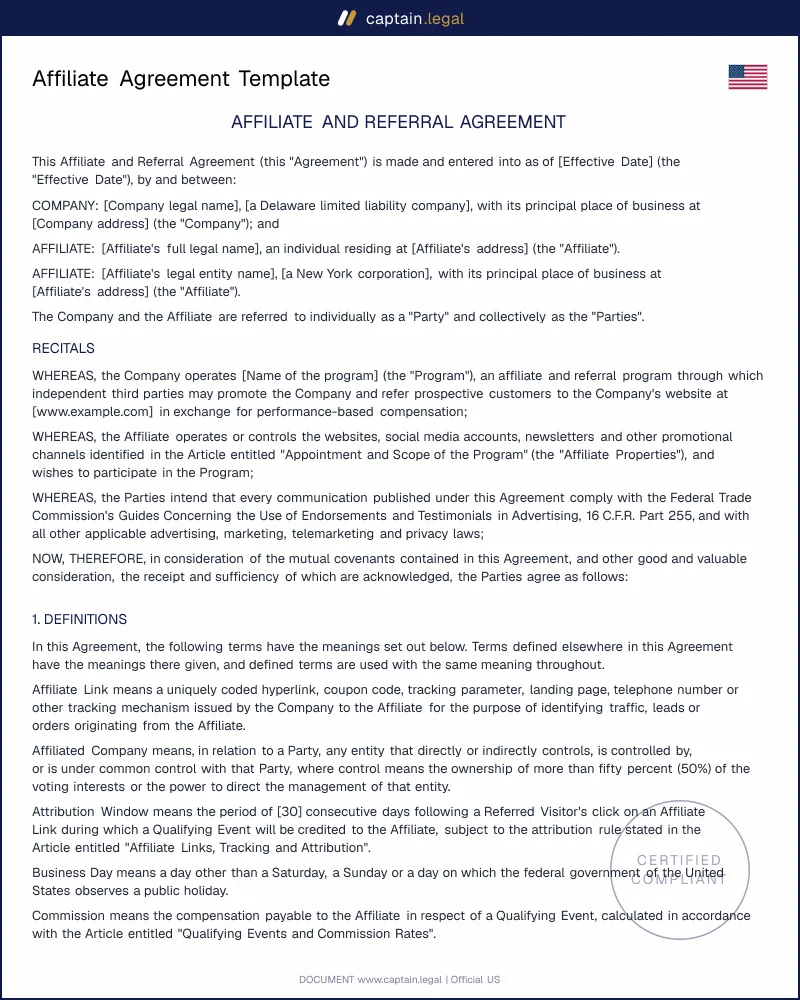
Affiliate Agreement Template | 16 CFR Part 255 Compliant

Lawyer-grade affiliate agreement drafted to 16 CFR Part 255, the FTC reviews rule and 15 U.S.C. 7705 email liability. State clauses for CA, NY, TX, FL.
4.4/517 reviews50 000+ downloadsInstant download
Share

An affiliate agreement sets the terms under which a business pays a partner for sending it customers. It defines who may promote the brand, how a referred sale is tracked, when a commission vests, and what happens to money already paid when the buyer refunds six weeks later. SaaS founders, ecommerce merchants recruiting creators, agencies running publisher networks and consultants who trade introductions all need it signed before the first payout, not after the first billing dispute. Our template covers commission tiers, cookie attribution windows, disclosure duties under 16 CFR Part 255 and termination clawbacks, drafted for use across all fifty states.

Compliant

2026 Legislation

50,000+ clients

trust us

Affordable

From $4.90 / doc

Secure payment

Instant download

Affiliate Agreement Template | 16 CFR Part 255 Compliant

Secure payment

Fill in the template

What is an affiliate agreement?

An affiliate agreement is a commercial contract between a merchant and an independent promoter who earns compensation for a measurable result, usually a completed sale, a qualified lead or a paid signup. The promoter is not an employee and not a joint venturer. They work on their own account and carry their own tax reporting, which is why a merchant who also buys services from that partner signs a separate 1099 independent contractor agreement built on the IRS common law test alongside it.

The referral variant sits at the informal end of the same family. A referral agreement pays a flat fee for an introduction, usually once, usually without tracking software, and it is standard between consultants, brokers and professional service firms. The affiliate side is the industrial version: tracked links, a partner dashboard, an attribution window, recurring payouts. Both rest on the same federal advertising law, so our affiliate agreement runs one instrument with a program type selector. Keep both distinct from a reseller agreement, where the partner takes title and sets its own resale price, and from a sales representative contract, which in states such as Texas and Illinois triggers statutory commission protections and multiple damages for late payment.

2

When do you need this document?

Most programs start identically. A merchant ships a signup page, three creators ask for a link, and the first payouts leave on a spreadsheet with nothing signed. That holds until a partner bids on the brand name in paid search, or a wave of chargebacks arrives and nothing in writing supports reversing commissions already banked. The next scenario is the network or agency intermediary recruiting publishers on your behalf, where the brand needs contractual reach past the network down to the publisher who writes the copy. Customer referral programs sit third, where the referrer is also a paying user and the reward is account credit rather than cash, and professional introductions between firms come fourth.

One edge case justifies a tighter affiliate agreement. A partner who is also an employee, a contractor or a founder's relative counts as an insider under 16 CFR 465.4, and any review that person publishes carries a disclosure duty the standard template does not satisfy alone, on top of the withholding questions that arise the moment a partner lives abroad.

3

Key clauses included in our affiliate agreement

  • The appointment and scope clause names the channels the partner may use, states that the relationship is non exclusive on both sides, and fixes the territory, because a partner promoting into a state where you are not registered creates tax questions rather than revenue.
  • The commission structure defines a qualifying transaction before it defines the rate. Tiered percentages, flat per lead pricing and recurring revenue splits are all supported, each keyed to net revenue after refunds, discounts and taxes rather than gross order value.
  • The attribution and tracking clause sets the cookie window, the last click rule and the treatment of cross device journeys, and bans self referral, coupon injection and cookie stuffing by name.
  • The payment and clawback clause holds each commission through a stated verification period, then reverses it on refund, chargeback or confirmed fraud. Those reversals keep operating after termination, alongside surviving indemnity, confidentiality and data deletion duties.
  • The marketing conduct clause makes 16 CFR Part 255 disclosure a contractual obligation, bans incentivized reviews, unapproved earnings claims and brand keyword bidding, and gives you an audit and takedown right over partner content.
  • The trademark license is limited, revocable, tied to a brand guideline and ended automatically by termination, on the same quality control logic that governs a full trademark license agreement with quality control clauses.
4

State-specific considerations

California applies the Unfair Competition Law, Cal. Bus. and Prof. Code 17200, which lets a private plaintiff borrow a federal advertising violation and litigate it in state court, so a partner's disclosure failure rarely stays federal. Section 16600 voids nearly every restraint on a person's trade, and amendments effective in 2024 made it independently unlawful to include a void restraint, with attorney fees for the affected party. Do not bar a California affiliate from promoting competing products. Restrict misuse of confidential information instead, and keep genuine restrictive covenants inside a non-compete and non-solicitation agreement for departing sales staff.

New York brings the tax problem. Under Tax Law 1101(8)(b)(vi) a remote seller is presumed to solicit business in the state once it pays New York residents for referrals and receipts from them pass the statutory threshold. The Court of Appeals upheld it in Amazon.com LLC v. New York State Department of Taxation and Finance, 20 N.Y.3d 586 (2013). Track where your partners live. General Business Law 349 then supplies a private right of action for deceptive practices, which affiliate landing pages regularly attract.

Texas enforces the Deceptive Trade Practices Act, Tex. Bus. and Com. Code 17.46, which reaches misrepresentations made by a partner acting for the merchant and carries multiple damages for knowing conduct. The state also runs its own email solicitation regime at chapter 321, so require partners to keep consent records.

Florida pairs FDUTPA, Fla. Stat. 501.204, with the Florida Telephone Solicitation Act, Fla. Stat. 501.059, which demands prior express written consent for marketing texts and has produced a heavy class action docket. Prohibit SMS promotion by default and lift the ban only for partners who produce consent evidence.

5

How to fill out this affiliate agreement

You start by choosing the program type, since the questionnaire branches immediately between a publisher program, a single partner arrangement and a customer referral scheme with credit rewards. Next come the merchant details and the governing state, which set the dispute resolution clause and pull in the state language described above. The commission engine follows: pick a percentage of net revenue, a flat amount per qualified lead or a tiered structure, then set the qualifying event, the verification hold and the clawback window. You choose the attribution window and the last click rule, then select the channels to prohibit, with brand keyword bidding, coupon extensions, incentivized reviews and unsolicited email offered as standard exclusions. The last screens cover the trademark license and the disclosure wording partners must publish, and the contract downloads in editable Word and signature ready PDF, alongside the other business contracts and incorporation documents for American companies in the catalogue.

6

Common mistakes to avoid

The first mistake is a commission defined on gross sales. Refunds, partial credits, sales tax and processing fees all sit inside that number, and once the affiliate agreement promises a percentage of it there is no clean route to a reversal when the customer cancels. The second is silence on attribution. Without a stated window and a last click rule, a coupon site that intercepts a buyer at checkout claims the same sale as the reviewer who created the demand, and you pay twice for one order. The third is the missing audit right. LeadClick turned on authority to control, and a contract granting no approval or takedown power leaves you carrying the advertising risk with no lever to reduce it.

The fourth runs the other way. Merchants sometimes script every post, dictate publishing schedules and demand exclusivity, which drifts toward the control indicators behind a worker misclassification claim. Control the message, meaning claims, disclosures and prohibited channels, and leave method and timing to the partner. The fifth is paying too fast. A commission released before the refund window closes is very hard to recover, particularly from a partner overseas.

Key takeaways

FTC DISCLOSURES

Make material connection disclosures unavoidable

Your affiliates are endorsers under 16 CFR Part 255, and a commission link counts as a material connection. Disclosures cannot be buried in a footer or implied; they must be hard to miss where the endorsement happens. The merchant carries this duty as much as the affiliate, so the agreement should make disclosure a binding program rule with clear enforcement tools.

REVIEWS RULE

Never pay for positive reviews

The 2024 FTC consumer reviews rule (16 CFR Part 465) raises the stakes: certain endorsement and review failures can trigger civil penalties per violation, not just warning letters. If your program rewards partners more for a positive review, you are in dangerous territory. The agreement should bar incentivized sentiment, require truthful substantiation, and separate performance-based commissions from review content.

LIABILITY RISK

Control without auditing increases your exposure

FTC v. LeadClick shows how a merchant or network can be directly liable under Section 5 (15 U.S.C. 45) for deceptive pages built by publishers when it recruits them, pays them, and has authority to control content. Reserving approval rights but never using them can look worse than active compliance monitoring. Add email risk too: 15 U.S.C. 7705 can attach when you benefit from unlawful commercial email and fail to act.

Frequently Asked Questions

Yes. It is a commercial contract between two businesses, and formation follows common law rules everywhere in the country, so offer, acceptance and consideration bind both sides once signed. The template asks for a governing state and adjusts the dispute resolution, notice and restrictive covenant language, which matters most in California and in states with sales representative commission statutes. Electronic signature is valid under the E-SIGN Act, 15 U.S.C. 7001, so a countersigned PDF carries the weight of ink.

Both formats come with the document. The Word file is fully editable, which matters because commission tables and prohibited channel lists need revision once a program grows past its first partners. The PDF is formatted for signature and archiving, with the schedule preserved so nobody can quietly alter the rate table before returning it. Most merchants keep the Word file as the master and republish a dated PDF whenever the rates change.

Programs commonly run between 24 hours and 90 days, and the right answer follows your sales cycle rather than market convention. Impulse ecommerce purchases justify a short window, since a click that converts three weeks later almost certainly came from somewhere else. Considered software purchases run to 60 or 90 days because the buyer researches, leaves and returns. Write the number into the contract rather than leaving it in the tracking platform, because a partner who screenshots an old dashboard will argue for the longer figure.

Yes, and the exposure is shared. 16 CFR Part 255 requires disclosure of any material connection a consumer would not expect, and a paid commission link qualifies. The disclosure has to be clear, conspicuous and placed where the endorsement appears, not buried below a fold or behind a link. Our template imposes the duty contractually, specifies approved wording and lets you demand removal of non compliant content.

The contract sets the period, and 30 days written notice for convenience is the common market position, with immediate termination reserved for fraud, prohibited channel use or a compliance breach. Notice is only half of it. The agreement also has to say what happens to pipeline commissions: whether pending conversions still pay after the notice date, whether recurring commissions continue as tail payments, and how long the clawback right survives.

American partners who are individuals or unincorporated entities receive a Form 1099-NEC once annual commissions pass the IRS reporting threshold, and you need a completed Form W-9 before the first payout. Foreign partners submit a Form W-8BEN instead, and payments may face withholding unless a treaty reduces the rate. Build form collection into onboarding, and pair the program with the contractor and marketing paperwork in the full library of downloadable American legal templates.

4.4/5

17 verified reviews · 50 000+ downloads

Affiliate Agreement Template | 16 CFR Part 255 Compliant
  • Immediate access to the document
  • PDF + Word download
  • Compliant with 2026 legislation
  • Reviewed by lawyers
Fill in the template
Secure payment
Updated on September 4, 2026

You might also like

Business Loan Agreement Template
Demand Letter for Payment Template