Create my document
Login

Choose country

United StatesUnited StatesChoose country
Business

Equipment Lease Agreement Template | UCC Article 2A

Lawyer-grade equipment lease drafted to UCC Article 2A and the section 1-203 true lease test. State clauses for CA, TX, NY, FL and Louisiana. Word & PDF.
4.7/515 reviews50 000+ downloadsInstant download
Share

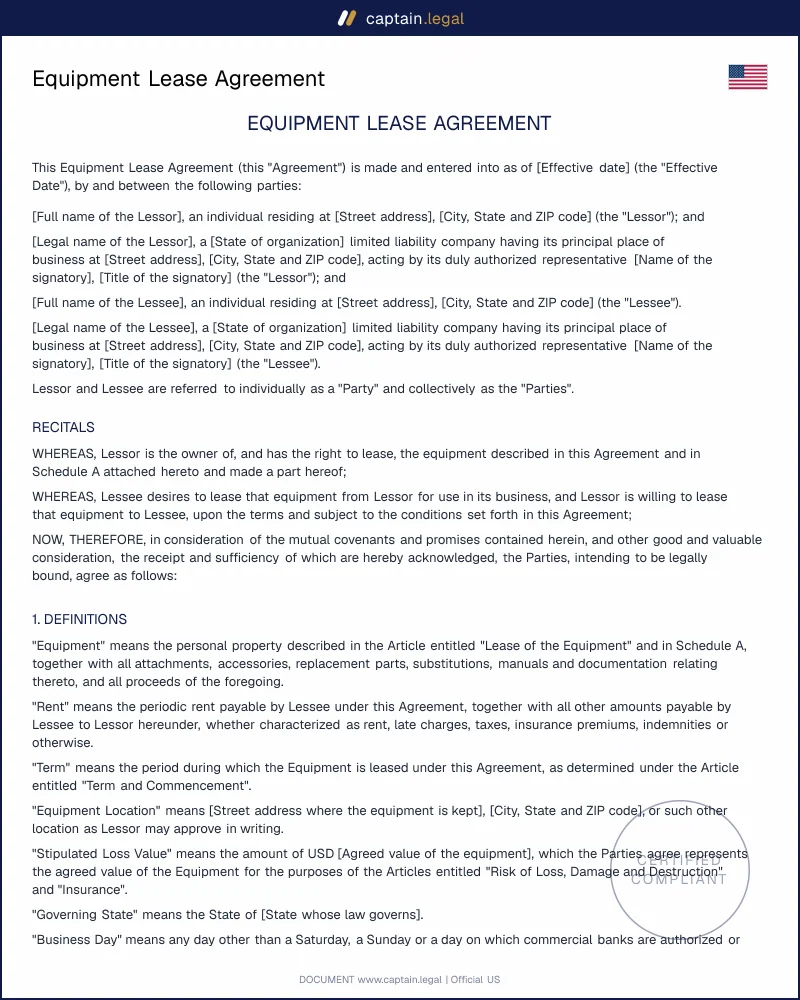
An equipment lease agreement is the written contract that lets one business use machinery, vehicles, medical devices or office hardware owned by another party for a fixed term, in exchange for periodic rent, with no transfer of title. It sits behind most capital-intensive operations in the United States: excavators on a jobsite, imaging systems in a clinic, forklifts on a warehouse floor, a fleet of service vans. Lessors sign it to protect ownership and residual value, lessees to put productive assets on site without draining a credit line. This template is drafted to Article 2A of the Uniform Commercial Code and covers rent, term, maintenance, insurance, default remedies, purchase option and early termination, in editable Word and signed PDF.

Compliant

2026 Legislation

50,000+ clients

trust us

Affordable

From $4.90 / doc

Secure payment

Instant download

Equipment Lease Agreement Template | UCC Article 2A

Secure payment

Fill in the template

What is an equipment lease agreement?

Under UCC §2A-103(1)(j), a lease is a transfer of the right to possession and use of goods for a term in return for consideration. That sentence carries the whole commercial architecture. The lessor keeps legal title and the residual interest. The lessee gets exclusive possession, operating control, and the tax and accounting consequences that follow from use rather than ownership. An equipment lease agreement is that transaction reduced to writing, with each unit identified by make, model and serial number so nobody argues later about which asset came back in what condition.

The distinction that matters most separates a true lease from a disguised security interest. If the lessee cannot terminate and the deal ends in automatic ownership or a nominal buyout, §1-203 treats the paper as a secured sale whatever the header says, and Article 9 takes over. That reclassification decides who wins the asset in bankruptcy and which remedies survive. A second distinction runs alongside: the finance lease at §2A-103(1)(g), where a funder buys equipment the lessee selected from a third-party supplier and takes on the irrevocable payment obligation of §2A-407. Our template handles both structures, drafted to the same standard as the rest of our US business contract templates.

2

When do you need this document?

The classic trigger is a business that needs a machine on site faster than its capital budget allows. Construction and landscaping firms lease seasonal equipment rather than buy an asset that idles half the year. Medical practices lease imaging and laser systems because the technology cycle is shorter than the useful life of the debt. Restaurants lease refrigeration and point-of-sale hardware, often bundled with a service plan. Each deal needs paper that pins down who repairs what and who bears the loss when a unit fails.

A second family of situations involves inter-company and peer-to-peer leasing. A holding company owns the fleet and leases it to the operating entity, a structure auditors and lenders will test for arm's length terms. A contractor cross-leases a crane to a subcontractor for one project. Short duration does not remove the need for a contract: the shortest leases produce the most disputes over return condition, because nobody documented the equipment at delivery.

Two edge cases justify attention. Equipment bolted to a building risks becoming a fixture, and a landlord or mortgagee may then claim it unless the lessor makes a fixture filing and obtains a landlord waiver, a point to check against your commercial lease and property agreements. Any lease of titled motor vehicles also brings registration, insurance minimums and vicarious liability into play, which a generic form will not handle.

3

Key clauses included in our template

  • The identification of the equipment goes beyond a category label. Each unit is described by manufacturer, model, serial or VIN number, location and delivery date, on a schedule that can be amended as units are added under a master lease.
  • The rent and payment terms set the periodic amount, the due date, the interim rent between delivery and commencement, and late charges. Rent is expressed as net to the lessor, meaning taxes, insurance and maintenance sit with the lessee.
  • The hell or high water covenant makes the lessee's payment obligation absolute and independent of any equipment failure or supplier dispute. In a finance lease it tracks §2A-407 directly; in a true lease it works as a negotiated allocation of risk between merchants.
  • The maintenance, use and insurance obligations require the lessee to service the equipment on the manufacturer's schedule, restrict relocation and sublease, and carry all-risk property coverage plus commercial general liability naming the lessor as loss payee and additional insured.
  • The default and remedies clause lists the events of default and the lessor's options under §§2A-523 to 2A-532: acceleration, repossession, disposition and recovery of the deficiency. It preserves self-help repossession under §2A-525(3), available only without a breach of the peace.
  • The end of term and tax provisions cover return condition, renewal, fair market value purchase and early buyout, then confirm the lessor as owner for tax purposes and allocate sales, use and personal property tax. Purchase pricing is drafted to market value rather than a nominal figure, precisely to survive the §1-203 test.
4

State-specific considerations

California codifies Article 2A at Division 10 of the Commercial Code, §§10101 and following. The tax treatment surprises out-of-state lessors: under Rev. & Tax. Code §6006(g) a lease of tangible personal property is a continuing sale, so tax attaches to each rental payment unless the lessor elected to pay on acquisition cost. County assessors separately levy unsecured personal property tax at the situs of the machine, not the lessor's office. State the equipment location accurately or your lessee receives an assessment nobody budgeted for.

Texas enacts Article 2A at Business & Commerce Code Chapter 2A and treats leases as sales under Tax Code §151.005, so a lessor needs a sales tax permit and collects on rental receipts. Repossession follows §2A.525, and Texas courts read the breach of the peace limit strictly when an agent enters a fenced yard. Equipment left at a repair shop can also fall under a worker's lien in Property Code Chapter 70, which may prime the lessor's ownership.

New York places Article 2A at UCC Article 2-A, §§2-A-101 and following, and its courts enforce commercial hell or high water clauses firmly between sophisticated parties, which is why lessors so often choose New York law. The unconscionability provision at §2-A-108 still restrains overreaching, and judges scrutinize liquidated damages formulas that produce a windfall rather than a reasonable forecast of loss under §2-A-504.

Florida adopts Article 2A at Chapter 680 of the Florida Statutes. The dangerous instrumentality doctrine historically exposed vehicle owners to liability for a driver's negligence, and Fla. Stat. §324.021(9)(b) now caps that exposure for long-term lessors, while the federal Graves Amendment at 49 U.S.C. §30106 preempts vicarious liability for businesses in the trade of leasing motor vehicles. Any lease covering trucks or trailers in Florida should invoke both expressly.

Louisiana stands apart. It never adopted Article 2A, so equipment leases follow the Louisiana Lease of Movables Act at R.S. 9:3301 et seq. alongside Civil Code principles. The scope rule at R.S. 9:3303 voids two clauses lessors use everywhere else: a Louisiana lessee's consent to another state's jurisdiction, and any clause fixing venue. Draft around it, or the dispute resolution section fails exactly when it is needed.

5

How to fill out this equipment lease agreement

You start by choosing the structure, because everything downstream depends on it. Select a true operating lease when the equipment returns with meaningful value left, or a finance lease when a funder buys a machine the lessee picked from a supplier. The form then sets the governing law state and adjusts the statutory citations, the repossession language and the tax clauses. Next come the parties, entered under the exact registered names filed with the Secretary of State, since a lease signed in a trade name is a familiar enforcement problem.

The equipment schedule follows: make, model, serial number, condition at delivery, and the address where the unit will be kept. From there the questionnaire walks through base term, rent frequency, interim rent, security deposit, insurance limits, maintenance responsibility and end of term option, flagging any choice that affects characterization. You finish with signature blocks and an acceptance certificate, then download in Word and PDF from the complete library of US legal documents.

6

Common mistakes to avoid

The most expensive error is a purchase option set at a token amount on a document titled as a lease. Under §1-203 that is a secured sale, the lessee owns the equipment subject to a security interest, and a lessor that never filed a UCC-1 stands unsecured behind a bank in the lessee's bankruptcy. Close behind sits the missing precautionary filing under §9-505, which costs almost nothing and preserves priority when a court disagrees with your characterization. Third comes the insurance certificate naming the lessor as additional insured but not as loss payee, so the lessee collects the property claim and the lessor collects nothing.

The rest cluster around documentation discipline. Nobody photographs the equipment at delivery, so the return condition dispute becomes a swearing contest. Serial numbers get copied from a quote rather than the machine, then fail to match when a sheriff arrives with a writ. Organizations leasing grant-funded assets face an extra layer, since restricted funds and board approval interact with the lease, an issue our nonprofit governance and formation templates address. And operators who run the machines are often engaged without written terms, a misclassification exposure better handled through proper employment and independent contractor agreements.

Key takeaways

Lease basics

You rent use, not legal title

An equipment lease is a written deal where the lessee gets possession and use of specific goods for a set term in exchange for rent, while the lessor keeps title and the residual interest. The equipment should be identified precisely (make, model, serial number) so the parties can later prove what was delivered and what must be returned, and in what condition.

Characterization

A bad structure can become a loan

The biggest legal trap is recharacterization. Under UCC §1-203, a transaction labeled a lease can be treated as a secured sale if the lessee cannot terminate for the full term and the economics effectively guarantee ownership (like an automatic transfer or a nominal buyout). That switch can pull the deal into Article 9 and change priorities and remedies, especially in bankruptcy.

Enforceability

Get it signed or it may fail

Article 2A is built around a signed writing for higher-value leases. UCC §2A-201 makes a lease unenforceable above its statutory threshold unless there is a signed document that describes the goods and states the term. An oral lease above that line will not hold up, and a purchase order alone often does not satisfy the requirement. Louisiana is a separate regime under its Lease of Movables Act.

Frequently Asked Questions

Yes. A lease of goods becomes enforceable once both parties sign a writing that identifies the equipment and states the term, as §2A-201 requires. The template is drafted to Article 2A as enacted across the states, with a governing law selector that adjusts statutory references and remedy language. Electronic signatures are valid for commercial leases under the federal E-SIGN Act and state versions of the Uniform Electronic Transactions Act. Enforceability then turns on accurate completion: correct entity names, a precise equipment schedule, and a purchase option priced at fair market value.

Both formats come with every document. The Word file stays fully editable, which matters here because schedules get amended as units are added or returned under a master lease. The PDF is formatted for signature and filing, with consistent pagination for exhibits. Most users keep Word as the working master, generate a fresh PDF for each execution, and attach the acceptance certificate as a separate page. If a lender requires a specific clause order, edit the Word version before signature.

That depends on your contract, because Article 2A defers to the lease agreement on termination. Most commercial equipment leases require written notice between thirty and ninety days before the intended end date, plus an early termination amount calculated from the remaining rent and the residual. A finance lease usually forbids early termination outright, since §2A-407 makes the lessee's promises irrevocable once the goods are accepted. Check whether your lease renews automatically if notice arrives late, because evergreen clauses are standard and courts enforce them.

In a net lease the lessee carries maintenance and repair, follows the manufacturer's service schedule, and keeps paying rent while the unit is down. In a finance lease that outcome is statutory: the lessor makes no implied warranty of merchantability, and under §2A-209 the lessee receives the supplier's warranty promises and pursues the manufacturer directly. Risk of loss shifts too. Under §2A-219(1) it stays with the lessor in an ordinary lease but passes to the lessee in a finance lease.

Yes, and cross-border leasing inside the United States is routine. Name a governing law state with developed Article 2A case law, then account for the rules that follow the equipment rather than the contract: registration for titled vehicles, sales and use tax on rent where the machine sits, and personal property tax assessed at the situs. Louisiana is the trap, since R.S. 9:3303 invalidates a local lessee's agreement to another state's jurisdiction. Multi-state arrangements sit alongside our other agreements for US companies.

Article 2A gives the lessor graduated remedies at §§2A-523 to 2A-532: cancel the lease, accelerate unpaid rent, take possession of the equipment, dispose of it, then recover the deficiency with incidental damages. Self-help repossession is available under §2A-525(3), but only without a breach of the peace, so entering a locked facility or removing a unit over an objection calls for a court order and a writ. A liquidated damages clause speeds this up, provided the formula reflects a reasonable forecast of loss under §2A-504.

4.7/5

15 verified reviews · 50 000+ downloads

Equipment Lease Agreement Template | UCC Article 2A
  • Immediate access to the document
  • PDF + Word download
  • Compliant with 2026 legislation
  • Reviewed by lawyers
Fill in the template
Secure payment
Updated on July 31, 2026

You might also like

Master Services Agreement
Demand Letter for Payment Template