Charity

Grant Agreement Template for Nonprofits and Foundations | Word & PDF

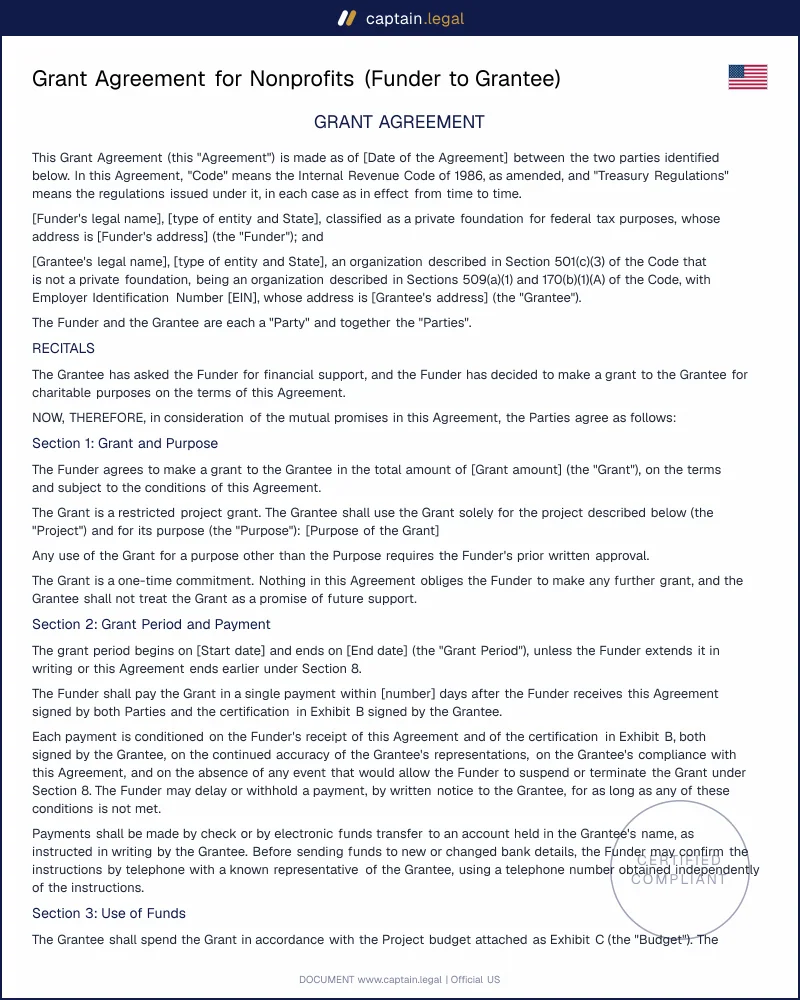
Grant agreement between a funder (private foundation, public charity, donor advised fund sponsor or company) and a 501(c)(3) charity, a fiscally sponsored project or another organization: payment, budget, reports, prohibited uses and expenditure responsibility.
4.6/5— 12 reviewsUS law 2026Instant download
Share

A grant agreement template gives a funder and a nonprofit one written contract for a private grant: how much is paid and when, what the money may be used for, which reports are due, and what happens to funds that are not spent. It is built for private foundations, public charities, donor advised fund sponsors and companies with a corporate giving program, and for the organizations they support: a 501(c)(3) public charity, a fiscally sponsored project or, with expenditure responsibility, another type of grantee. Program officers use it to standardize their grant award letters; executive directors use it when a smaller funder asks them to prepare the paperwork.

Compliant

2026 Legislation

50,000+ clients

trust us

Affordable

From $4.90 / doc

Secure payment

Instant download

Grant Agreement Template for Nonprofits and Foundations | Word & PDF

Secure payment

Fill in the template

What is a grant agreement template?

In legal terms, a grant agreement is the contract that turns a funding decision into enforceable terms. The board or grants committee approves an amount; the agreement then fixes the purpose, the grant period, the payment schedule, the reporting calendar and the funder's remedies if the money is misused. Unlike a pledge, which is a donor's promise to give, the agreement places obligations on both sides. The funder commits to pay on stated conditions, and the grantee accepts limits on how it spends the funds, keeps records and returns what it cannot use. A grant agreement template saves the program officer from rebuilding those terms for every award.

The document also differs from a sponsorship. A grant buys nothing for the funder's own benefit, and recognition is limited to acknowledgment of support; once a company receives advertising or other substantial return benefits, part of the payment stops being a gift. Where a project has no tax-exempt status of its own, the usual vehicle is a fiscal sponsorship agreement for a project run inside a 501(c)(3) sponsor, and the grant is then signed with the sponsor, which keeps discretion and control over the funds. Our grant agreement template handles that case directly: the sponsor is the Grantee and the project is named in the agreement.

When do you need this document?

The most common trigger is a restricted project grant. A family foundation funds a literacy program for one school year, pays half on signature and half after an interim report, and wants unspent money back. Without a signed agreement, the foundation has no clean way to withhold the second payment when the report never arrives.

General operating support is the second case. Some foundations prefer unrestricted grants, and the agreement then does less policing: the grant is not earmarked, the grantee reports on its overall programs and finances, and leftover funds stay with the organization. Community foundations that regrant from their own funds use the same structure, with lighter tax language since Section 4945 does not apply to them.

Grants from a donor advised fund raise their own question, because the sponsor, not the donor, is the funder, and the grantee must not hand the donor tickets, dinners or a receipt in return.

The edge cases are where a template earns its keep. A foundation funding a 501(c)(4) for a nonpartisan study, or a social enterprise LLC for a job training course, needs the full expenditure responsibility package. Grantees still building their files will find bylaws, gift policies and board resolutions in the library of nonprofit legal templates.

Key clauses included in our template

The agreement opens with the parties described by tax status, which drives the rest of the document. A private foundation funder gets the Section 4945 limits on electioneering and voter registration, a warranty that no disqualified person benefits from the grant, and a reminder that excise taxes may follow if funds are diverted. A donor advised fund sponsor gets the Section 4967 no-benefit clause and a promise that the grantee will not give the donor an acknowledgment treating the grant as a personal gift. For a grantee that is not a public charity, the grant agreement template adds the expenditure responsibility commitments: a separate fund, repayment of misused amounts, annual reports and no regranting without approval. Funders who screen board conflicts on their own side can pair it with a conflict of interest policy for 501(c)(3) boards.

  • Payment follows your choice: one payment within a set number of days, or installments conditioned on receipt and approval of the reports due before each date.
  • For project grants, a budget is attached as Exhibit C with a permitted variance per line item.
  • Reporting is set out in Exhibit A, with a final report date, optional interim dates and, for an expenditure responsibility grant, annual reports until the money is spent.
  • Grantees certify their status in Exhibit B, including the public charity classification and, for a supporting organization, the control tests.
  • If funds are misused, the funder can suspend payments, terminate and demand repayment within thirty days; sanctions compliance, anonymity or publicity, intellectual property and indemnification complete the contract.

How to fill out this grant agreement

You start by saying whether you are the funder or the grantee. A funder sets a deadline for the grantee to sign, after which the offer can be withdrawn; a grantee preparing the draft gets a clause stating that nothing is awarded until the funder signs. Next come the funder's identity and tax status, with the fund name for a donor advised fund. The grantee step asks who receives the grant: a public charity, a fiscally sponsored project or another organization. That single answer decides whether the document adds expenditure responsibility terms, a separate fund and a different certification.

For a public charity, you pick the Section 509(a) classification shown on its determination letter and the type of support. The questionnaire then asks for the purpose in plain charitable terms, the amount, the grant period, the payment method and, for project grants, the budget lines and variance. You finish with the report dates, acknowledgment or anonymity, governing law and the county where disputes are heard. The preview updates as you answer. Companies that run a giving program alongside their commercial activity will find their vendor and service contracts among the business contract templates for US companies.

Common mistakes to avoid

The first mistake is paying a project instead of its sponsor. A check made out to the founder of an unincorporated initiative is not a grant to a charity, and a private foundation that does this risks a taxable expenditure. The second is a vague purpose such as "general support of the project", which makes misuse impossible to prove. Funders also forget to tie later installments to reports, and once the money is out the pressure is gone. Never release a second installment before the report that conditions it has been received and reviewed.

Grantees make the opposite errors. They move budget lines beyond the permitted variance without asking, or keep unspent project funds after the end date. Another frequent problem is a donor receipt sent to the advisor of a donor advised fund: the sponsor made the grant, and any deduction belonged to the donor when the account was funded. Corporate funders sometimes ask for endorsements, booth space or free tickets in exchange for a "grant"; those return benefits take part of the payment out of the gift, while a plain display of the company's name or logo remains an acknowledgment. Finally, a Type III supporting organization that is not functionally integrated should not certify itself as an ordinary public charity. Check the classification on the IRS Tax Exempt Organization Search before anyone signs.

Key takeaways

IRC § 4945(h)

Expenditure responsibility for non-charity grantees

A private foundation that funds an organization other than a public charity, such as a 501(c)(4), a business or a non-functionally integrated Type III supporting organization, must exercise expenditure responsibility. An officer, director or trustee of the grantee signs a written commitment to use the funds only for the grant purpose, repay any misused amount, report yearly on spending, compliance and progress, keep records and avoid lobbying.

Lobbying

No earmark: how foundations fund charities that lobby

A public charity may lobby within its own limits, but a private foundation cannot pay for that lobbying. Treasury rules make a general support grant safe if it is not earmarked for lobbying, and a project grant safe if it does not exceed the project's non-lobbying budget. The agreement states that no part of the grant is earmarked, while project grants exclude lobbying outright.

IRC § 4967

Grants from a donor advised fund carry no perks

When the money comes from a donor advised fund, the sponsoring organization is the funder, not the donor. A grant that gives the donor or advisor more than an incidental benefit, such as event tickets, a dinner or the payment of a personal pledge, can trigger excise taxes. The agreement bars those benefits and forbids issuing the donor a receipt that treats the grant as a personal gift.

Frequently Asked Questions

It becomes a binding contract once both parties sign it, provided the signers have authority to commit their organizations. No notarization, witness or public filing is required, and electronic signatures are valid under the federal E-SIGN Act to the extent applicable law permits. Tax effects are a separate matter: the agreement records commitments the IRS expects, such as expenditure responsibility terms, but it does not guarantee any tax result, so each side should confirm its own position with a tax adviser.

Both formats are available once the questionnaire is complete. The PDF is the clean version for signature and for the grant file, and the Word file lets your counsel or program officer adjust a clause before it goes out. Many funders keep the Word version as an internal master and change only the amount, the dates and the purpose for each award. If you edit it, keep the exhibits consistent with the body, since Exhibit A and Exhibit C are referred to throughout.

The deadline is the date you enter in the questionnaire, and it appears both in the reports section and in Exhibit A. Foundations usually set it between thirty and ninety days after the end of the grant period. When the grantee is not a public charity, the template adds annual reports covering each accounting year in which funds are received or remain unspent, as the expenditure responsibility rules require, and sets them due within ninety days. Late reports matter because later installments depend on them, and a funder may suspend payments until the missing report arrives.

Only some grants require it. A private foundation needs it when it funds an organization other than a public charity described in Section 509(a)(1) or (2), a qualifying supporting organization or an exempt operating foundation, for example a 501(c)(4), a business, or a Type III supporting organization that is not functionally integrated. Donor advised fund sponsors face the same requirement under Section 4966. Public charities and companies are not bound by those rules, yet the template applies the same controls when they fund a non-charity, because those controls help show that the money served a charitable purpose.

An officer with authority under the bylaws or a board resolution signs for each side, usually the executive director or president. For an expenditure responsibility grant, the regulations call for a written commitment signed by an officer, director or trustee of the grantee, and the questionnaire reminds you of that point. Corporate funders often want a written acknowledgment as well; a donation acknowledgment letter for 501(c)(3) gifts handles it once the grant is paid. Keep the signed original in the grant file; the grantee must also keep its grant records for at least four years.

Unspent money follows the type of grant. In a project grant, anything not spent or irrevocably committed for project expenses by the end of the grant period goes back to the funder within thirty days, income included, unless the funder approves an extension or another use in writing. A general operating support grant works the other way: leftover funds stay with the charity, unless the funder has demanded repayment after a breach or a termination. Forms for other transactions sit in the catalog of US legal documents.

4.6/5

12 verified reviews · US law 2026

Grant Agreement Template for Nonprofits and Foundations | Word & PDF
  • Immediate access to the document
  • PDF + Word download
  • Compliant with 2026 legislation
  • Reviewed by lawyers
Fill in the template
Secure payment
Updated on November 26, 2026

You might also like

Nonprofit Sponsorship Agreement
Nonprofit Dissolution Plan