Business

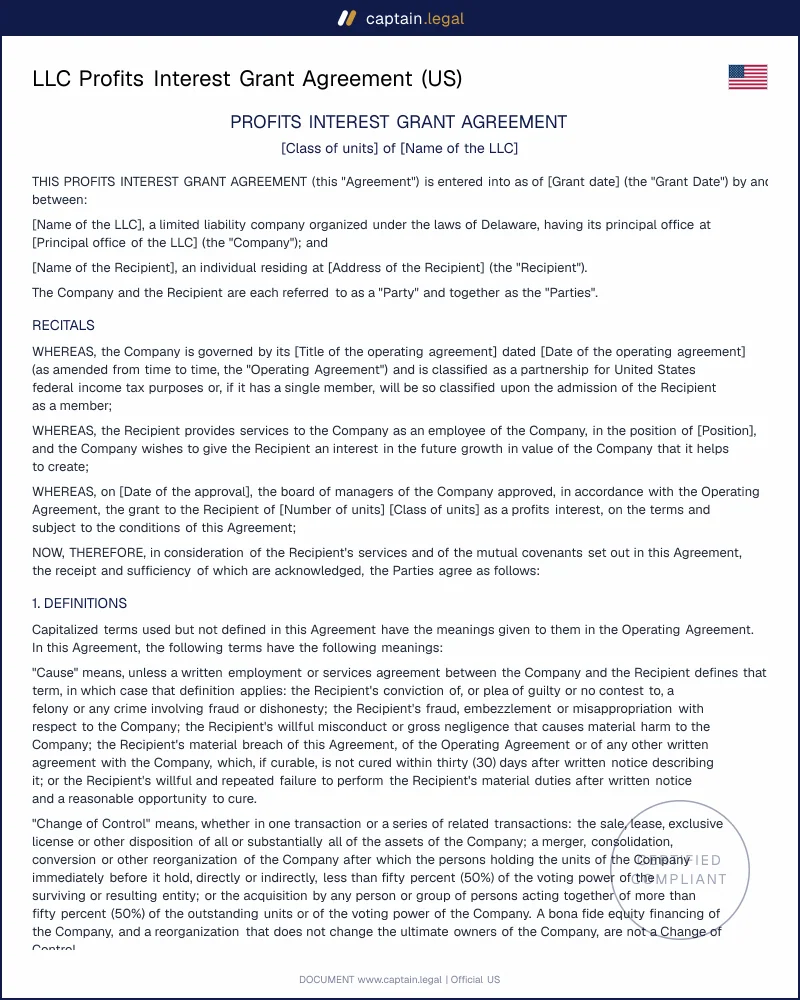
LLC Profits Interest Grant Agreement Template with Vesting | Word & PDF

Grant agreement for profits interest units in an LLC taxed as a partnership: distribution threshold, time or performance vesting, change of control, repurchase right, protective 83(b) election, joinder and spousal consent.
4.8/5— 31 reviewsUS law 2026Instant download
Share

A profits interest grant agreement is the contract an LLC taxed as a partnership uses to give an employee, contractor or manager a share of the future growth of the business without asking them to buy in. The recipient gets incentive units, often called Class B or P units, that pay out only on value created after the grant date. It is the partnership counterpart of a stock option. This template covers the grant, the distribution threshold, vesting, forfeiture, a repurchase right on vested units, the Section 83(b) paperwork and the joinder to the operating agreement, with state law choices handled in the questionnaire.

Compliant

2026 Legislation

50,000+ clients

trust us

Affordable

From $4.90 / doc

Secure payment

Instant download

LLC Profits Interest Grant Agreement Template with Vesting | Word & PDF

Secure payment

Fill in the template

What is a profits interest grant agreement?

On the day of the grant, the new membership interest has a liquidation value of zero. If the LLC sold every asset at fair market value on the grant date and distributed the cash in liquidation, the holder of the new units would receive nothing, because every dollar of existing value belongs to the members who were already there. The agreement locks that in through a distribution threshold (a hurdle) equal to the liquidation value at grant, which existing holders must receive before the new units share in any distribution.

The contrast with a capital interest matters for tax. A capital interest gives the holder a slice of today's value, and when it is received for services it is compensation income under IRC § 83, taxed when it vests or, with an 83(b) election, when it is received. A profits interest that meets the IRS conditions is generally not taxed when granted or when it vests. It also differs from stock-based equity: a corporation grants options under a plan such as an employee stock option plan with ISO and NSO grants, or sells shares under a restricted stock purchase agreement with an 83(b) election. An LLC that has elected to be taxed as an S or C corporation cannot issue a true profits interest and should use one of those tools instead.

When do you need this document?

The classic case is an early-stage LLC that wants to bring a key hire into the cap table without making them write a check. A head of sales accepts a lower salary in exchange for units that pay off only if the company grows. A professional services firm organized as an LLC uses the same structure for a senior employee on a partner track, long before admitting that person as an equity partner with capital at risk. Most of the companies that grant these units also rely on other business agreements for LLCs and their owners.

Fractional executives and outside contractors come next. A part-time CFO who works for several companies often prefers a profits interest over a cash bonus, and the template handles the reporting differences that apply when a contractor becomes a member. Real estate and investment LLCs grant these interests to sponsors too, the edge case where Section 1061 and the predictable income exception of Rev. Proc. 93-27 call for a tax advisor before signing. A second edge case is the single-member LLC: the grant turns it into a partnership for tax purposes the day a second member is admitted, which changes its filings from that day on.

Key clauses included in our template

The agreement opens with the grant itself, the class name and number of units, the approval by the managers or members under the operating agreement, and the distribution threshold with the date and basis of the valuation behind it. A clause lets the managers raise the threshold if it proves to be below liquidation value. Vesting comes next, and the questionnaire offers time-based schedules (a cliff then monthly installments, quarterly or annual), performance conditions with a deadline, or full vesting at grant. Confidentiality is always included with the whistleblower immunity notice required by 18 U.S.C. § 1833(b), while non-solicitation and non-competition are optional and apply only where the recipient's state allows them.

  • Acceleration on a change of control can be single trigger, double trigger with a protected period and a Good Reason definition, or none.
  • Unvested units are forfeited without payment when service ends, while vested units can be bought back at fair market value; the repurchase window opens only after the second anniversary of the grant, which is designed to keep a buyback outside the two-year window of Rev. Proc. 93-27.
  • Tax provisions follow sections 4.01 and 4.02 of Rev. Proc. 2001-43: partner treatment from the grant date and no deduction for the value of the units.
  • Exhibits include the joinder, a vesting schedule, a protective 83(b) election with filing instructions when the units vest over time or on performance and, for married recipients, a spousal consent.

State-specific considerations

The governing law is the law of the state where the LLC was formed, because that law controls admission of members and internal affairs. Restrictive covenants are where state law bites hardest. California voids non-competes and most customer non-solicitation clauses under Cal. Bus. & Prof. Code § 16600, and Minnesota voids non-competes under Minn. Stat. § 181.988, contractors included. Colorado restricts them heavily, and Washington, which limits them today under RCW 49.62.020, has amended that statute to void every non-compete from June 30, 2027. Several of these states penalize a non-compliant covenant. A saving clause does not shield the LLC from those penalties, which is why the questionnaire defaults to confidentiality only.

Marital property is the other state issue. In the nine community property states (Arizona, California, Idaho, Louisiana, Nevada, New Mexico, Texas, Washington and Wisconsin), a spouse can acquire an interest in units earned during the marriage, and the attached consent binds that interest to the vesting and repurchase terms. Securities notice filings depend on the recipient's state, and the agreement assigns them to the company.


How to fill out this profits interest grant agreement

You start with the LLC itself: legal name, state of formation, principal office, the title and date of the operating agreement, and the body that approved the grant. The recipient's details follow, with the capacity in which they serve, since employees, contractors and managers each get their own tax paragraph. Then come the units: class name, number of units and the grant date. Use the date the units are actually issued, normally the day both parties sign, since the 83(b) clock runs from the real transfer.

The threshold step asks for the liquidation value and its basis, appraisal or good-faith determination. Vesting choices reshape the document as you answer. The last steps cover acceleration, the repurchase window and price after a termination for cause, restrictive covenants, marital status, the taxpayer identification number for the election, and courts or arbitration. When the preview reads correctly, you click Finish and download the file.

Common mistakes to avoid

The most expensive error is a threshold that is too low. When a company has just closed a financing round or turned down an offer, a stale valuation from last year understates liquidation value, and the units can end up treated as a capital interest, with compensation income on the value they carry. Value the company as close to the grant date as you can. The second is issuing units the operating agreement does not authorize: without an incentive class and a waterfall that honors the threshold, amend the LLC operating agreement that governs members and managers first.

Backdating a profits interest grant agreement is the third. Signing in June an agreement that carries a March date moves the 83(b) deadline on paper but not in fact. Fourth, companies keep running payroll for a new member as if nothing changed; the IRS position in Rev. Rul. 69-184 means withholding and benefits should be reviewed the day the units issue. Finally, buying back a departing member's units within two years can cost the safe harbor, which is why the template defers that right.

Key takeaways

Rev. Proc. 2001-43

Taxed on future growth, not on the grant

The units carry a distribution threshold equal to the LLC's liquidation value on the grant date, so the recipient shares only in value created afterwards. Under Rev. Proc. 93-27 and 2001-43, the IRS does not treat the grant or the vesting as taxable if the LLC treats the recipient as a partner from day one, nobody deducts the value of the units, they are not disposed of within two years and the other conditions are met.

IRC § 83(b)

A protective 83(b) election within 30 days

For units that vest over time or on performance, the agreement attaches a protective Section 83(b) election reporting a value of zero, with filing instructions. The election must be filed with the IRS no later than 30 days after the units are actually transferred; that statutory period cannot be extended, and a copy goes to the LLC. Fully vested units need no election, and the safe harbor does not require one.

Employment status

A new member usually leaves W-2 payroll

Under the IRS position in Rev. Rul. 69-184, a bona fide partner is not an employee of the partnership. Once the units are issued, an employee usually receives a Schedule K-1 instead of a Form W-2, with guaranteed payments, self-employment tax and estimated payments. The agreement explains this shift, lets the parties settle compensation changes in writing and recommends independent tax advice.

Frequently Asked Questions

It is a binding contract once the LLC and the recipient sign it and the grant has been approved as the operating agreement requires. Admission as a member also needs the signed joinder attached as Exhibit A. The agreement itself is not notarized or filed with a state agency, though a state securities notice filing may apply. Tax treatment is a separate question: the IRS safe harbor depends on facts such as a correct threshold, so the agreement states the parties' intent and recommends tax advice rather than promising a result.

The election must be filed with the IRS no later than 30 days after the units are transferred, and the deadline cannot be extended. When the thirtieth day falls on a weekend or legal holiday, it moves to the next business day under IRC § 7503. Mail it by certified mail with return receipt to the IRS office where you file your return, keep the receipt, and give a copy to the LLC. Fully vested units do not need an election. For unvested units it is protective, reporting a value of zero, so it should not create tax if the threshold is right.

Usually not. Under Rev. Rul. 69-184 a bona fide partner is not an employee of the partnership, so once the units are issued the LLC generally stops withholding and reports your share of income on Schedule K-1, while payments for your work become guaranteed payments. That shift brings self-employment tax and quarterly estimated payments, and it can affect pre-tax benefits. If you also hold an executive employment agreement with salary and severance terms, review both documents together with your tax advisor.

Unvested units are forfeited without payment on your last day of service, unless a change of control accelerated them first. Vested units stay yours. If the LLC kept a repurchase right, it can buy them at fair market value, but only within the window that opens after the second anniversary of the grant. When service ends for cause, the price can be a percentage of fair market value if that option was chosen, subject to state law limits. If the LLC waived the right, you remain a member under the operating agreement and its transfer rules.

Yes. After you click Finish, the completed agreement is available as an editable Word file and as a PDF, with every exhibit in the same document: the joinder, the vesting schedule, the 83(b) election with its instructions for units that do not vest at grant and, where relevant, the spousal consent. The Word version lets your attorney or accountant adjust the language before signing. You can return to the questionnaire to change an answer, and the full catalog of US legal document templates has related agreements you may need.

That depends on how the company is taxed. An LLC taxed as a partnership can grant profits interests, which carry no exercise price and can qualify for capital gain treatment when the company is sold. A corporation, or an LLC that elected corporate taxation, cannot, and uses options or restricted stock instead. Profits interests bring K-1 reporting and the loss of W-2 status, which some employees dislike, while options keep payroll simple. Compare both with a tax advisor before you choose.

4.8/5

31 verified reviews · US law 2026

LLC Profits Interest Grant Agreement Template with Vesting | Word & PDF
  • Immediate access to the document
  • PDF + Word download
  • Compliant with 2026 legislation
  • Reviewed by lawyers
Fill in the template
Secure payment
Updated on November 26, 2026

You might also like

Joint Venture Agreement Template
Memorandum of Understanding (MOU)