Business

MOU Template | Tribune Type I & II Binding Intent Rules

Memorandum of understanding drafted to Tribune, Restatement §27 and SIGA v. PharmAthene. Clauses for CA, NY, TX, FL, DE. Editable Word and PDF.
4.6/5— 31 reviews50 000+ downloadsInstant download
Share

A memorandum of understanding (MOU) records the points two or more parties have agreed on before they sign a definitive contract, and states in plain words which of those points bind them today. Founders use it to frame a strategic partnership, companies use it to open a window of exclusive talks, and nonprofits use it to document a collaboration with a city agency. Our template is drafted to the binding versus non-binding intent tests American courts apply to preliminary agreements, with confidentiality, exclusivity and governing law provisions written to survive when the commercial terms do not. Clauses adapt to California, New York, Texas, Florida and Delaware, and the MOU agreement downloads in Word and PDF.

Compliant

2026 Legislation

50,000+ clients

trust us

Affordable

From $4.90 / doc

Secure payment

Instant download

MOU Template | Tribune Type I & II Binding Intent Rules

Secure payment

Fill in the template

What is a memorandum of understanding?

An MOU is a written record of a meeting of the minds on the main terms of a future deal or relationship. Under American contract law, the title on the first page decides nothing: courts read the four corners of the document, then look at how the parties behaved after signing. A signed MOU can be a fully enforceable contract, a statement of intent with no legal effect, or a hybrid document in which the commercial terms are aspirational while a few protective clauses bind both sides from signature. That hybrid is what experienced deal counsel draft. A pure statement of intent protects nobody when talks collapse and one side walks away with the other's pricing model.

The line between an MOU and a letter of intent is thin. In acquisition practice, a letter of intent for a business acquisition usually comes from the buyer, proposes a price and a structure, and leads to a purchase agreement. An MOU is more often bilateral or multilateral and frames a relationship rather than a single transaction (a co-marketing program, a research collaboration, a pilot with a municipality). It may govern that relationship for months without ever becoming a longer contract. Whatever the label, the question courts ask first stays the same: which sentences did the parties intend a judge to enforce, and which did they not?

When do you need this document?

The most common trigger is a strategic partnership that is real but not yet priced. Two companies agree to co-develop a product or share a distribution channel, and the lawyers need three months to finish the long-form contract. An MOU lets the project begin under defined confidentiality and cost rules. When the relationship matures into shared ownership or shared profits, it usually graduates into a joint venture agreement drafted under RUPA. The second scenario is a window of exclusive negotiations before an investment, where the only binding promises that matter are the no-shop, confidentiality and expense allocation.

Nonprofits and public bodies rely on MOUs more than any other sector. A food bank coordinating with a county health department, a university sharing a laboratory with a startup, or a charity running a project under another organization's exemption all document their roles this way; the last case often sits alongside a fiscal sponsorship agreement for 501(c)(3) projects.

Two edge cases deserve attention. When the parties are competitors, the MOU must restrict what sensitive data flows during talks, because information exchange can raise issues under Section 1 of the Sherman Act, and acting on a deal before clearance can amount to gun jumping under the Hart-Scott-Rodino Act. When one party is a public agency, the signed MOU is generally a public record, whatever its confidentiality clause says.

Key clauses included in our template

  • The statement of binding effect identifies, by section number, the provisions that bind the parties on signature and declares every other provision non-binding. Courts give far more weight to a precise list than to a generic "this MOU is not a contract" sentence buried at the end.
  • The description of the proposed relationship sets out the purpose, each party's role and the milestones toward a definitive agreement. It is written in the language of expectation rather than obligation, so it cannot be read as a Type I commitment by accident.
  • The confidentiality undertaking covers information exchanged during talks, survives termination for a defined period and carves out disclosures required by law. When the exchange is extensive or technical, many clients sign a standalone mutual non-disclosure agreement first and reference it in the MOU.
  • The exclusivity period, if selected, bars each party from soliciting or negotiating a competing deal until a fixed calendar date. An open-ended no-shop invites an indefiniteness challenge under Restatement §33 and a dispute over when the restriction lapsed, so the template refuses to generate one without an end date.
  • The expense allocation provides that each party bears its own negotiation and diligence costs, which closes the door on reimbursement claims if talks fail. It also blunts the reliance damages theory that California and other states allow when a negotiation covenant is breached.
  • The term and termination clause sets an outside date and lets either party end the memorandum of understanding on written notice. It lists the surviving obligations by section number, so confidentiality does not lapse with the rest of the document.
  • The governing law and forum selection clause picks one state's law and one court system. An optional waiver of expectation damages for the negotiation covenant neutralizes the Delaware SIGA remedy when neither side wants that exposure.

State-specific considerations

California enforces an express promise to negotiate in good faith but limits recovery. In Copeland v. Baskin Robbins U.S.A. Co., 96 Cal. App. 4th 1251 (2002), the Court of Appeal held that breach supports reliance damages, not the profits the final deal would have produced. Intent is read under Cal. Civ. Code §1636. Restrictive covenants must clear Cal. Bus. & Prof. Code §16600, so our California version limits restrictions to confidentiality and exclusivity of the negotiation itself. Agency MOUs fall under the California Public Records Act.

New York is the home of the Type I and Type II framework and applies it rigorously. In Brown v. Cara, 420 F.3d 148 (2d Cir. 2005), the Second Circuit held that a document titled memorandum of understanding was a Type II agreement binding the parties to good faith negotiation, even without agreement on final terms. An express reservation of the right not to be bound remains the strongest factor. N.Y. Gen. Oblig. Law §5-1401 lets parties choose New York law for commercial transactions above the statutory threshold.

Texas produced the cautionary tale every deal lawyer knows. A Houston jury found that a memorandum of agreement and a press release between Pennzoil and Getty created a binding deal despite "subject to" language, and the Court of Appeals upheld liability in Texaco, Inc. v. Pennzoil Co., 729 S.W.2d 768 (Tex. App. 1987), leaving one of the largest civil verdicts in American history. Foreca, S.A. v. GRD Development Co., 758 S.W.2d 744 (Tex. 1988), confirmed that intent to be bound is usually a fact question for the jury. In Texas, ambiguity goes to trial. Where binding terms fall within the statute of frauds, the signed writing requirement of Tex. Bus. & Com. Code §26.01 applies. Our Texas version therefore states the non-binding character in the operative clauses themselves, not only in a closing disclaimer.

Florida is the least receptive of the five states to Type II obligations. In Midtown Realty, Inc. v. Hussain, 712 So. 2d 1249 (Fla. 3d DCA 1998), a letter of intent followed by continued negotiation was held a mere agreement to agree, and the Eleventh Circuit, applying Florida law in FI Real Estate Fund Two LP v. Donda, LLC, No. 23-13742 (11th Cir. 2024), treated promises to negotiate key terms in good faith as non-binding. Binding provisions in a Florida MOU must be concrete and self-contained. Agencies remain subject to Chapter 119, Florida Statutes.

Delaware offers the strongest remedy for a broken negotiation covenant. After SIGA v. PharmAthene, a party that breaches a duty to negotiate in good faith can owe the benefit of the bargain, provided the court finds the parties would have reached agreement but for the bad faith. 6 Del. C. §2708 validates the choice of Delaware law for contracts above the statutory threshold, even without other contacts with the state. Disputes typically go to the Court of Chancery, where judges are experienced with preliminary deal documents. Choose Delaware deliberately, and pair it with the damages waiver if that exposure is unwanted.

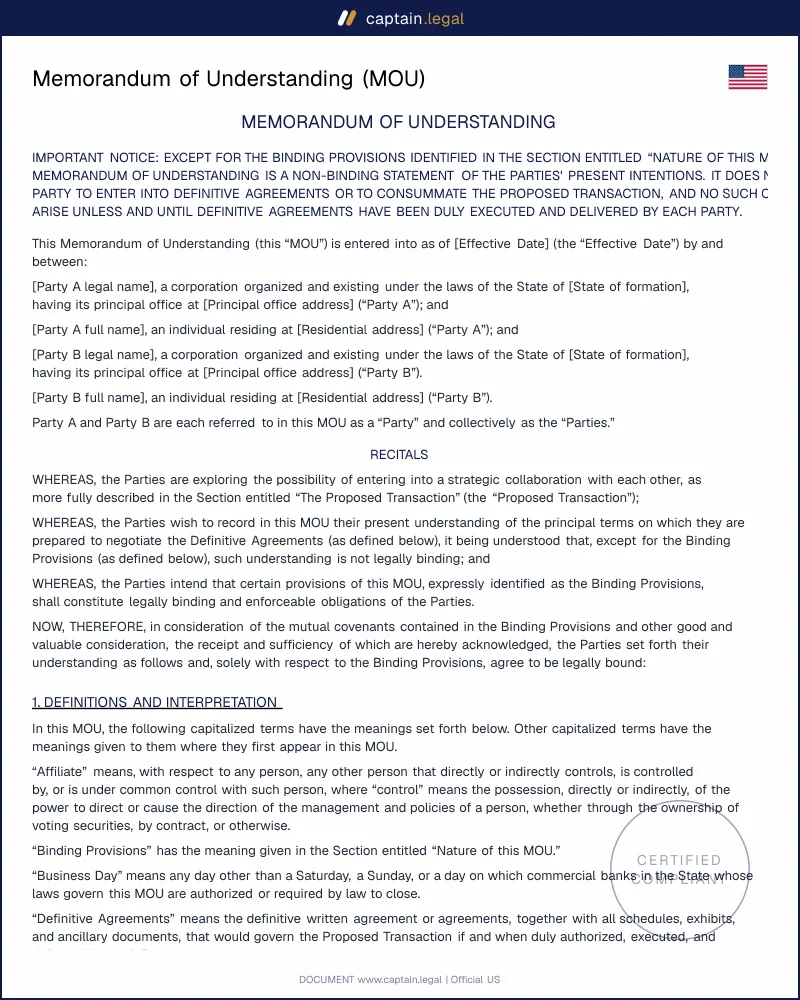
How to fill out this memorandum of understanding

You start by naming the parties exactly as they appear in their formation records, with each entity's state of organization and the title of the person signing. The form then asks for the purpose of the relationship in two or three sentences. Write it as you would explain the project to a new board member, because that paragraph frames how a court reads everything else. From there, you choose between a non-binding MOU with binding protective clauses (the default, right for most users) and a binding MOU where every material term is already settled.

Confidentiality is on by default. Exclusivity is optional, and if you activate it the form requires an end date rather than a duration, so nobody argues later about when the clock started. You then pick the governing state, and the template swaps in the matching statutory references, public records carve-out and damages language. The last screen covers termination notice and surviving provisions.

The document is ready for signature by hand or electronically. If the relationship later needs a founders' pact, a financing instrument or a services contract, our business contracts and incorporation documents follow the same drafting conventions.

Common mistakes to avoid

The error we see most often is a contradiction between the disclaimer and the body. The MOU states on its last page that it is non-binding, yet every paragraph above uses "shall," lists a price and a closing date, and leaves no open terms. Courts weigh the whole document, and one boilerplate sentence rarely outweighs ten pages of mandatory language. The second mistake is conduct: the parties sign a non-binding MOU, then hire staff for the project, share source code and announce the partnership publicly. Partial performance is one of the factors courts use to find that a "non-binding" MOU was binding all along.

Exclusivity written as "for a reasonable period" causes the third category of disputes, because nobody can tell when the restriction ended. Fourth, confidentiality obligations are often drafted to expire with the MOU, so the protection disappears exactly when talks fail and the risk of misuse peaks. A fifth error is signing a non-binding memorandum of understanding and assuming it cannot be breached, when its binding provisions carry full contractual weight. Finally, many MOUs are signed by a business development manager with no authority to bind the company, or circulated only as unsigned email drafts. Check signature authority before anyone signs, and make sure both sides execute the final version.

Key takeaways

Binding intent

The label does not control enforceability

Calling the document an MOU does not make it nonbinding. Courts read the full text and the parties' conduct after signature to decide what can be enforced. A hybrid approach is often safest: commercial terms can remain aspirational, while confidentiality, exclusivity, and governing law obligations bind immediately.

Court test

Type I and Type II mean different duties

Under Restatement Section 27 and the Tribune framework, a Type I agreement can bind the parties to the deal itself when all material terms are settled. A Type II agreement is narrower: it requires good-faith negotiation of open terms, without forcing anyone to close. Clear reservation language carries heavy weight.

Formalities

Signature rules are light, but not absent

Private MOUs are governed by state common law, not a single federal MOU statute. No notarization, witness, or filing is generally required, but the statute of frauds can require a signed writing when obligations cannot be performed within one year. Electronic signatures can work under the E-SIGN Act, 15 U.S.C. Section 7001.

Frequently Asked Questions

It depends on the words used and on what the parties do afterwards. An MOU that settles every material term and shows intent to be bound can be enforced as a contract. An MOU that expressly states it is non-binding and leaves material terms open is usually treated as a statement of intent. Our template is a hybrid: the commercial sections are non-binding, while confidentiality, exclusivity, expense allocation, governing law and termination bind the parties from signature, following the Tribune framework.

Most MOUs run for a fixed term, typically 60 days to 12 months, or until the definitive agreement is signed, whichever comes first. Our template lets you set the expiration date and a written notice period for early termination. Confidentiality usually survives for two to five years after termination. If obligations cannot be performed within one year, the statute of frauds requires a signed writing, so keep the executed copy with your corporate records.

Yes. The federal E-SIGN Act and state electronic signature laws give electronic signatures the same effect as handwritten ones for commercial documents. Any reputable e-signature platform works, provided each signatory is identified and the platform keeps an audit trail of who signed and when. The one precaution is authority: the person clicking "sign" must be able to bind the organization, which usually means an officer for a corporation and a manager or authorized member for an LLC.

For a standard partnership, collaboration or pre-negotiation MOU, the template covers the provisions courts examine first, and many businesses sign it without outside review. Review becomes worthwhile when the parties are competitors, when a public agency is involved, when exclusivity runs long, or when one side invests heavily in reliance on the MOU.

You receive an editable Word file and a clean PDF. The Word version lets you exchange redlines with the other party without retyping, while the PDF is the version to circulate for signature and archive. If your project also calls for a services contract or a funding document, you can generate it from the full catalog of US legal templates with the same account.

Yes, and it is among the most common binding provisions in an otherwise non-binding MOU. The clause must be designated as binding, describe the prohibited conduct (soliciting, negotiating or accepting a competing offer) and end on a fixed calendar date. Florida courts in particular refuse to enforce vague negotiation duties, so precision is what makes the clause hold.

4.6/5

31 verified reviews · 50 000+ downloads

MOU Template | Tribune Type I & II Binding Intent Rules
  • Immediate access to the document
  • PDF + Word download
  • Compliant with 2026 legislation
  • Reviewed by lawyers
Fill in the template
Secure payment
Updated on September 27, 2026

You might also like

Settlement Agreement & Mutual Release Template
Joint Venture Agreement Template