Business

Settlement Agreement & Mutual Release | Cal. Civ. Code 1542

Settlement and mutual release drafted to Cal. Civ. Code 1542, Fed. R. Evid. 408 and CCP 664.6. Clauses for California, New York, Texas, Florida. Word & PDF.
4.7/518 reviews50 000+ downloadsInstant download
Share

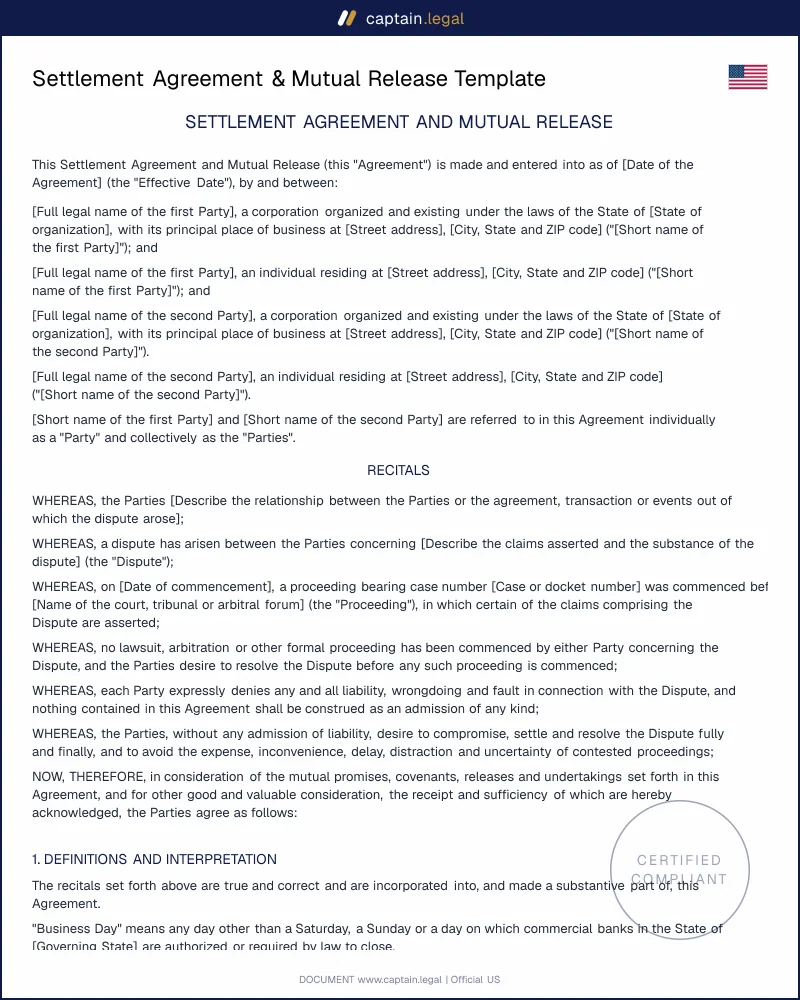
A settlement agreement and mutual release is the contract that closes a business dispute for good: one side pays or performs, both sides give up their claims, and the matter never reaches a courtroom. Vendors use it to collect an aging invoice at a discount. Departing partners use it to walk away clean. The document does two jobs at once, trading consideration for a general release of claims, and it holds up because every state enforces the compromise of a disputed claim as a binding contract. Our template is drafted for commercial disputes in all 50 states, with the Cal. Civ. Code §1542 waiver, confidentiality, non-disparagement and no-admission language opposing counsel expects to see.

Compliant

2026 Legislation

50,000+ clients

trust us

Affordable

From $4.90 / doc

Secure payment

Instant download

Settlement Agreement & Mutual Release | Cal. Civ. Code 1542

Secure payment

Fill in the template

What is a settlement agreement and mutual release?

A settlement agreement and mutual release is a private contract in which two or more parties end a dispute by exchanging something of value for a waiver of claims running in both directions. The word mutual carries real weight. A one-way release protects only the party writing the check, leaving it exposed to the very counterclaim it thought it had bought off. In a construction payment fight where the contractor wants money and the owner wants credit for defective work, the release has to run both ways.

Three neighboring documents get confused with it. A standalone release is usually one-way and carries no payment schedule and no default remedy, so it works for a simple write-off and little else. An accord and satisfaction under UCC §3-311 happens when a debtor sends a check marked "payment in full" and the creditor cashes it, which is cheap, fragile and limited to liquidated debts. A marital settlement agreement used in a divorce resolves property and support under family law and shares nothing with a commercial release beyond the name. If a lawsuit is already on file, the release alone will not close the case: you still need a stipulation of dismissal with prejudice.

2

When do you need this document?

The everyday trigger is a payment dispute that has stalled. An invoice sits 120 days past due, the client says the work was incomplete, and both sides can price a lawsuit well enough to prefer a discount. Once a demand letter for payment produces a counteroffer, the settlement agreement turns that phone call into an enforceable obligation with a payment date and a default remedy. The same pattern repeats in construction defect and supply contract disputes.

The second family of situations involves people leaving. A co-founder resigns and wants a clean break on equity and expense reimbursements. A member forces a buyout and the operating agreement is silent on valuation. A tenant abandons the premises owing arrears and the landlord prefers cash now to a judgment later. In each case the release is the point of the exercise, and the money is only its price.

Two edge cases deserve attention. If a releasing party is a Medicare beneficiary, the settlement can trigger reporting and conditional payment recovery under the Medicare Secondary Payer rules at 42 U.S.C. §1395y(b)(8), and ignoring that exposes the payer to double damages. If the other side has filed for bankruptcy, a settlement of estate claims takes effect only once the court approves it under Fed. R. Bankr. P. 9019. A signed agreement with a party in Chapter 11 that never goes to the judge is worth nothing.

3

Key clauses included in our template

  • The recitals and definition of the dispute identify the parties, the transaction and the claims asserted. Courts read release scope against the recitals, and a vague recital invites an argument that later claims were never covered.
  • The consideration and payment terms set the amount, schedule, method and default consequences. Installment deals include an acceleration clause and, in pending litigation, a stipulated judgment held in escrow so a missed payment becomes an enforceable judgment without a new suit.
  • The mutual general release waives known and unknown claims in both directions, extends to officers, members, insurers and successors, and carries an express Cal. Civ. Code §1542 waiver plus equivalent language for other unknown-claim statutes.
  • The carve-outs name what survives: obligations created by the agreement itself, ongoing contracts the parties intend to keep, and claims that cannot lawfully be waived.
  • The no-admission clause records that payment settles a disputed claim and admits no liability or wrongdoing, and states that the agreement is inadmissible under Fed. R. Evid. 408 and its state equivalents.
  • The confidentiality and non-disparagement provisions limit disclosure to accountants, lenders, tax authorities and counsel, and carve out compelled testimony. They borrow the permitted-disclosure structure of a mutual non-disclosure agreement rather than imposing a blanket gag.
  • The general provisions cover governing law and venue, entire agreement, severability, attorney fees to the prevailing party, counterparts and electronic signature under the E-SIGN Act, 15 U.S.C. §7001.
4

State-specific considerations

California takes the strictest line on unknown claims. Omit the §1542 waiver and a court may later allow a claim the releasing party did not know about at signature, defeating the purpose of buying peace. Where litigation is pending, the parties must ask the court to retain jurisdiction under Code Civ. Proc. §664.6 while the case is still open. Mediated settlements face a further wrinkle: under Evid. Code §1123, the agreement stays inadmissible unless it states that it is binding, enforceable or admissible.

New York enforces written releases without consideration under Gen. Oblig. Law §5-1103, an unusual rule that makes release scope drafting more important than elsewhere. In a settled damages action, CPLR 5003-a gives the settling defendant 21 days to pay after tender of the executed release and stipulation of discontinuance, or 90 days for a municipality, and an unpaid plaintiff can enter judgment without further notice. Releasing one of several tortfeasors does not discharge the others unless the release says so, under Gen. Oblig. Law §15-108.

Texas treats a mediated settlement as an enforceable written contract under Civ. Prac. & Rem. Code §154.071, and breach of the settlement itself is a four year action under Civ. Prac. & Rem. Code §16.004.

Florida voids confidentiality in one often overlooked case. Under the Sunshine in Litigation Act, Fla. Stat. §69.081, any part of an agreement whose purpose or effect is to conceal a public hazard is unenforceable, and news organizations have standing to challenge it. Never accept a confidentiality clause covering a product that has injured someone in Florida. Release of one tortfeasor also leaves the others exposed under Fla. Stat. §768.041.

5

How to fill out this settlement agreement

You start by naming the parties exactly as they appear on the contract or the court caption, entity type included, because a release signed by "Smith Construction" rather than Smith Construction LLC gives the other side room to argue later. The form then asks you to describe the dispute and to state whether a lawsuit is pending, which changes the closing mechanics: a pending case adds dismissal and jurisdiction language, a pre-suit deal does not need it.

Next comes the money. You choose a lump sum or an installment schedule, set the payment method and due dates, and decide whether a stipulated judgment secures the balance. The form then walks through release scope, asks whether officers, insurers and affiliates are included, and inserts the unknown-claim waiver where required. Confidentiality, non-disparagement and tax allocation are optional switches.

Governing law, venue and the signature blocks come last. Download in Word if you expect a redline, in PDF once terms are settled. Other agreements in the business contracts and incorporation documents catalogue follow the same drafting logic.

6

Common mistakes to avoid

The most expensive mistake is a release broader or narrower than the deal actually struck. Business owners routinely sign a general release of "all claims" while assuming their unpaid warranty claim survives, then discover the language wiped it out. The fix is a carve-out clause naming every relationship the parties intend to keep alive. Nearly as common is releasing the entity and forgetting its owners, officers and insurers, which lets a claimant sue the individual behind the company on the same facts.

Payment terms cause the second cluster of failures. An installment settlement with no acceleration clause and no stipulated judgment means a defaulting payer forces you into a brand new breach of contract suit, exactly what you were trying to avoid. Parties also skip the tax question, then argue months later over whether a Form 1099 should have issued and who owes it. Allocate the settlement amount among the claims in the agreement itself, not afterwards. Oral settlements reached at mediation and never signed fail routinely in California, Texas and New York for the form reasons above.

Key takeaways

Mutual release

Make the release run both ways

The word mutual is not window dressing. A one-way release can protect only the party paying, while leaving that party exposed to counterclaims the other side still holds. In a typical construction dispute, the contractor wants payment and the owner wants credits for defective work. The settlement should trade consideration for a general release in both directions so the dispute actually ends.

Unknown claims

California needs a Section 1542 waiver

In California, a broad release does not automatically cover claims you do not know or suspect at signing. Cal. Civ. Code 1542 says those unknown claims stay alive if they would have changed the deal, which is why agreements regularly include an express 1542 waiver that quotes the statute. Without it, a party can sign, take the money, and still assert later-discovered claims.

Pending lawsuit

A release alone will not close the case

If a lawsuit is already on file, signing a release does not, by itself, end the court action. You typically still need a stipulation of dismissal with prejudice, and enforcement rules get strict once litigation is pending. California ties quick enforcement to Code Civ. Proc. 664.6, which generally requires party signatures or an in-court recitation. Other states impose similar written, signed formalities.

Frequently Asked Questions

Yes, once both parties sign and the consideration is exchanged. A settlement agreement is an ordinary contract, so it binds as soon as offer, acceptance, capacity and consideration are present, and the compromise of a disputed claim satisfies consideration on its own. The template carries the recitals, release scope, governing law and signature formalities courts look for when deciding whether the parties intended to be bound. If a lawsuit is pending, you still need a stipulation of dismissal.

An editable Word file and a ready to sign PDF. The Word version matters more than people expect in settlement work, because opposing counsel almost always returns a redline on release scope and confidentiality carve-outs. The PDF is what you circulate for execution and keep once terms are final. Both carry the same clause set and state language you selected. Related contracts sit in the full catalogue of US legal document templates.

Whatever the agreement says, which is why the payment date belongs in the document rather than in an email. Commercial settlements commonly run 10 to 30 days from execution for a lump sum, with installment deals stretched over 6 to 24 months. New York adds a backstop in settled damages actions: CPLR 5003-a requires payment within 21 days of tender of the executed release and stipulation of discontinuance.

In most commercial disputes, yes. Confidentiality is a negotiated term, and the template lets you restrict disclosure while carving out accountants, tax authorities, lenders, counsel and anything compelled by subpoena. Two limits apply. Florida's Sunshine in Litigation Act voids any clause concealing a public hazard, so product defect settlements there cannot be sealed by contract. In sexual harassment or assault disputes, the Speak Out Act at 42 U.S.C. §19403 makes pre-dispute confidentiality clauses unenforceable.

Usually. Payments made in the course of a trade or business generally require a Form 1099-MISC to the recipient, and gross proceeds paid to a claimant's attorney are separately reportable under IRC §6045(f). Only damages for personal physical injury are excluded from income under IRC §104(a)(2), which almost never applies to a commercial dispute. Allocate the amount among the claims inside the agreement, because an allocation agreed at signature is far more defensible than one invented at tax time.

Not on its own. Employment claims carry their own statutory overlay: age discrimination waivers require the consideration and revocation periods set by 29 U.S.C. §626(f), unpaid wage claims under the FLSA generally need agency or court approval, and non-disparagement terms interact with federal labor law. This settlement agreement and mutual release is built for disputes between businesses, contractors and partners. For a departure package, use an employment-specific release.

4.7/5

18 verified reviews · 50 000+ downloads

Settlement Agreement & Mutual Release | Cal. Civ. Code 1542
  • Immediate access to the document
  • PDF + Word download
  • Compliant with 2026 legislation
  • Reviewed by lawyers
Fill in the template
Secure payment
Updated on September 4, 2026

You might also like

Post-Money SAFE Template (YC-Style)
Non-Compete Agreement