Business

Letter of Intent for Business Acquisition | 16 CFR 803.5

Letter of intent for business acquisition drafted to the Tribune Type I and Type II rules, SIGA v. PharmAthene and the 16 C.F.R. 803.5 HSR affidavit.
4.6/514 reviews50 000+ downloadsInstant download
Share

A letter of intent for business acquisition is the short preliminary document a buyer signs before spending real money on due diligence. It fixes the headline terms, price, structure, escrow and closing timeline, while making clear that almost none of it binds anyone until a definitive purchase agreement is executed. The exceptions are what give the paper its teeth: exclusivity, confidentiality and expense allocation bind on signature. Buyers, sellers, brokers and lenders treat this document as the first real milestone in a transaction. Our template is built for privately held US targets of every size, from a competitor buyout to a search fund acquiring a family business.

Compliant

2026 Legislation

50,000+ clients

trust us

Affordable

From $4.90 / doc

Secure payment

Instant download

Letter of Intent for Business Acquisition | 16 CFR 803.5

Secure payment

Fill in the template

What is a letter of intent for business acquisition?

An LOI, sometimes called a term sheet or an agreement in principle, is a written summary of the commercial terms both sides have accepted in outline, signed before counsel starts drafting. In a company sale it runs two to five pages and covers price, structure, excluded assets, the seller's role after closing and the conditions the buyer will insist on before funding. Everything economic in it is expressly non-binding. What binds is the scaffolding wrapped around those terms.

The gap between an LOI and a definitive agreement is wider than most first-time buyers expect. A purchase agreement transfers title, allocates risk through representations and warranties, and survives closing through indemnity and escrow. A letter of intent does none of that. It buys alignment, and it buys the buyer a window of exclusivity in which to pay accountants and lawyers without a rival bidder appearing late. The caption on page one carries no legal weight. Courts read the operative language, not the title. Once the terms survive diligence, our definitive business purchase agreement for asset and stock deals picks up where the LOI stops.

2

When do you need this document?

The most common trigger is a lender. Banks and SBA 7(a) participating lenders will not open an underwriting file on a change of ownership loan without a signed letter of intent showing price, structure and sources of funds. The second is competitive tension: when a seller is running even an informal process with two or three interested parties, a buyer about to commit diligence spend needs a no-shop covenant with a defined end date. Price discipline is the third, since a number on paper exposes a valuation gap before either side pays for a quality of earnings report.

Sellers use it defensively. A founder who has spent six weeks answering questions from a buyer who never intended to close will insist on a letter of intent for business acquisition before releasing customer contracts, payroll files or supplier pricing. Two edge cases matter. Where the target is an LLC with transfer restrictions in its operating agreement, condition the deal on member consent from the outset, and expect the eventual paper to be a membership interest purchase agreement drafted to state LLC acts rather than a stock purchase. The second is a regulated target, where licence transfer or franchisor approval adds months. Set the outside date after confirming the longest approval timeline.

3

Key clauses included in our template

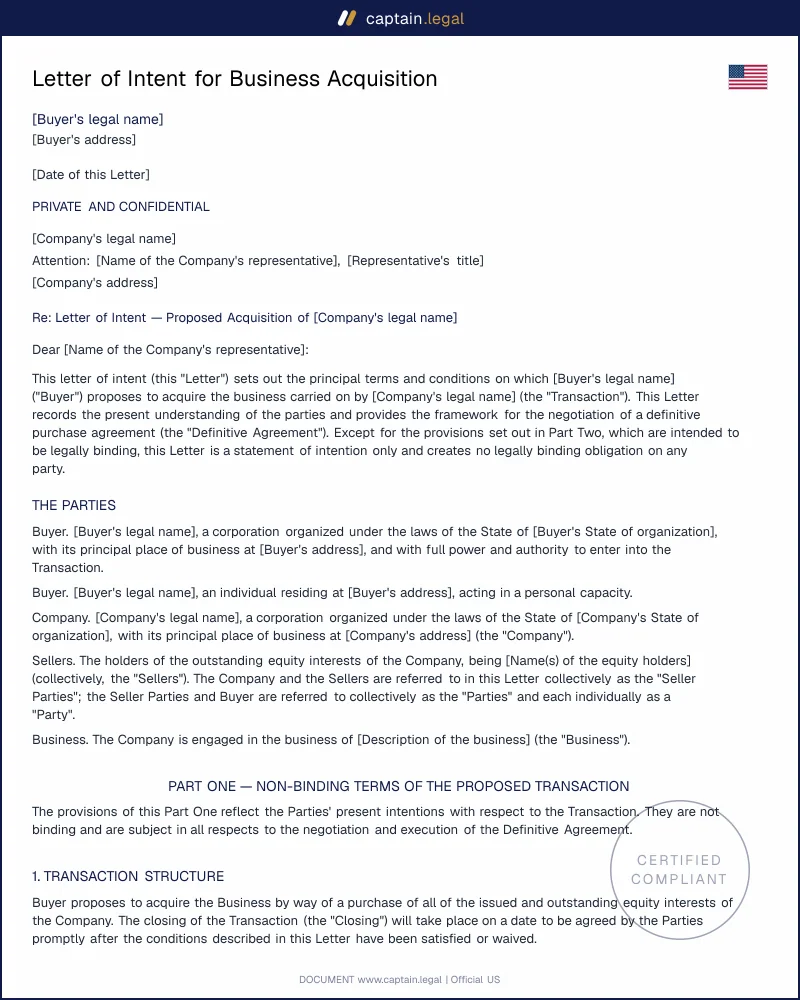
  • The binding and non-binding designation sits in its own numbered section rather than buried in a closing paragraph. It names the paragraphs taking effect on signature and states that every other provision creates no obligation until a definitive agreement is signed and delivered. This is the clause Empro turned on.
  • The purchase price and consideration mix sets out enterprise value, cash payable at closing, any seller note, earnout or rollover equity, and whether the figure assumes a cash free and debt free balance sheet with a normalised working capital target. Ambiguity here produces retrades three weeks before closing.
  • The exclusivity and no-shop covenant binds immediately and stops the seller soliciting or continuing discussions with any other prospective acquirer for a stated period. It adds a notice obligation if an unsolicited approach arrives, plus an automatic extension where the seller causes the delay.
  • The confidentiality and employee non-solicitation provisions carry the DTSA immunity notice and a standstill on hiring the target's staff during and after exclusivity, which protects the seller if the deal collapses.
  • The treatment of restrictive covenants flags that the seller and key managers will sign covenants at closing, sized to what the governing state permits on a sale of goodwill. Scope is negotiated later in the seller non-compete and non-solicitation agreement built for all fifty states.
  • The expense allocation and termination language confirms that each side bears its own advisory costs, addresses any break fee or diligence deposit, and gives either party a clean exit at the outside date.
4

State-specific considerations

Delaware is the default governing law for entity level deals, and its courts enforce good faith negotiation duties more aggressively than most. SIGA remains the cautionary tale for anyone tempted to reopen agreed economics after signature. Where the target is a Delaware corporation and the structure is an asset sale, condition closing on stockholder approval under 8 Del. C. 271, since a sale of substantially all assets is not a board only decision.

New York applies the Tribune analysis directly and has grown less predictable on remedies. In Cresco Labs New York v. Fiorello Pharmaceuticals, 178 N.Y.S.3d 425 (Sup. Ct. 2022), the court awarded expectation damages for breach of a preliminary agreement, unsettling the assumption that Type II exposure stops at out of pocket loss. Buyers using an intermediary should also note New York General Obligations Law 5-701(a)(10), which puts finder fees inside the statute of frauds.

California is friendlier to a party that wants out, since Copeland caps damages at reliance expenditure. Two local points belong in the letter itself. Seller covenants survive only through the goodwill exception in Business and Professions Code 16601, and California still runs a bulk sales notice regime under Division 6 of the California Commercial Code, which affects timing on asset deals carrying inventory.

Texas produced the most expensive preliminary agreement dispute in American corporate history in Texaco, Inc. v. Pennzoil Co., 729 S.W.2d 768 (Tex. App. 1987), where an agreement in principle supported a tortious interference verdict against a rival bidder who broke it up. A Texas seller who signs an LOI and then accepts a competing offer exposes both itself and the new buyer. Covenants signed at closing must be ancillary to an otherwise enforceable agreement under Texas Business and Commerce Code 15.50.

Florida codifies restrictive covenants in Florida Statutes 542.335, which presumes reasonable any restraint of three years or less against the seller of business assets and presumes unreasonable anything beyond seven years.

5

How to fill out this letter of intent

You begin by selecting the acquisition structure, because the form branches immediately. An asset purchase produces schedules for excluded liabilities and assumed contracts; a stock or membership interest purchase produces consent and capitalisation language instead. Next come the parties, entered under exact registered names and state of formation rather than trade names, since a mismatch here is the defect brokers see most.

The economic section asks for enterprise value, the deposit if any, the share payable in cash at closing, and whether an earnout or seller financing applies. Choosing an earnout opens fields for the measurement period and accounting basis. You then set the exclusivity period in days, the diligence deadline and the target closing date, and the form checks they run in sequence.

The governing law selector adjusts the covenant language and venue clause to the state you pick. A final screen lets you mark each section binding or non-binding, with sensible defaults applied. You download the result in editable Word and signature ready PDF, attach any schedules, and send it the same day.

6

Common mistakes to avoid

The costliest error is silence on binding effect. A letter that lists terms, says nothing about enforceability and closes with a signature block invites a court to settle the question for you, and Tribune shows how a party loses that argument while believing the deal was still a discussion. Almost as damaging is exclusivity without an end date, or with one running past the buyer's financing commitment. Sellers who grant open ended no-shop periods have handed over control of their own process.

Buyers routinely understate the price mechanics. A single number with no reference to working capital, debt or transaction expenses guarantees a renegotiation once the quality of earnings report lands. The other recurring failure is ignoring third party consents. Leases and major customer contracts often carry change of control provisions, and a landlord who refuses can stall a closing for weeks, which is why the commercial lease terms governing assignment and landlord consent should be pulled and read while the letter is still being drafted. Without an expense clause, each side argues about advisory fees at the worst possible moment.

Key takeaways

Binding terms

Most deal points are nonbinding here

An acquisition LOI is mainly a roadmap: price, structure, escrow, and timing are usually stated as expressly nonbinding until a definitive purchase agreement is signed. What can bind right away is the deal scaffolding, especially exclusivity, confidentiality, and who pays expenses. Also, the label on page one does not control; courts look to the operative language, not the caption.

Court risk

Drafting can create real obligations

Enforceability turns on state contract law and how your LOI reads. Under the Tribune framework, a Type I preliminary agreement can bind immediately, while a Type II can still require good-faith negotiation. Delaware showed the upside-down risk in SIGA v. PharmAthene: bad-faith negotiating after a signed term sheet can trigger expectation damages, not just reimbursement of costs.

Regulatory overlay

An LOI can trigger HSR filings

A signed LOI can be more than deal etiquette: it may satisfy the document requirement for premerger notification under the HSR affidavit rule, 16 C.F.R. 803.5, which accepts a contract, agreement in principle, or letter of intent. Separately, your confidentiality language should include the Defend Trade Secrets Act whistleblower immunity notice (18 U.S.C. 1833(b)), ideally paired with a standalone NDA before the data room opens.

Frequently Asked Questions

Partly, and that is deliberate. The commercial terms are drafted as non-binding statements of intent, so neither side can be forced to complete on those figures. Exclusivity, confidentiality, employee non-solicitation, expense and governing law paragraphs bind on signature and are enforceable like any other contract. Courts read the operative words rather than the heading, so the binding effect clause has to be explicit. Silence risks the letter being read as a Type II preliminary agreement carrying a good faith duty to negotiate.

Both. The editable Word file is the working version you send across, because acquisition letters always go through a round of markup on price mechanics or exclusivity length. The PDF is the clean signature copy. Each carries schedule placeholders for excluded assets and assumed contracts, and nothing is locked, so counsel can add a financing condition without rebuilding it. For the rest of the paperwork, the complete catalogue of US legal document templates covers definitive agreements and closing certificates.

Thirty to sixty days is the working range for a lower middle market deal, and ninety is common where third party financing, licence transfers or landlord consents are involved. Start the clock when the seller delivers a complete diligence package rather than at signature, otherwise a slow data room eats the buyer's window. Add an automatic extension of fifteen to thirty days where the delay is the seller's doing.

Not while the no-shop covenant is running, assuming it is drafted as binding. A properly written clause stops the seller soliciting or continuing discussions with any other prospective acquirer, requires existing conversations to end, and obliges the seller to report unsolicited approaches. Breach is actionable because that paragraph binds on signature. Texaco v. Pennzoil shows that a rival bidder who knowingly induces the breach faces tortious interference exposure of its own.

It can. Premerger notification under the Hart-Scott-Rodino regime requires documentation of the transaction, and the affidavit rule accepts an executed letter of intent alongside a contract or agreement in principle. Where the deal clears the size of transaction and size of person thresholds, which are adjusted annually, both parties file and observe the waiting period before closing. Signing does not itself create the obligation, but it often supplies the paperwork that starts the clock.

The template covers both, and you pick the structure at the start. An asset purchase needs language on excluded liabilities, assumed contracts and price allocation for tax purposes; an equity purchase needs consent, capitalisation and shareholder release language instead. Buyers prefer assets for the liability shield and the stepped up basis, sellers prefer equity for capital gain treatment, and the letter is where that argument gets settled.

4.6/5

14 verified reviews · 50 000+ downloads

Letter of Intent for Business Acquisition | 16 CFR 803.5
  • Immediate access to the document
  • PDF + Word download
  • Compliant with 2026 legislation
  • Reviewed by lawyers
Fill in the template
Secure payment
Updated on September 4, 2026

You might also like

Partnership Agreement Template
Software Development Agreement Template