Business

Software Development Agreement | 17 U.S.C. 101 Compliant

Lawyer-grade software development agreement drafted to 17 U.S.C. 204(a) assignment, DTSA notice and 11 U.S.C. 365(n) escrow. CA, NY, TX, FL, DE clauses.
4.8/59 reviews50 000+ downloadsInstant download
Share

A software development agreement is the contract a client and a development team sign before the first commit lands. It fixes the specification, the delivery milestones, the tests a build must pass before payment releases, and the ownership of everything produced along the way. Ownership is where American deals break, because 17 U.S.C. §101 does not list software among the categories of commissioned work that can be a work made for hire. Founders buying a first product version, agencies delivering client sites and counsel papering an outsourced platform all sign the same instrument. Without a written assignment signed by the author, code you paid for still belongs to the developer who wrote it.

Compliant

2026 Legislation

50,000+ clients

trust us

Affordable

From $4.90 / doc

Secure payment

Instant download

Software Development Agreement | 17 U.S.C. 101 Compliant

Secure payment

Fill in the template

What is a software development agreement?

A software development agreement is a services contract for the creation of custom code: a web application, a mobile app, an integration layer, an e-commerce build. The developer commits to a defined result described in a specification, the client to payment tied to milestones and a written acceptance procedure. It is not a software license, where a vendor keeps ownership of a finished product and grants permission to use it. It sits below a master services agreement with statement of work structure, which sets commercial terms across a relationship and pushes per-project scope into separate work orders.

The classification question underneath matters more than buyers expect. Courts apply the predominant purpose test to decide whether UCC Article 2 governs a mixed deal of goods and services, and custom development usually lands on the services side. So the warranty disclaimer formalities of §2-316 and the four year limitations period in §2-725 may or may not apply. A well drafted agreement settles the point by writing its own warranty, remedy and limitations terms rather than inheriting a default nobody chose.

2

When do you need a software development agreement?

The common trigger is a company commissioning a build it cannot staff internally: a marketplace, a customer portal, a payments integration, a website rebuild. Agencies on the other side need the document just as much, because a client who never signed an acceptance procedure can reject a delivery on taste rather than on specification. Startups outsourcing a first product version are the second group, for investor reasons. Chain of title gets tested during a seed round, and a missing signature from the contractor who wrote the authentication layer becomes a closing condition.

Two situations deserve a closer look. Staff augmentation drifts: a team hired to supplement in-house engineers starts producing standalone deliverables, and the paperwork still reads like a staffing order with no assignment clause. The other is location. Since the addition of IRC §174A, domestic research expenditure, which expressly includes software development costs, is deductible in the year incurred, while foreign research stays on the fifteen year schedule of §174. Where code is written is now a tax fact, and the contract should make the developer warrant it. Early technical work that predates the entity itself belongs in a co-founder agreement with vesting and IP assignment instead.

3

Key clauses included in our template

  • The statement of work and specification anchors everything else. It is an exhibit incorporated by reference with a stated order of precedence, so a sales deck cannot silently expand scope.
  • Milestones and payment triggers tie each release of funds to a named deliverable rather than to elapsed time. Fixed fee, time and materials and capped structures are supported, with retainage until final acceptance.
  • The acceptance testing clause sets objective criteria, a testing window and a cure cycle for rejected deliverables. A deemed acceptance rule stops a client who tests nothing and says nothing from freezing the project.
  • The intellectual property transfer combines a work made for hire designation with an unconditional present assignment, a moral rights waiver and a further assurances covenant that survives termination.
  • Background IP and developer tools are carved out and licensed back to the client on a perpetual, irrevocable, royalty free basis. Without that carve out, developers hide their reusable libraries or refuse to sign.
  • The open source clause requires disclosure of every third party component with its license, bars copyleft terms that would reach the deliverable without written consent, and provides a bill of materials at each milestone.
  • Source code escrow is an optional module with named release conditions and an express statement that it is an agreement supplementary to the license for the purposes of 11 U.S.C. §365(n).
  • Warranties, indemnity and liability stay separate: a conformity warranty, an infringement indemnity with defense control, and a liability cap carved out for confidentiality breach. Pre-contract talks belong in a mutual non-disclosure agreement for technical due diligence.
4

State-specific considerations

California sets a trap that surprises out of state buyers. Under Labor Code §3351.5(c) and Unemployment Insurance Code §686, an individual who signs an agreement expressly designating the deliverable as a work made for hire becomes a statutory employee of the commissioning party for workers compensation and unemployment insurance purposes. Companies engaging solo developers there either carry the coverage or rely on assignment language without the work for hire label. Add Business and Professions Code §16600 and §16600.5, voiding non-compete and broad non-solicit terms even in agreements signed elsewhere.

New York regulates the paperwork itself. Article 44-A of the General Business Law, the statewide Freelance Isn't Free Act, requires a written contract with any one person independent contractor above the statutory value threshold, aggregated across a 120 day period, listing services, rate and payment date. Payment falls due within 30 days of completion where the contract is silent, and the hiring party keeps a copy for six years. General Obligations Law §5-1401 lets larger deals choose New York law with no other connection to the state.

Texas links the contract language to sales tax. Under 34 Texas Administrative Code §3.308, contract programming is a non-taxable service only where the programmer transfers all rights, intellectual property included, in the program to the customer. A partial assignment or a broad developer retained license can convert the whole engagement into a taxable sale. Non-compete terms sit in Business and Commerce Code §15.50, and trade secret claims run under the Texas Uniform Trade Secrets Act at Civil Practice and Remedies Code chapter 134A.

Florida applies Statutes §542.335 to restrictive covenants, which demands a pleaded legitimate business interest and presumptively reasonable durations, with recent legislation moving further toward enforceability for senior personnel. Trade secrets sit in chapter 688. Delaware stays the default forum for venture backed clients, since 6 Delaware Code §2708 validates a Delaware governing law clause for qualifying commercial contracts and the Court of Chancery hears injunctive relief over source code quickly. Teams hiring employees rather than vendors should also read Washington RCW 49.44.140, which limits how far invention assignment reaches into personal projects.

5

How to fill out this software development agreement

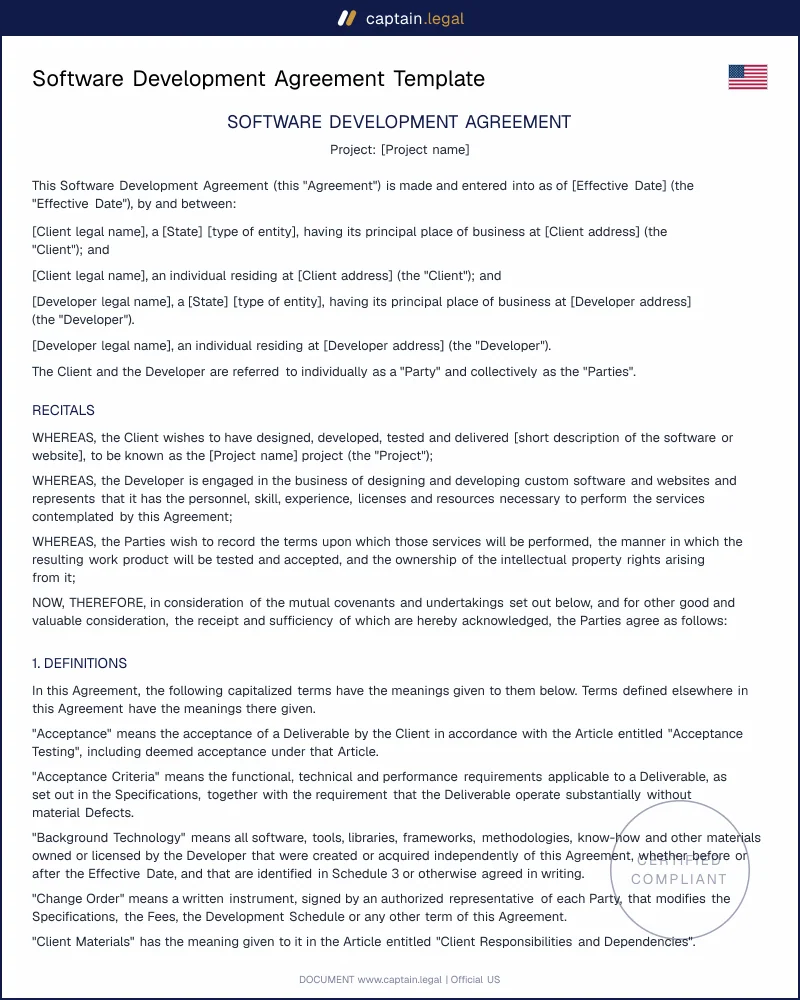
You start with the parties and the engagement model, since the questionnaire branches on whether the developer is an individual, a domestic company or an offshore vendor, and the classification, tax and signature blocks adjust to that answer. Next comes the specification: paste an existing scope document, or build one by describing deliverables, environments and the technology stack. The milestone builder converts those deliverables into payment events and asks for the acceptance window and the number of cure cycles you want before rejection turns into a termination right.

The intellectual property section asks whether the developer keeps background components and whether open source is permitted, then writes the assignment, license back and disclosure duties to match. Escrow, maintenance and support are optional modules. You then select governing law from the state list, which adjusts the restrictive covenant, classification and tax clauses. The agreement downloads in editable Word and signature ready PDF, exhibits numbered and cross referenced. Store the signed copy with your US business contracts and incorporation documents.

6

Common mistakes to avoid

The costliest mistake is relying on a work made for hire clause alone. The second is signing the assignment after delivery rather than before work starts, because a developer who has already been paid has no incentive to sign and one who has disappeared cannot sign at all. Payment structures cause the next tier of problems: milestones defined by date rather than by deliverable turn every schedule slip into an argument about whether money is owed, and a final payment with no retainage removes the only leverage that survives go live. Acceptance criteria written as adjectives fail too, since nobody can litigate whether a build is intuitive.

Open source is the quiet one. A single copyleft library pulled in during a sprint can, depending on how it is linked and distributed, put obligations on the whole deliverable, and the problem surfaces during an acquisition rather than during the build. Ask for a component bill of materials at every milestone, not at the end. Confidentiality clauses drafted without the §1833(b) notice quietly forfeit exemplary damages. Directing a long term contractor's hours, tools and priorities invites a reclassification assessment that no clause labeled independent contractor status will cure. Where the same people are effectively in-house, a confidentiality and invention assignment agreement for employees is the correct instrument.

Key takeaways

OWNERSHIP

Paid-for code can still be theirs

Custom software is not one of the nine commissioned categories that can qualify as a work made for hire under 17 U.S.C. 101. So a bare work-for-hire clause with an outside developer often does not transfer copyright. If you want to own the source code, you need a written assignment signed by the author that satisfies 17 U.S.C. 204(a) (e-signatures can work under the E-Sign Act).

DEAL STRUCTURE

Lock scope, milestones, tests, and acceptance

This agreement is a services deal for building custom code, not a software license where a vendor keeps ownership and just grants permission to use. The practical backbone is the spec plus delivery milestones, objective tests, and a written acceptance procedure that controls when payment is released. If those gates are vague, the project drifts, disputes rise, and you can end up paying while still arguing about whether the build is done.

LEGAL LANDMINES

Defaults and IP rules can surprise you

Mixed goods-and-services contracts can trigger UCC Article 2 depending on the predominant purpose test, which affects issues like warranty disclaimer rules under 2-316 and a four-year limitations period under 2-725. A well-drafted development agreement avoids inheriting defaults by setting its own warranty, remedies, and limitations terms. It also covers trade secrets and patents: DTSA immunity notice belongs in the confidentiality clause, and “hereby assigns” language avoids the “agrees to assign” trap.

Frequently Asked Questions

Yes. It is drafted to the contract requirements applied in every state: offer, acceptance, consideration and terms definite enough to enforce. The intellectual property transfer satisfies 17 U.S.C. §204(a), the formality most homemade agreements miss, and the signature blocks work for wet ink or electronic execution. Enforceability still depends on accurate completion, so the specification exhibit and the governing law selection matter. For a build with unusual regulatory exposure, have counsel review the warranty and indemnity sections first.

Usually not by itself. Custom software falls outside the nine categories of specially commissioned works listed in 17 U.S.C. §101, so the clause operates only where the developer is a genuine employee under the Reid factors, or where the deliverable fits a listed category such as a contribution to a collective work. The template therefore pairs the designation with an unconditional present assignment: if a court finds no work made for hire, the assignment carries the transfer rather than leaving you with an implied license.

An editable Microsoft Word file and a signature ready PDF are generated at the end of the questionnaire. The Word version keeps the exhibit structure, numbered clauses and cross references intact, so your counsel or your counterparty can redline it without rebuilding the document. Most negotiations touch the same three places: the liability cap, the acceptance window and the background IP carve out. Related contracts sit in the catalog of US legal document templates.

Thirty days is the market standard for a substantial deliverable, with 10 to 15 days for smaller iterative releases. The mechanics matter more than the number. The client tests against written criteria inside a defined window, the developer gets a cure period, and the contract says what happens on a second failure, normally one further cure cycle then a termination and refund right. Deemed acceptance protects the developer from silent rejection, and warranty coverage runs from acceptance, typically for 90 days.

It depends on who holds the running code after launch. If the developer also hosts and maintains the system, escrow earns its overhead, because 11 U.S.C. §365(n) lets you keep licensed rights when a vendor files for bankruptcy but will not produce source code you never received. Where the client owns the repository and receives every commit, escrow adds little. The template treats it as an optional module with named release conditions: insolvency, abandonment and failure to maintain within agreed service levels.

Disclosure is the answer. The agreement requires a list of every third party component and its license at each milestone, bars any license that would impose source disclosure duties on the deliverable without your written consent, and puts a warranty behind that list. Permissive terms such as MIT, BSD and Apache 2.0 rarely cause difficulty. Strong copyleft can, depending on how the component is linked and whether the software is distributed, and a prohibited component found later carries a remediation duty.

4.8/5

9 verified reviews · 50 000+ downloads

Software Development Agreement | 17 U.S.C. 101 Compliant
  • Immediate access to the document
  • PDF + Word download
  • Compliant with 2026 legislation
  • Reviewed by lawyers
Fill in the template
Secure payment
Updated on September 3, 2026

You might also like

Joint Venture Agreement Template
Corporate Bylaws Template