Business

Personal Guaranty Agreement | Cal. Civ. Code 2856 Ready

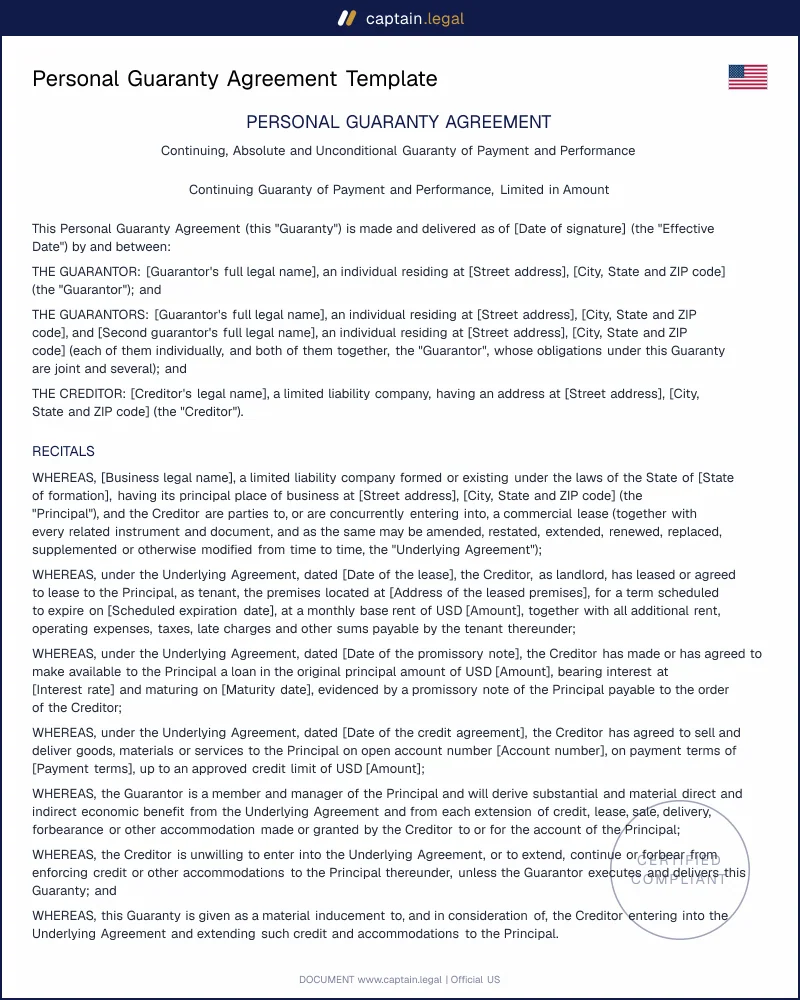
Personal guaranty agreement drafted to Cal. Civ. Code 2856 waivers, Tex. Prop. Code 51.003 offset and Regulation B spousal rules. All 50 states, Word and PDF.
4.5/518 reviews50 000+ downloadsInstant download
Share

A personal guaranty agreement is what a landlord, a lender or a supplier asks for when the company on the other side of the deal has thin credit and few assets worth chasing. The owner signs in an individual capacity and promises to cover the obligation if the business does not. One signature moves the risk off a balance sheet and onto a household, which is why the drafting details matter more here than in almost any other commercial form. This template covers unconditional and limited guaranties, the statute of frauds writing requirement, the suretyship waivers courts enforce, and the spousal signature rules under Regulation B.

Compliant

2026 Legislation

50,000+ clients

trust us

Affordable

From $4.90 / doc

Secure payment

Instant download

Personal Guaranty Agreement | Cal. Civ. Code 2856 Ready

Secure payment

Fill in the template

What is a personal guaranty agreement?

A guaranty is a promise to answer for the debt of another party. The principal obligor is the business, the creditor is the bank, landlord or supplier, and the guarantor is the individual who pays when the company stops. The instrument stands separate from the underlying note or lease even when both are signed the same afternoon, and New York courts treat an absolute guaranty as an independent agreement imposing direct payment obligations.

The distinction that decides most litigation separates a guaranty of payment from a guaranty of collection. A guaranty of payment is enforceable the moment the business defaults, with no requirement that the creditor sue the company, foreclose on collateral or exhaust any remedy first. A guaranty of collection obliges the creditor to pursue the principal to judgment first. Commercial forms are almost always guaranties of payment, and absolute and unconditional is the shorthand that gets there.

A personal guaranty agreement is also not co-signing. A co-borrower is liable on the underlying instrument, while a guarantor is liable on a separate collateral promise, which is why suretyship defenses exist for guarantors and not for co-makers. California is the outlier: Civil Code §2787 abolished the distinction between sureties and guarantors, so a California signer gets surety treatment by statute.

2

When do you need this document?

Commercial landlords ask for one first. A newly formed operating entity has no rent history, so the lease closes only if a principal backs it, often through the New York style good guy guaranty capping exposure at rent accrued up to the day the tenant hands back vacant possession. That structure belongs in the lease file next to the commercial lease agreement template, not bolted on afterwards. Banks are the second trigger. Any small business term loan, line of credit or SBA backed facility requires owners with a meaningful equity stake to guarantee the debt, and the bank form arrives unconditional and continuing unless someone pushes back.

Trade credit is the quiet third category. A supplier extending a net thirty account to a young company routinely conditions it on a guaranty, which is why the document and the vendor agreement template travel together in the same onboarding packet.

Two edge cases justify a careful read. When a business is sold and the lease assigned, the outgoing owner stays on the original guaranty unless the landlord signs a written release, so sellers regularly find they still guarantee a tenant they no longer control. In community property states, one spouse's guaranty can reach community assets even where the other never signed.

3

Key clauses included in our template

  • The scope of the guaranteed obligations is drawn narrowly around one identified note or broadly as a continuing guaranty covering future advances. California defines the continuing form at Civil Code §2814 and lets the guarantor revoke it as to future transactions at §2815, so that option comes paired with a written revocation mechanic.
  • The liability cap converts an unlimited guaranty into a limited one, expressed as a stated maximum, a percentage of the outstanding balance or a pro rata share among several owners. The cap language says whether it absorbs accrued interest and collection costs, because silence there is litigated constantly.
  • The waiver of suretyship defenses is drafted to the statute rather than in generalities, with the §2856 language reproduced for California collateral and express references to each section surrendered. Vague waivers fail; itemized ones hold.
  • The absolute and unconditional payment covenant makes the guaranty enforceable on the business default alone, without prior suit against the company, and it survives amendment, renewal or extension of the underlying debt.
  • The spousal acknowledgment block is optional and drafted so a spouse signs voluntarily to bind community property, never as a lender imposed condition, which keeps the transaction clear of Regulation B.
  • The subordination and subrogation provisions push the guarantor's reimbursement claim behind the creditor's until the guaranteed debt is paid, a term every institutional lender expects alongside its promissory note.
4

State-specific considerations

California gives the guarantor the most statutory protection and the most detailed way to give it up. Beyond Civil Code §2856, the sleeper issue is the sham guaranty defense: where the guarantor is in substance the borrower, for instance the sole member of a single purpose entity formed at the lender's request, courts have refused enforcement because it would let the lender evade the anti-deficiency statutes. Structure matters more than labels here.

Texas takes the opposite posture on waivers. In Moayedi v. Interstate 35/Chisam Road, L.P., the Texas Supreme Court held that the fair market value offset under Tex. Prop. Code §51.003 is an affirmative defense, and that a general waiver of every defense surrenders it. The guarantor there lost the benefit of a wide gap between the foreclosure bid and the appraised value. Lenders now add express Chapter 51 waivers, and a Texas signer who skips that clause has agreed to pay a deficiency the collateral would have covered.

New York enforces absolute and unconditional guaranties aggressively. Cooperatieve Centrale Raiffeisen-Boerenleenbank v. Navarro confirmed that such language forecloses defenses the guarantor might otherwise raise, including allegations touching the creditor's own conduct. New York also lets a creditor holding a guaranty of payment move for summary judgment in lieu of complaint under CPLR 3213, compressing a collection action into a motion. Tenants in the city negotiate good guy carve outs because of it.

Florida adds a constitutional twist. The guaranty is enforceable, but the judgment cannot be levied against the guarantor's homestead, protected from forced sale by Article X, Section 4 of the state constitution and subject to the usual acreage limits. Deficiency judgments after foreclosure are also discretionary under Fla. Stat. §702.06. A Florida guarantor is exposed in everything except the house, which is why lenders there ask for extra collateral or a spousal signature. A prenuptial agreement signed before the business existed can matter a great deal in that conversation.

5

How to fill out this personal guaranty agreement

You begin by naming the three parties precisely: the guarantor as an individual, the business as it appears on the secretary of state filing, and the creditor. A guaranty signed in a corporate capacity guarantees nothing, so the signature block carries no title. Next you identify the guaranteed obligation, by attaching the note, lease or credit application, or by describing it well enough that a court could match the two documents years later. The form then asks whether the guaranty is limited, and if so whether the cap covers interest and enforcement costs.

From there it adjusts to the governing state. California inserts the §2856 waiver and the Gradsky wording; Texas adds the express §51.003 offset waiver; New York adds the absolute and unconditional recital that supports the accelerated procedure. You then choose whether the guaranty is continuing and how notice of revocation must be delivered. The last screens cover joint and several liability, the spousal block, and notice addresses.

6

Common mistakes to avoid

The most expensive mistake is signing an unlimited continuing guaranty for a facility the signer believes is a one time loan. Continuing language survives repayment and attaches to every future advance, and unless the guarantor sends written revocation covering future transactions, the exposure follows the relationship for years. The second is failing to revoke on the way out. Owners who sell their stake or resign as officers assume the guaranty leaves with them, and it does not: only a written release changes anything. The third is the missing carve out for interest and legal fees in a limited guaranty, which turns a capped exposure into a far larger number after a year of default interest.

Two more surface in litigation. Signers add a title after their name and later argue they signed for the company, an argument that rarely works and looks evasive to a judge. And a spouse signs a bank form without asking whether the lender required the signature or merely accepted it, which matters because a required spousal guaranty is a regulatory violation while a volunteered one is enforceable. Ask which one it is, in writing, before signing.

Key takeaways

Personal exposure

Your personal assets back the business debt

A personal guaranty moves the risk from the company to you as an individual. If the business defaults, you can be on the hook even though you did not borrow in your own name. This is why the agreement is treated as separate from the lease or note, and why terms like absolute and unconditional are not just boilerplate.

Enforcement type

Payment guaranty can be collected immediately

The clause that drives most disputes is whether this is a guaranty of payment or a guaranty of collection. A guaranty of payment lets the creditor pursue you as soon as the company defaults, without first suing the business, foreclosing on collateral, or exhausting other remedies. Most commercial forms aim for that result by using absolute and unconditional language.

Compliance & waivers

Writing, waivers, and spouse rules matter

A guaranty generally must be in writing and signed by the guarantor under each state’s statute of frauds; an oral promise to cover a company debt is typically unenforceable. In California, Civil Code 2856 allows broad, itemized waivers of suretyship defenses, and courts tend to enforce the waiver language as written. Separately, Regulation B (12 C.F.R. 1002.7(d)) restricts when a spouse can be required to sign.

Frequently Asked Questions

Yes, provided it is written, signed by the guarantor and supported by consideration. All fifty states enforce written guaranties under a statute of frauds provision such as Fla. Stat. §725.01. What varies is which defenses the signer keeps: California limits waivers to the categories listed in Civil Code §2856, Texas enforces broad general waivers after Moayedi, and Florida shields the homestead from the resulting judgment. The document is valid everywhere; the recovery it produces is what shifts.

Yes, and you should try. A limited guaranty states a maximum exposure, a percentage of the outstanding obligation, or a pro rata share where several owners sign. Landlords in New York often accept a good guy structure capping liability at rent accruing until surrender, and lenders sometimes accept a burn down provision reducing the cap as principal is repaid. The point most signers forget is whether the cap absorbs accrued interest and collection costs.

Not as a condition of credit. Regulation B prohibits a creditor from requiring a spouse to guarantee a business obligation where the applicant qualifies alone, and asking anyway creates regulatory exposure for the lender. A spouse may sign voluntarily, and in community property states such as California and Texas that signature is what puts community assets behind the promise. Document which of the two it was before anyone signs.

A guaranty tied to one identified note ends when that note is paid. A continuing guaranty runs until revoked, and revocation reaches only future transactions, never obligations already incurred, a rule California states at Civil Code §2815. Revocation means written notice delivered exactly as the agreement specifies, usually certified mail to a named officer. Selling your shares or resigning does nothing on its own, and without a written release the obligation continues.

Under an absolute and unconditional guaranty of payment, immediately. No requirement exists to sue the company first or foreclose on collateral unless the agreement says so. In New York a creditor can move for summary judgment in lieu of complaint under CPLR 3213, producing a judgment in weeks rather than the year a full action takes. Limitations periods on written contracts run four to six years from default.

No, and that is the commercial point of the document. The corporate discharge extinguishes the company's debt, not the guarantor's separate promise, and creditors pursue guarantors precisely because the operating entity is in bankruptcy. The automatic stay protects the debtor, not third parties. A guarantor in that position has one real lever: settling while the creditor still values speed over the full amount.

You download the completed personal guaranty agreement in editable Word format and as a signature ready PDF. Word matters more here than with most contracts, because caps, revocation periods and spousal blocks get negotiated across two or three drafts. Notarization is not required unless the guaranty is recorded or secured by a mortgage. The rest of the paperwork sits in our catalogue of US legal documents.

4.5/5

18 verified reviews · 50 000+ downloads

Personal Guaranty Agreement | Cal. Civ. Code 2856 Ready
  • Immediate access to the document
  • PDF + Word download
  • Compliant with 2026 legislation
  • Reviewed by lawyers
Fill in the template
Secure payment
Updated on September 4, 2026

You might also like

Master Services Agreement Template
LLC Operating Agreement Template