Personal

Trustee Resignation Letter (US)

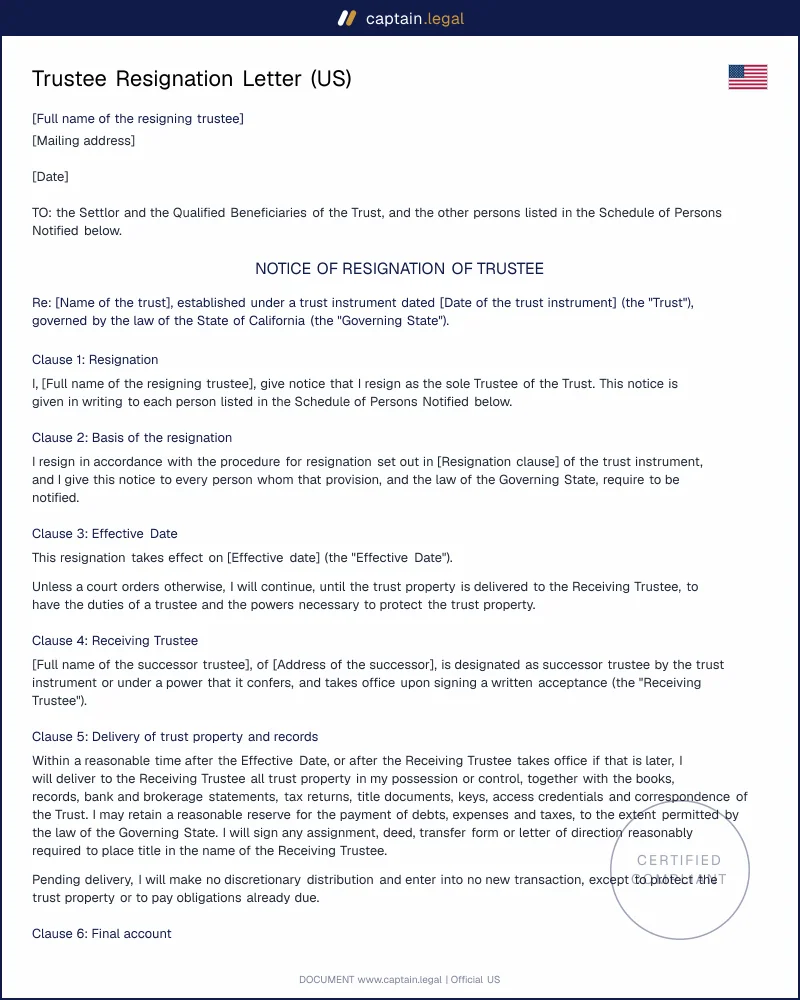
Notice of resignation of a trustee of a private trust, sent to the settlor if living, the cotrustees and the qualified beneficiaries: basis of the resignation, effective date, successor trustee, handover of property and records, final account and compensation.
4.6/5— 15 reviewsUS law 2026Instant download
Share

A trustee resignation letter is the written notice a trustee sends to step down from managing a private trust, usually a revocable living trust that became irrevocable when the settlor died, or a family trust set up for children. It goes to the people the law says must hear about it: the settlor if still living, every cotrustee, and the qualified beneficiaries. Done properly, the notice fixes an effective date, names who takes over, and explains how the trust property, records and final account will change hands. This template is written for family members and friends who agreed to serve as successor trustee and now need to hand the job to someone else.

Compliant

2026 Legislation

50,000+ clients

trust us

Affordable

From $4.90 / doc

Secure payment

Instant download

Trustee Resignation Letter (US)

Secure payment

Fill in the template

What is a trustee resignation letter?

A trustee resignation letter is a unilateral notice, not a contract. Nobody has to countersign it, although a signed receipt from each person notified is the best proof of the date the notice was given. In most American trusts, that means following the resignation clause of the trust agreement first, and the default rules of the State's trust code second. The letter records the three things a court would later ask about: the basis of the resignation, its effective date, and the person who received the trust property.

Neighboring documents are easy to confuse with it. A trust amendment changes the terms of the trust and can only be signed by a settlor who still holds the power to amend, which is the role of our living trust amendment form. And a director who leaves the board of a charity is not resigning from a private trust at all: that departure goes through the board's own minutes, such as a nonprofit board resolution, not through this letter.

When do you need this document?

The most frequent case is the reluctant successor. A parent dies, the living trust names the eldest child as successor trustee, and within a few months the job turns out to be bigger than expected: tax returns, a house to sell, siblings who disagree. The letter passes the baton to the next person named.

Distance and conflicts explain much of the rest. A cotrustee who moves abroad cannot sign checks or attend the closing, and the remaining cotrustee often prefers to act alone.

One edge case deserves attention. When the trust instrument is silent and the governing State has no 30-day route, a letter alone does not end the office. The trustee must ask a court to approve the resignation, and the notice informs the beneficiaries before the petition is filed; our template then makes the effective date the date of the court's order. Trusts that hold a house raise a second issue: the title company will want a clean chain of authority, often with a quitclaim deed into the new trustee's name, and a notarized resignation helps.

Key clauses included in our template

Every version identifies the Trust by name, date and governing State, then states who is resigning and in what capacity, sole trustee or one of several cotrustees. The notice is addressed to the settlor, the cotrustees and the qualified beneficiaries as your answers require, and a schedule at the end lists each person notified with an address.

  • Depending on the route you choose, the basis clause cites the resignation provision of the trust instrument, the 30-day statutory notice rule, or a future court petition.
  • An effective date is fixed, either on a date you pick or on the thirtieth day after the last person receives the notice.
  • Who takes over is spelled out: the remaining cotrustees, a named successor who signs an acceptance at the foot of the notice, or a successor still to be appointed.
  • Handover of property and records happens within a reasonable time, with a reasonable reserve where State law allows it and no discretionary distributions until delivery.
  • A final account is enclosed or promised within a set period, and compensation is either waived or claimed as the trust and State law allow.

A liability clause then confirms that the resignation releases no claim of the beneficiaries and waives none of the protections the trust instrument gives the trustee. Optional blocks add a short reason, a signed acknowledgment of receipt and a notarial acknowledgment.

State-specific considerations

Trustees in Florida have the most predictable path. The 30-day route works even when the trust instrument restricts resignation, so the risks are practical: send the notice by a method that proves receipt, because the 30 days run from delivery, and prepare the final account early.

A different logic applies in Texas. With no 30-day route, the resignation clause of the trust instrument decides everything, so read it closely for the notice period and the persons to notify. Where it is silent, a court petition is the only path, and the court may attach conditions to protect other interested persons.

Many other States sit closer to the Florida model because they adopted the UTC, but their versions differ on notice periods, on who must be notified and on whether the trust instrument can displace the 30-day route, and several States never adopted the UTC at all. Always start with the resignation clause of the trust instrument, then check the trust code of the State that governs the trust. If the two point in different directions, the court route is the safe choice.

How to fill out this trustee resignation letter

You begin with the trust itself: its exact name, the date the trust agreement was signed and the State whose law governs it. The next step asks for your name, your mailing address and whether you are the sole trustee or one of several cotrustees. That answer reshapes the letter, since a sole trustee needs a successor.

From there, the form asks whether the settlor is still living and who receives the notice, with role and address, in one box that becomes the schedule at the end. You then choose the basis of the resignation and, if you rely on the trust instrument, the article or section you are following. The last steps cover the successor, the final account, compensation, an optional reason, the signing date and the notarial block. The preview updates as you type, and like the other estate planning and personal documents in the catalog, the result is ready to print, sign and deliver.

Common mistakes to avoid

The first mistake is sending the letter to the wrong people. A trustee who notifies only the successor, and forgets the beneficiaries who receive distributions or would take if the trust ended, has not given the notice the statute requires, and the 30 days never start. The second is an effective date set too close: under the statutory route it must fall at least thirty days after the last person receives the notice, and the trust instrument may demand more. A third is walking away on the effective date: until the property is delivered, the duties remain.

Two further errors surface years later. Trustees often skip the final account because the family trusts them, then face a demand for one when bank records are harder to rebuild. Others assume that resignation wipes the slate clean; a trustee worried about past administration should ask for a written release or court approval of the account, which is a separate step. Finally, check that the original revocable living trust agreement was actually funded: property left in a deceased settlor's own name is not trust property and may need probate.

Key takeaways

THREE ROUTES

Resign under the trust, State law or a court

The letter follows the route that fits your trust: the resignation clause of the trust instrument, the thirty-day notice rule of States that adopted the Uniform Trust Code, such as Florida, or a court petition where neither applies, as in Texas when the instrument is silent. The basis, the effective date and the persons notified are stated, so beneficiaries and banks can see when your office ended.

HANDOVER

Property, records and the final account

Until the trust property reaches the next trustee, the resigning trustee keeps the duties needed to protect it. The template commits you to deliver the property, statements, tax returns, title documents and access credentials within a reasonable time, with a reasonable reserve for debts and taxes, and to provide a final account, either enclosed or sent within the period you choose.

PROOF

Receipts, acceptance and notarization

A schedule lists each person notified with an address, and an optional acknowledgment of receipt proves the date on which the thirty days started. When a successor is named, an acceptance block lets that person take office on the same document. A notarial acknowledgment, recommended when the trust holds real estate, gives title companies and banks the chain of authority they ask for.

Frequently Asked Questions

Yes, once it follows a route that the trust instrument or State law recognizes. A resignation made under the resignation clause of the trust agreement, or under a statutory rule such as the 30-day notice route of the Uniform Trust Code, takes effect without anyone's consent once notice has been given and the effective date arrives. In a State like Texas, where the instrument is silent and no statutory route exists, the letter alone is not enough and a court must approve the resignation. In every case, liability for past acts is untouched, and the trustee keeps protective duties until the trust property is delivered.

Under the Uniform Trust Code model, at least thirty days to the qualified beneficiaries, the settlor if living and all cotrustees. Florida applies that period in section 736.0705. The trust instrument may set a different period for its own resignation procedure, and in some States, such as Arizona, that period displaces the 30-day rule. Count the days from the date the last person actually receives the notice, which is why a signed receipt or certified mail matters. When the court route is used there is no fixed period: the resignation takes effect on the date of the order approving it.

Yes. Once you finish the questionnaire, the completed letter is available as an editable Word file and as a PDF. The Word file suits a lawyer who wants to adjust a clause; the PDF is the version most people print, sign and send. Both include the schedule of persons notified and, if you selected them, the successor's acceptance, the acknowledgment of receipt and the notarial block. Keep a signed copy with the trust records.

Neither the Uniform Trust Code model nor the Florida and Texas resignation statutes make notarization a condition of a valid resignation. In practice it is often requested. Title companies, banks and brokers want proof that the person now signing for the trust has authority, and a notarized resignation gives them that chain. If the trust holds real estate, notarize it. Many States prescribe their own acknowledgment wording, so the notary may attach the certificate form of his or her State in place of the generic one in the template.

Send it to the settlor if still living, to every cotrustee and to every qualified beneficiary, meaning each person currently eligible for distributions and each person who would take if the trust ended today. Add the successor trustee named in the instrument and anyone the resignation clause lists, such as a trust protector. For a beneficiary who is a minor, check the State's rules on who may receive notice on the minor's behalf, often a parent or guardian. Listing everyone in the schedule of the trustee resignation letter makes it easy to show later who was told and when, which settles most disputes about the effective date.

The trust does not end because its trustee resigns. The trust instrument usually says who may appoint a successor, often a majority of adult beneficiaries or a named protector, and the letter asks that person to act without delay. If the instrument provides nothing, State law fills the gap. In Florida, the qualified beneficiaries may appoint a successor by unanimous agreement, and the court appoints one otherwise (section 736.0704); in Texas, the court appoints a successor on the petition of an interested person (section 113.083). Meanwhile, the resigning trustee keeps the duties needed to protect the property until it is delivered. For the documents that follow, the full template catalog groups every trust and estate form in one place.

4.6/5

15 verified reviews · US law 2026

Trustee Resignation Letter (US)
  • Immediate access to the document
  • PDF + Word download
  • Compliant with 2026 legislation
  • Reviewed by lawyers
Fill in the template
Secure payment
Updated on November 16, 2026

You might also like

Revocation of Power of Attorney Template
Promissory Note Template