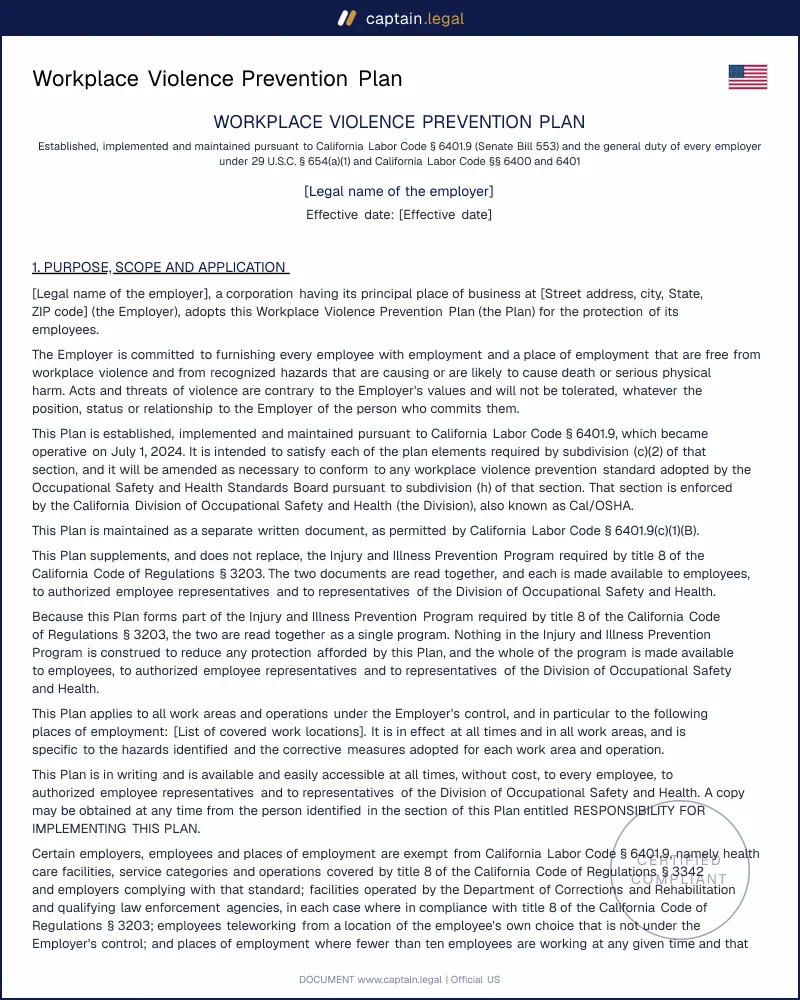
California Senate Bill 553 (Cortese) created Labor Code section 6401.9 and made it enforceable on July 1, 2024. The scope is wide: all employers, all employees, all places of employment, and employer-provided housing. The exceptions are narrow and frequently misread. They cover sites where fewer than 10 employees are present at any given time, that are not accessible to the public, and where the employer already complies with the IIPP regulation; teleworkers at a location of their own choosing; healthcare facilities under title 8, section 3342; and correctional and law enforcement facilities. Miss any one of the three conditions in the small-employer exception and the exception disappears. A ten-person office with a public reception desk is covered.
The statute enumerates what the plan must contain: responsible persons, active involvement of employees and their authorized representatives, coordination with other employers at shared worksites, compliance procedures for supervisory and nonsupervisory staff, communication and training, hazard identification and correction, incident response, reports accepted without retaliation, post-incident investigation, and review for effectiveness at least annually, whenever a deficiency becomes apparent, and after any incident. Subdivision (d) adds a violent incident log entry for every incident, drawn from employee accounts, witness statements, and investigation findings, with personal identifying information stripped out. Hazard records, logs, and investigation files are kept five years, training records one year. The Cal/OSHA overview of workplace violence prevention requirements in general industry is the authoritative reference on scope.
Outside California there is no federal standard, which is not the same as no exposure. Section 5(a)(1) of the Occupational Safety and Health Act, at 29 U.S.C. 654(a)(1), obliges every employer to furnish a workplace free of recognized hazards. In Secretary of Labor v. Integra Health Management, Inc., OSHRC Docket No. 13-1124, the Review Commission affirmed general duty citations against an employer whose field worker was killed by a client with a known violent history.