Create my document
Login

Choose country

United StatesUnited StatesChoose country
Employment

Resignation Letter Template | Labor Code §202 Ready (US)

US resignation letter drafted to state final-pay rules, from Cal. Labor Code 202 to the Texas Payday Law. Notice, handover and COBRA wording. Word and PDF.
4.7/519 reviews50 000+ downloadsInstant download
Share

A resignation letter gives you a short, dated, signed record that you left your job voluntarily and on your own terms. Employment in the United States is at-will almost everywhere, so no federal statute forces you to put your departure in writing. Practice says otherwise. HR files run on paper, and the letter you hand in at the start of your notice period is what later settles arguments about your last day, your final paycheck, your accrued PTO and the tone of the reference your next employer will call for. This resignation letter template covers the standard two weeks notice, the immediate resignation and the retirement notice, with wording that stays professional even when the exit is not amicable.

Compliant

2026 Legislation

50,000+ clients

trust us

Affordable

From $4.90 / doc

Secure payment

Instant download

Resignation Letter Template | Labor Code §202 Ready (US)

Secure payment

Fill in the template

What is a resignation letter?

A resignation letter is a written, dated notice from an employee to an employer stating that the employment relationship will end on a specific day, at the employee's initiative. It is a unilateral act, not an agreement. Nobody has to accept it, countersign it or approve it for it to work, which is what separates it from a severance agreement or a mutual separation agreement where both sides negotiate and sign. The letter does one legal job: it converts a voluntary departure into a documented event with a fixed date attached.

A resignation letter is also not a two weeks notice email in substance, only in formality, and formality is the point. If you later need to prove you gave the notice your contract required, a signed letter with a delivery record beats a message thread.

That distinction matters more than most people expect. A resignation is a voluntary separation, and voluntary separations carry consequences that involuntary ones do not, starting with unemployment insurance eligibility and running through severance entitlement, equity vesting cliffs and retention bonus clawbacks. Once a clear, unconditional resignation is delivered, most employers treat it as irrevocable, and courts have generally backed them when an employee tries to withdraw it after the company has started recruiting a replacement. The rest of the paperwork around a departure sits in the same file as everything else in our employment document templates for US employers and staff.

2

When do you need this document?

The obvious case is the ordinary move to a new employer, where the letter goes in once the offer is signed and the background check has cleared, never before. Resigning on a verbal offer is the most expensive mistake in this category. The second scenario is the extended notice period, typical for managers, physicians and licensed professionals whose contracts require thirty, sixty or ninety days, where the letter must reference the contractual clause by number so nobody argues later about compliance.

Immediate resignations need the most careful drafting. An employee leaving without notice for a family emergency, a relocation or intolerable conditions still benefits from a letter, because the written record is what distinguishes a resignation from a no-call no-show coded as job abandonment. Retirement deserves its own wording, since pension administrators and retiree medical plans usually need a stated retirement date rather than a termination date. Founders leaving to build something of their own generally pair the letter with the corporate paperwork in our business formation and commercial contract templates.

Two edge cases are worth flagging. An employee resigning while on FMLA leave or with a pending internal complaint should know the letter can later be used to argue there was no adverse employment action. And an employee told to resign or be fired is not really resigning at all. That is a constructive discharge question, and a cheerful letter of gratitude can undercut a later claim.

3

Key clauses included in our template

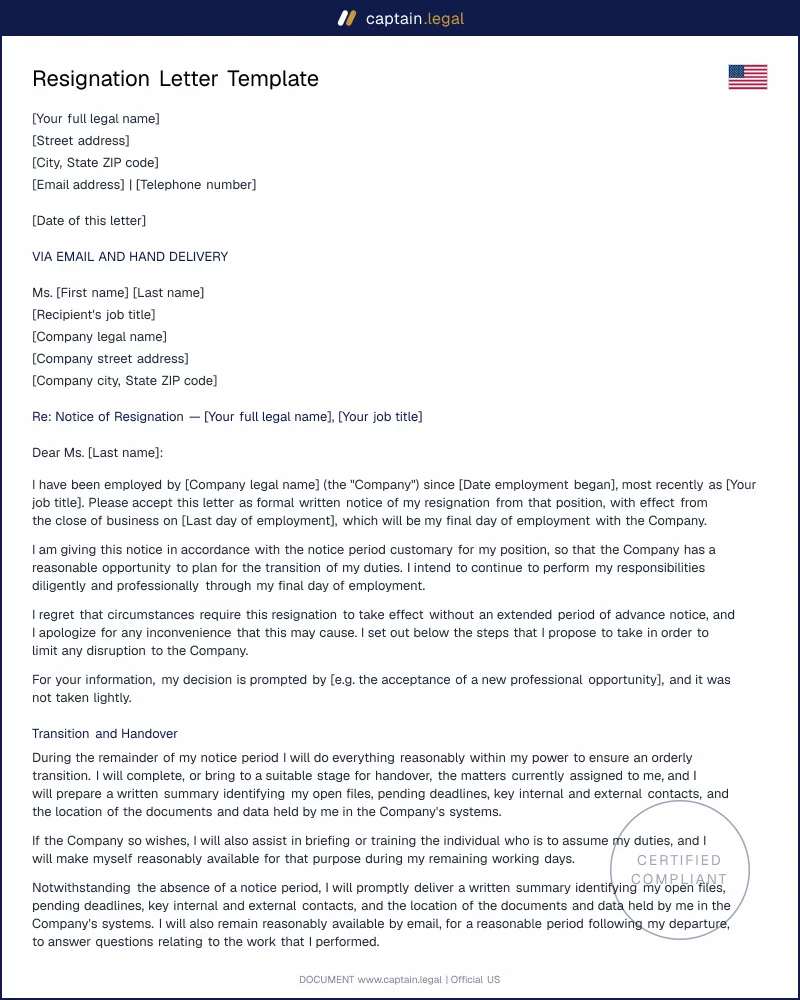
  • The statement of resignation opens the letter and is unconditional by design. Wording such as "I am considering other options" is not a resignation, and HR will treat it as an open conversation rather than a separation. The template uses one declarative sentence naming the exact job title and the legal entity that employs you.
  • The effective last day of employment appears as a calendar date rather than a duration. "Two weeks from today" starts an argument about which day counts and whether weekends are included. A fixed date removes the ambiguity for payroll, benefits and the COBRA qualifying event date.
  • The notice period reference ties that date back to its source, whether a contract clause, the handbook or simple professional courtesy. Naming the source is what protects a contractual bonus or a relocation repayment waiver.
  • The transition and handover paragraph offers something specific: written handover notes, introductions to key clients, availability during a defined window. It also confirms the return of laptops, badges and credentials, which usually happens under a separate return of company property agreement.
  • The final pay and benefits request asks in writing for the final paycheck date, the treatment of accrued PTO and the benefits termination date. Asking in the letter creates a paper trail worth a great deal if the last check turns up short.
  • The reference and future contact block closes on a professional note and supplies a personal email and phone number, since your company account is deactivated the moment you badge out.
4

State-specific considerations

California ties the payment deadline directly to the notice you give. Under Labor Code §202, an employee who gives at least seventy two hours of notice must be paid all final wages on the last day worked, while an employee who quits without that notice is paid within seventy two hours. Late payment triggers waiting time penalties under Labor Code §203, a full day of wages for every day the check is late, capped at thirty days. Accrued vacation is vested wages under Labor Code §227.3, so use it or lose it policies are void. The notice date in your California letter is what starts the seventy two hour clock in your favor.

New York is flatter. Final wages are due on the next regularly scheduled payday under Labor Law §191, whether the separation was voluntary or not. Accrued vacation is different: under Labor Law §198-c, an employer may lawfully refuse to pay out unused vacation if it has a written policy saying so and the employee was notified of it. Read the handbook before choosing a last day, because timing a departure just past an accrual date can be worth real money.

Texas follows the Texas Payday Law at Labor Code §61.014, under which an employee who quits is paid on the next regularly scheduled payday, against six calendar days for a discharged employee. No vacation payout is required unless a written policy or agreement provides one, so the policy document is the whole story. Non-compete clauses are enforceable in Texas when reasonably limited, which makes the letter a poor place to name your next employer.

Illinois requires final compensation at the time of separation where possible, and no later than the next regularly scheduled payday, under the Illinois Wage Payment and Collection Act at 820 ILCS 115/5. Earned vacation must be paid out, and the state enforces that actively.

Massachusetts distinguishes sharply between quitting and being fired. Under Mass. Gen. Laws ch. 149 §148, an employee who resigns is paid on the next regular payday, while a discharged employee is paid the same day. Accrued vacation counts as wages, and the statute carries mandatory treble damages, which makes the state unforgiving of a payroll error on a departing employee.

5

How to fill out this resignation letter

You start by choosing the situation that matches your departure, since the standard notice, the immediate resignation and the retirement notice use different opening paragraphs and different transition wording. The form then asks for your job title, the employing entity as it appears on your pay stub rather than the trade name, your manager's name and the recipient, usually your direct manager with HR copied. Next comes the date question, and this is where your state changes the output: selecting California triggers the seventy two hour language tied to Labor Code §202, while other states adjust the final pay request to match the local payday rule.

From there you decide how much to offer on transition. The template lets you commit to written handover notes, a client introduction schedule or a limited availability window after your last day, keeping each commitment specific enough to be credible without creating open ended obligations. A final screen handles the requests you want on record: final paycheck date, PTO payout treatment, benefits end date and the COBRA packet. You then download in Word to adjust the tone, or in PDF if you are ready to sign and send.

6

Common mistakes to avoid

The most damaging mistake is explaining too much. A resignation letter is not an exit interview and not a grievance. Every sentence about a difficult manager or a broken promise becomes a document the employer's counsel reads first if a dispute follows, and it rarely helps the writer. Keep the reasons out and save them for the exit interview form, where feedback belongs. The second mistake is the conditional resignation, the letter saying the writer will leave unless something changes. That is a negotiating position, and employers frequently accept it as the other thing.

There is a quieter version of the same error, the letter that thanks everyone at length and praises a manager the writer has been documenting for six months. Consistency counts, and an enthusiastic farewell sits badly next to a later complaint.

Third, notice can be cut short. In an at-will relationship an employer is generally free to accept your resignation effective immediately, so the two weeks of pay you counted on may never arrive. Fourth, resigning before a written offer is countersigned leaves you with no job and no unemployment claim. And fifth, sending the letter only by email with no acknowledgment leaves you unable to prove the delivery date. Send it as a signed attachment and keep the delivery confirmation, because the date you gave notice is the fact everything else turns on.

Key takeaways

Purpose

A resignation letter locks in your end date

A resignation letter is a short, dated, signed record that you ended the job voluntarily on a specific day. It is a unilateral act, not a deal: it does not need acceptance, a countersignature, or approval to be effective. That fixed date later drives practical disputes about your last day, final paycheck timing, accrued PTO, and even how HR describes your departure.

Notice

Two weeks is custom, not law

In most of the United States, no statute forces advance notice, so the two-week standard is tradition, not a legal requirement. Real notice duties come from your written employment agreement, an executive contract (including garden leave), a union contract, or professional rules like continuity of care. If you leave earlier than required, the typical hit is losing a signing bonus, repaying relocation, or forfeiting unvested equity.

Final pay

Your notice can affect when you get paid

Final wages are controlled by state wage payment laws, not the Fair Labor Standards Act, which generally leaves timing to the next regular payday. Some states tighten the deadline and may tie it to how much notice you give, so what you write in your letter can change the pay date. Vacation payout is also state-driven and may depend on what your written PTO policy says.

Frequently Asked Questions

No. Two weeks is a workplace convention with no statutory basis anywhere in the United States. Because employment is at-will in every state except Montana, you can end the relationship at any time without cause and without notice. The exception is contractual: an employment agreement or collective bargaining agreement setting a notice period binds you, and leaving early can cost a bonus or unvested equity.

Yes, in the sense that matters. A resignation is a unilateral act, so the letter takes effect on delivery, without your employer's signature or approval. What makes it binding is clarity: an unconditional statement, a named position, a fixed last day and evidence of delivery. Once those elements are present the employer can rely on it, and generally cannot be forced to let you withdraw it.

That depends on your state and, in California, on how much notice you gave. California pays on your last day if you gave at least seventy two hours of notice, and within seventy two hours otherwise, under Labor Code §202. Texas, New York, Massachusetts and most other states pay resigning employees on the next regularly scheduled payday. Accrued vacation is separate: it must be paid out in California, Illinois and Massachusetts, while Texas and New York follow your written policy.

Email is legally sufficient almost everywhere, since no statute prescribes a form for resignations. The reason to send a signed letter anyway is evidentiary: a signed PDF, or a printed copy handed over with an acknowledged receipt, gives you a dated document nobody can later call ambiguous. If your contract specifies a delivery method, follow it exactly. Notice clauses in executive agreements are enforced literally, and a resignation delivered the wrong way can be treated as no notice at all.

Almost never. A short, neutral letter ages well and a detailed one does not. Complaints about management, pay or workload belong in an exit interview or, where the conduct is unlawful, in a formal complaint following the employer's reporting procedure. One narrow exception: an employee resigning because conditions have become intolerable may need to document them to preserve a constructive discharge claim, and that is a call to make with an employment attorney.

Usually not, though the exceptions are real. Every state disqualifies workers who leave voluntarily without good cause, and in many states that cause must be attributable to the work itself. Safety hazards the employer refused to fix, a substantial cut in pay or hours, and harassment reported through proper channels and left unaddressed can all qualify. A quit or be fired ultimatum is generally not treated as voluntary at all.

Both Word and PDF, and either version stays available in your account. Word is the practical choice if you want to adjust the tone or add a paragraph about a specific handover project. PDF is what you send, because it fixes the layout and reads as a document rather than a draft. Every other separation form you might need sits in the full catalogue of US legal documents under the same account.

4.7/5

19 verified reviews · 50 000+ downloads

Resignation Letter Template | Labor Code §202 Ready (US)
  • Immediate access to the document
  • PDF + Word download
  • Compliant with 2026 legislation
  • Reviewed by lawyers
Fill in the template
Secure payment
Updated on July 30, 2026

You might also like

Executive Employment Agreement Template
Return of Company Property Agreement