
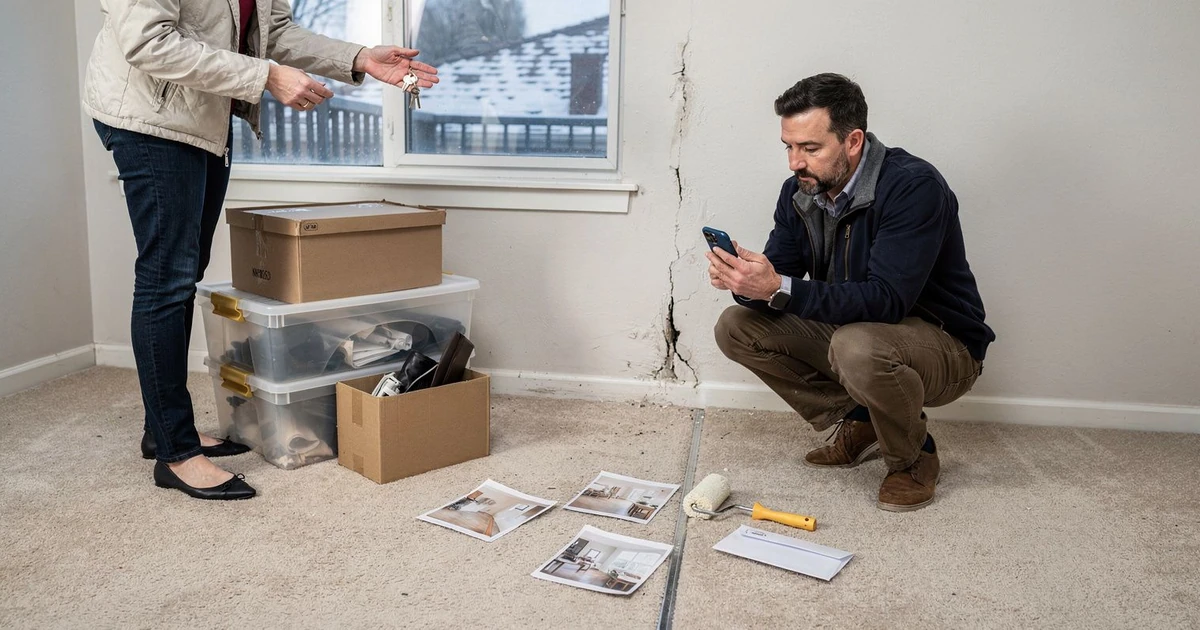
A security deposit is the only money in a residential tenancy that changes hands twice, and the second transfer is where the fighting happens. Two waves of state legislation have moved the ground under it. The first capped how much a landlord may collect. The second, which arrived with Colorado's Tenant Security Deposit Protections Act on January 1, 2026, targets something else: what the landlord must document, and which lease clauses a court will now ignore.
The second wave is the one that catches people out. A lease signed three years ago can remain a valid tenancy document while its deposit clause has quietly stopped working. Nobody sends a notice when that happens. The clause simply fails the first time it is tested.
What changed in the security deposit rules, and what did not
There is no federal security deposit statute for private residential tenancies. Every rule that matters lives in a state landlord-tenant code, which is why the same lease language can be enforceable in one state and void across the border. What changed is the kind of rule legislatures are writing.
Through 2024 the action was on amount. California's AB 12 took effect July 1, 2024 and capped most deposits at one month's rent, with a narrow exception letting an owner of two or fewer residential properties, four units or less, collect two months. Roughly twenty states, including Texas and Florida, still impose no statutory cap, so there the figure is pure negotiation.
Since 2025 the action has moved to proof and procedure. California's AB 2801 rewrote the evidence rules inside Civil Code §1950.5. Colorado's act redefined what a landlord may deduct for and moved the burden of proof onto the landlord. Neither changes how much money a landlord may hold. Both change whether the landlord gets to keep any of it. The cap that appeared in earlier drafts of the Colorado bill did not survive, so the state still has no statutory ceiling on the amount.
Legal framework: the statutes behind the shift
Colorado's HB25-1249 was signed on June 3, 2025 and took effect January 1, 2026 as chapter 401 of the 2025 session laws, rewriting the definition at C.R.S. §38-12-102(4) and the return rules at §38-12-103. Normal wear and tear now expressly covers uncleanliness, with one limit: it does not cover uncleanliness that leaves the unit substantially less clean than it was when the lease began. The act also bars retention for damage or a defective condition that preexisted the tenancy, requires the landlord to hand over supporting documentation within fourteen days of a written request, and lets either party ask for a walk-through inspection, in person or by video, before the lease ends and after furniture is out.
Two provisions rewrite common deduction practice. A landlord has no actual cause to charge for carpet replacement or repainting unless the carpet damage is substantial and irreparable, or the paint damage substantial, beyond wear and tear and not preexisting, and then only for the minimum needed to repair it. Carpet not replaced with new carpet in the preceding ten years cannot be treated as substantially and irreparably damaged at all. A landlord is presumed to have kept an unreasonable amount once the retention reaches 125 percent of actual damages, and in any tenant suit the landlord carries the burden of proving those damages. The full text sits on the Colorado General Assembly page for the Tenant Security Deposit Protections Act.
California moved first on documentation. Under Civil Code §1950.5(g) as amended by AB 2801, a landlord has since April 1, 2025 had to photograph the unit after possession returns and before any repair or cleaning charged against the deposit, then again once that work is done. For tenancies beginning on or after July 1, 2025, a third set must be taken at or immediately before the start of the tenancy. All of it travels with the itemized statement and a written explanation of the cost. The baselines still frame everything: twenty-one days in California, fourteen days in New York under General Obligations Law §7-108, thirty days in Texas under Tex. Prop. Code §92.103, and a fifteen or thirty day split in Florida under Fla. Stat. §83.49(3).
The lease clauses that no longer hold
The automatic cleaning fee is the first casualty. A clause charging every departing tenant a flat move-out fee cannot survive in a state that treats ordinary uncleanliness as normal wear and tear, because the deposit may not be charged for wear and tear at all. Cleaning is still chargeable where the unit comes back substantially dirtier than it started, but that is a fact to prove, not a fee to schedule. California gets there differently: professional cleaning is chargeable only where reasonably necessary to restore the cleanliness the unit had at the start, which is rarely what the invoice covers.
The carpet and paint clause is the second. Language letting the landlord deduct the full replacement cost of carpet, or repainting the whole unit, has been vulnerable for years under the useful-life doctrine; Colorado has now put a number on it. Any clause assuming the tenant pays for a fresh coat of paint after a one-year tenancy drafts against the statute.
Third is the non-refundable deposit. Calling money a nonrefundable deposit, a redecoration fee or an administrative charge does not lift it out of the deposit statute in most states, and several codes convert non-refundable charges back into refundable deposits subject to the full return deadline and itemization duty. Fourth, and quietly the most dangerous, is the waiver clause: any provision by which the tenant gives up the itemization right, the statutory deadline or the multiplied damages remedy. Those rights are not waivable by contract, and a court that sees the attempt reads the rest of the lease with a colder eye. These statutes govern residential tenancies only; a commercial lease rent structure runs on ordinary contract principles.
Deadlines, forwarding addresses, and the forfeiture rule
The return clock is the most enforced rule here and the easiest to lose. In most states, missing the deadline or failing to send the itemized statement forfeits the right to deduct anything, including for damage the tenant genuinely caused. Colorado sets that default at thirty days, extendable by the lease to no more than sixty, and applies the forfeiture rule without softening: no timely statement, no retention, whatever the walls look like.
When the clock starts is a separate question, and it trips tenants more often than landlords. Texas suspends the refund obligation until the tenant gives a written forwarding address under §92.107, so a demand letter sent on day thirty-one where no address was ever provided is premature. Florida requires a notice of intent to impose a claim, by certified mail and in statutory wording, within thirty days; failure forfeits the deduction entirely. The penalties reward precision: three times the amount wrongfully withheld plus $100 and fees in Texas under §92.109, up to twice the deposit in California under §1950.5(l), and treble damages in Colorado after the tenant gives seven days' written notice of intent to sue.
Rewriting the lease, or writing the demand letter
For a landlord, the practical response is a lease rebuild rather than an amendment. The deposit clause needs to name the statutory return period, describe the itemization the tenant will receive, and drop any automatic fee the code now treats as wear and tear. Captain.Legal's residential lease agreement template asks for the property's state before building the deposit section, so the deadline and permitted deductions match the right code, not a form from another market. The same applies to a month-to-month rental agreement, where the shorter notice cycle puts the deposit language to the test more often.
For a tenant whose deadline has passed, the document to build is the security deposit demand letter. The interview asks for the state, the surrender date and whether a forwarding address was given, then walks through each claimed deduction so the letter contests them line by line. Both download in Word and PDF: the Word file is what gets edited before signature, the PDF what gets attached as an exhibit.
Where both sides lose the argument
Landlords lose most often by reusing a template that predates the change. A deposit clause drafted before a state redefined wear and tear reads as evidence of intent to charge for it. The second is photographic: in California the photos are mandatory, and everywhere else their absence leaves the landlord's word against the tenant's in a forum that resolves ties against whoever holds the money. The third is billing the whole repair when the statute allows only the damaged portion, which in Colorado triggers the 125 percent presumption.
Tenants lose in procedural ways. Sending the demand before the statutory clock has started, usually because no written forwarding address was given, hands the landlord a clean defense. Sending it to the leasing agent rather than the owner named in the lease creates a service defect. And overreaching, contesting damage the tenant plainly caused alongside the improper deductions, costs credibility on the winnable items. Concede the legitimate line and fight the invented one.
Frequently asked questions
How long does a landlord have to return a security deposit?
It depends on the state. New York requires return with an itemized statement within fourteen days of the tenant vacating, California twenty-one days, Texas and Colorado thirty, and Florida fifteen where no deduction is claimed or thirty where one is. Several run to forty-five or sixty. In most of them, missing the deadline forfeits the right to keep any part of the deposit, which makes the surrender date the most important fact in the file.
Can a landlord charge an automatic cleaning fee from the deposit?
Increasingly no. Colorado's wear-and-tear definition now takes in uncleanliness, and a deposit may not be retained for wear and tear, which leaves a flat fee nothing to attach to. Cleaning stays chargeable where the unit is substantially less clean than when the lease began, but that has to be shown. California allows a charge only where reasonably necessary to restore the unit's original cleanliness. A fee applied to every departing tenant is what courts reject fastest.
What counts as normal wear and tear?
The deterioration that follows ordinary use without negligence or abuse. Faded paint, small nail holes, carpet flattened in traffic lanes, scuffed baseboards and light soiling sit inside the exclusion in most states. A cracked window, a pet-stained subfloor or a hole in drywall does not. The line matters because deducting for an excluded category is itself evidence of bad faith in several codes, which turns a modest dispute into a multiplied damages claim.
Is a non-refundable deposit clause enforceable?
Usually not as written. Labelling money a nonrefundable deposit, redecoration fee or move-out charge does not lift it out of the deposit statute, and several state codes treat non-refundable charges as refundable deposits subject to the full return and itemization duty. A landlord who wants a genuine fee has to structure and disclose it under the state's rules for rent or separately bargained charges, not bury it in a deposit clause.
What happens if the landlord ignores the deadline entirely?
The tenant's claim gets stronger. In most states a late return or a missing itemized statement forfeits the landlord's right to deduct anything, and the bad-faith multipliers open up: treble damages plus $100 and fees in Texas, up to twice the deposit in California, treble damages in Colorado after seven days' written notice. Unpaid rent runs on a separate track, through an eviction notice rather than a silent deposit deduction.
Are these templates valid in every state?
The documents are drafted to the state selected at the start of the interview, which is what makes them usable. A deposit clause built for Texas is wrong in New York and unenforceable in Colorado, so a single national form is worse than useless here. The generated lease and demand letter cite the controlling statute by section, insert the right deadline, and reflect the deduction categories the code allows. The full US document catalog lists what a complete rental file usually contains.
In what format do the documents download?
Both the lease and the demand letter generate as an editable Microsoft Word file and a signature-ready PDF. The Word version is the working copy, used to adjust the deposit clause for an unusual property or to add a line about a successor landlord after a mid-tenancy sale. The PDF is the one to sign, serve and archive. Both stay in your account, which helps when a dispute surfaces months after move-out.