Non-Profit

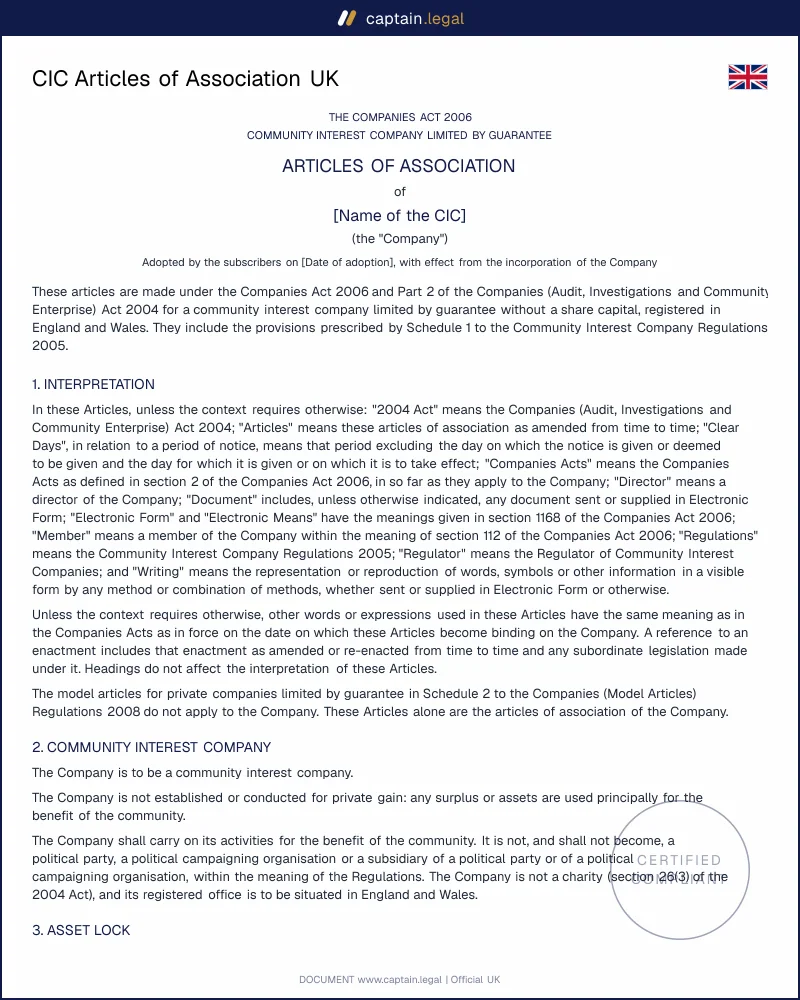
CIC Articles of Association UK: Community Interest Company Template

Complete articles of association for a community interest company registered in England and Wales, limited by guarantee or by shares (Schedule 1, 2 or 3), with the statutory asset lock, an asset-locked body, board and member rules, in Word and PDF.
4.7/5— 11 reviewsEngland & Wales law 2026Instant download
Share

CIC articles of association are the constitution of a community interest company: the rulebook that says who the members are, how the directors take decisions and, above all, how the company's assets stay locked for the community it serves. This template is written for founders setting up a community interest company in England and Wales, limited by guarantee or limited by shares, and for existing companies that want new articles or plan to convert. It reproduces the clauses that the Community Interest Company Regulations 2005 make compulsory and adds the governance rules a company solicitor would expect. The Regulator checks the articles before Companies House registers the company, so the wording matters. Scotland and Northern Ireland are outside its scope.

Compliant

2026 Legislation

50,000+ clients

trust us

Affordable

From $4.90 / doc

Secure payment

Instant download

CIC Articles of Association UK: Community Interest Company Template

Secure payment

Fill in the template

What are CIC articles of association?

A community interest company is an ordinary limited company with three extra layers: it must pass the community interest test, it is bound by a permanent asset lock, and its directors file a community interest company report every year with the accounts. Section 26 of the Companies (Audit, Investigations and Community Enterprise) Act 2004 created the form and makes clear that a CIC is never a charity: no Gift Aid, no charity rate relief, and tax like any other company. Groups that want charitable status usually look at a charitable incorporated organisation constitution instead.

The articles are where the CIC status lives. Section 32 of the 2004 Act requires them to state that the company is to be a community interest company and to contain every provision the Regulations prescribe; anything inconsistent with those provisions simply has no effect. Beyond that core, CIC articles of association work like those of any private company under the Companies Act 2006: they bind the company and its members and can be changed by special resolution. The difference is that the asset lock can never be removed, and a new statement of objects needs the Regulator's approval. Our UK nonprofit and community templates cover the documents that usually follow incorporation.

When do you need this document?

The most common trigger is a new incorporation. Online, Companies House asks for two uploads, the articles and the CIC36; on paper, the articles travel with the IN01, the memorandum and the CIC36, and every name must match. A community group that has outgrown its unincorporated association or a social enterprise café bidding for council contracts typically lands here, because funders want limited liability with a visible public benefit lock.

An existing CIC with outdated articles is the second scenario. Many still rely on Table A or on objects written into an old memorandum. Replacing them takes a special resolution, and the amended articles must be sent to Companies House within 15 days under section 26 of the Companies Act 2006. A change to the objects goes further: it has no effect until the Regulator approves it, under regulation 13.

Conversion is the edge case that catches people out. An ordinary company becoming a CIC passes the special resolutions of section 37 of the 2004 Act, which adopt the new articles and change the name, and sends them with form CIC37 rather than filing them separately. Members or shareholders holding 15% who did not vote in favour can apply to court within 28 days (section 37A), and the new articles only take effect when the new certificate of incorporation is issued (section 38A). A charitable company needs the Charity Commission's written consent first.

Key clauses included in our template

The template builds complete CIC articles of association and excludes the model articles expressly. Four parts deserve a closer look:

  • Article 3 reproduces the statutory asset lock in the prescribed wording of the schedule that matches your company type, since the Regulator turns away articles that alter or negate those clauses.
  • Choosing to name an asset-locked body (another CIC, a charity or a permitted registered society) lets the company transfer assets to it without asking the Regulator, and directs the residual assets there on a winding up. Leaving the question open is possible, but every such transfer then needs consent.
  • Where the company has shares, the dividend article follows the schedule you choose: under Schedule 3 the aggregate dividend cap applies, exempt dividends are defined, and interim dividends need an ordinary resolution.
  • Directors' meetings come with a quorum you set, an optional casting vote for the chair, declarations of interest under sections 177 and 182 of the Companies Act 2006 and the identity verification rule of section 167M.

Membership has its own options. With the small membership model, every member must be a director, which suits a founding team; for a share company the template then obliges a departing director to transfer their shares to the remaining directors, at a fair value certified by an independent accountant if no price is agreed. The wider model admits users, volunteers or residents, with removal only after a hearing. General meetings run on fourteen clear days' notice and minutes are kept for ten years. Investor CICs usually pair the articles with a shareholders' agreement for UK companies covering exit and information rights.

How to fill out the CIC articles template

You start with the name of the CIC, typed exactly as it will appear on the CIC36. The next question fixes the type: guarantee, shares under Schedule 3 or shares under Schedule 2, with the amount each member guarantees for a guarantee company. From there you choose the membership model and write the community purpose, starting with a verb because the sentence follows "in particular (without limitation) to".

The asset-locked body screen asks for its name and registration number. You then set the minimum number of directors and the board quorum, and decide whether the chair keeps a casting vote. The last questions cover adoption: a new CIC lists up to five subscribers, who sign the subscriber block, while an existing company records the date of its special resolution and the director or secretary who certifies the copy.

Every answer updates the preview before you download the articles in Word or PDF. If you file on paper, the memorandum of association template and the Companies House IN01 application template complete the bundle; the CIC36 itself comes from the Regulator's page on gov.uk.

Common mistakes to avoid

A common reason for rejection is an asset-locked body that cannot hold the role. A CIC cannot name itself, one of its directors or an ordinary company. Close behind comes the edited statutory clause: founders rewrite the asset lock in plainer English, or add a sentence that lets directors "release" assets, and the application stalls. Leave the prescribed wording alone and put your own rules elsewhere in the articles.

Objects that benefit only the members or the staff fail the community interest test, and so does a company whose main activity is political campaigning; incidental campaigning is tolerated, a campaigning organisation is not. The type of company is another trap. A company limited by guarantee can never later issue shares to investors, so a social enterprise that expects to raise equity should start with shares under Schedule 3. Promising dividends to shareholders in the CIC36 surplus statement with guarantee or Schedule 2 articles is a contradiction the Regulator spots. Last, directors forget that the community interest company report must go to Companies House every year with the accounts, dormant years included.

Key takeaways

ASSET LOCK

The statutory asset lock can never be removed

Every CIC must include in its articles the asset lock prescribed by the Community Interest Company Regulations 2005: no transfer of assets other than for full consideration, unless it goes to an asset-locked body named in the articles, to another one with the Regulator's consent, or is made for the benefit of the community. Clauses that alter or contradict this wording have no effect under section 32 of the 2004 Act.

DIVIDENDS

Shares under Schedule 3 allow capped dividends

A CIC limited by guarantee pays no dividends. A share company chooses Schedule 2, where only asset-locked bodies may receive dividends, or Schedule 3, where investors may be paid within the aggregate dividend cap, currently 35% of distributable profits under regulation 22. Every dividend needs a members' resolution, so the directors cannot pay an interim dividend on their own, and a guarantee company cannot later issue shares.

FORMATION

The articles are filed with the CIC36 statement

The articles do not create the CIC on their own. They go to Companies House with form CIC36, the community interest statement signed by every first director, and the Regulator decides whether the company passes the community interest test before registration. A CIC is not a charity: it cannot claim Gift Aid. An existing company that converts needs special resolutions under section 37 and form CIC37.

Frequently Asked Questions

They are. Under section 33 of the Companies Act 2006, the articles bind the company and its members as if each had signed and sealed covenants to observe them, and the courts enforce them on that basis. For a new CIC they take effect on incorporation, once the Regulator has accepted the application and Companies House has issued the certificate. Provisions prescribed by the CIC Regulations prevail over anything else in the document: section 32(5) of the 2004 Act deprives an inconsistent clause of effect. Signing the subscriber block remains good practice.

You can, and many small CICs do. The Regulator publishes model articles for guarantee and share companies, in small and large membership versions. Their limits show when you need to adjust them: a casting vote you may not want or a membership model that does not match your group. This template follows the same statutory clauses but lets you answer those choices in the form, and it adds provisions the models leave out, such as a transfer mechanism for shares held by a departing director.

The deadline is 15 days. Section 26 of the Companies Act 2006 requires a company that amends its articles to send a copy of the amended text to the registrar within 15 days of the amendment taking effect, and section 30 applies the same period to the special resolution itself. Missing it is an offence. Two exceptions apply to CICs. A change to the objects has no effect until the Regulator approves it, and a company converting into a CIC files its resolutions with the CIC37 application rather than within the usual period.

Yes. Unlike charity trustees, CIC directors can be paid a reasonable salary or fee for the work they do, and the template allows the board to set remuneration, with the director concerned staying out of the decision. The limits come from the asset lock: every payment must be for full consideration, so a director cannot be paid more than the services are worth. The amount is disclosed in the annual community interest company report or in the notes to the accounts. Reasonable expenses can be reimbursed too.

Both formats are available once the form is complete. The Word version suits a solicitor's review or the Regulator's comments, while the PDF is the copy to upload with the CIC36 through the Companies House service, which accepts the two documents as separate PDF files. Keep a signed copy with the company's records. If you also need policies, resolutions or a register for the new company, you can browse the full catalogue of UK legal templates by category.

On a winding up under the Insolvency Act 1986, the liquidator pays the creditors first. Shareholders then receive no more than the paid up value of their shares, and members of a guarantee company receive nothing. Whatever remains goes to the asset-locked body named in the articles, in the proportions the Regulator directs, or to bodies the Regulator chooses when none is named. A CIC that is struck off rather than wound up must transfer its remaining assets before the application, and without a named body it needs the Regulator's consent on form CIC53.

No. A community interest company is not a charity, even when its purposes would qualify, because section 26(3) of the 2004 Act says so expressly. It cannot claim Gift Aid on donations, does not receive the mandatory business rates relief reserved for charities and pays tax on its profits like any other company. Groups whose activities are exclusively charitable and who want the tax advantages usually register a charity or a charitable incorporated organisation instead.

4.7/5

11 verified reviews · England & Wales law 2026

CIC Articles of Association UK: Community Interest Company Template
  • Immediate access to the document
  • PDF + Word download
  • Compliant with 2026 legislation
  • Reviewed by lawyers
Fill in the template
Secure payment
Updated on November 12, 2026

You might also like

CIO Constitution UK
UK Charity AGM Minutes Template