Business

Data Processing Agreement UK: UK GDPR Article 28 Template (Word, PDF)

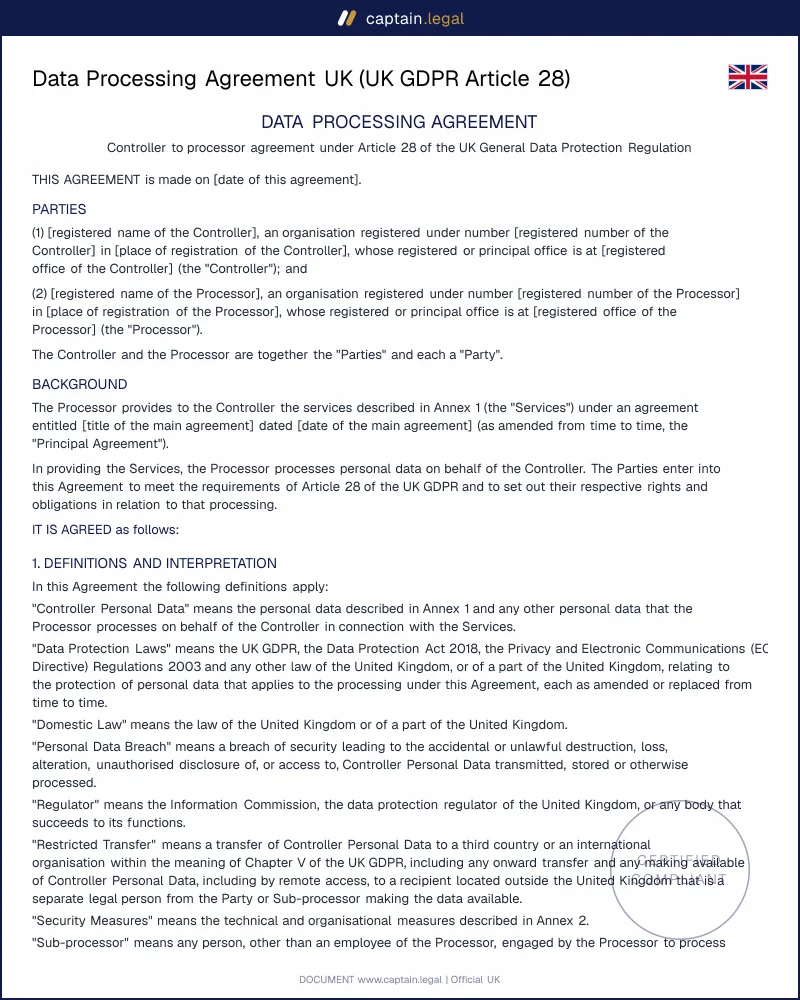
A controller to processor agreement under Article 28 of the UK GDPR, governed by the law of England and Wales, for any supplier that handles personal data for your business: instructions, security, sub-processors, breaches, transfers, audits and deletion.
4.5/5— 12 reviewsEngland & Wales law 2026Instant download
Share

A data processing agreement is the contract a UK business signs with any supplier that handles personal data on its behalf: the IT firm with remote access to your server, the cloud platform that hosts your customer records, the payroll bureau, the mailing tool. Article 28 of the UK GDPR makes this contract compulsory and lists what it must say. Our template is written for controllers and processors in England and Wales, follows that list point by point, and adds the commercial terms that the regulation leaves open: breach deadlines, sub-processor approval, audits, liability and the end of the relationship. It sits alongside your main services contract rather than replacing it.

Compliant

2026 Legislation

50,000+ clients

trust us

Affordable

From $4.90 / doc

Secure payment

Instant download

Data Processing Agreement UK: UK GDPR Article 28 Template (Word, PDF)

Secure payment

Fill in the template

What is a data processing agreement?

A data processing agreement (often shortened to DPA) governs one specific relationship: a controller, who decides why and how personal data is used, and a processor, who uses that data only on the controller's instructions. The controller is usually the customer. A dental practice that keeps patient records in a hosted practice management system is the controller; the software company that runs the servers is the processor. The DPA records what the processor may do with the data, why, for how long, and what happens if something goes wrong. Some suppliers call it a data processing addendum; the label makes no legal difference.

The document is not a privacy notice, which tells individuals how you use their data, and it is not a data sharing agreement between two controllers who each use the data for their own ends. If your supplier decides for itself how to use the information (a recruitment agency choosing which candidates to approach, for example), it is a controller in its own right and a processor contract is the wrong tool. A non-disclosure agreement does not fill the gap either. A mutual or one-way NDA for UK businesses protects confidential business information, but it says nothing about instructions, sub-processors or deletion, which are the points the regulator checks.

When do you need this document?

The short answer is whenever a supplier touches personal data you are responsible for. The obvious cases are technology contracts. Managed IT support with remote access, website hosting, cloud storage, a CRM or booking system, an email marketing platform: each one processes your customers' or staff's data, and the supplier is a processor. An online retailer is a typical example: its online shop terms and conditions for UK consumers promise customers careful handling of their orders, and the e-commerce platform, the email tool and the fulfilment partner all need a DPA behind that promise. Outsourced business functions come next, such as payroll bureaus, bookkeepers who run your PAYE, call centres, mailing houses, document scanning and secure shredding firms. A freelancer can be a processor too. If you engage a self-employed developer or virtual assistant under a UK contractor agreement and they work inside your customer database, the contractor agreement covers the work and the DPA covers the data.

Large software providers push their own standard terms; the template earns its keep with smaller suppliers who have no DPA at all. Two edge cases deserve attention. When the processor is based abroad, the data leaves the UK the moment you send it, so the transfer safeguards apply from day one. When the data includes health information, biometrics or criminal records, the security bar rises and the agreement should say so expressly.

Key clauses included in our template

The agreement runs to 18 clauses and two annexes. Annex 1 holds the description of the processing that Article 28(3) requires; Annex 2 lists the security measures, from multi-factor authentication to tested back-ups. The clauses that do most of the work in a dispute are these:

  • Sub-processors can be refused entirely, approved from a named list, or authorised generally with 30 days' notice and a 14-day right to object; once you object, the new supplier may not touch the data until the objection is resolved.
  • A personal data breach must be reported without undue delay and within a fixed deadline you choose (24, 48 or 72 hours), with the details the controller needs for its own report.
  • Where data goes abroad, clause 8 ties every transfer to Article 44A, names the IDTA and the UK Addendum, and requires a written assessment of the data protection test.
  • Audit rights start with certifications and questionnaires, then allow one inspection a year on 30 days' notice, more often after a breach.
  • At the end, the controller chooses return or deletion, and back-up copies must disappear within 90 days.

Liability follows Article 82: each party answers to individuals under the statute, and the one that pays compensation can recover the other's share. You can keep the caps in your main contract or set a figure for this agreement. No cap ever limits liability for fraud, death or personal injury caused by negligence, or the rights of the individuals concerned.

How to fill out this data processing agreement

You start by identifying the two parties. For a company, LLP or CIO, the form asks for the registered name, place of registration, number and office address, then the person signing; for a sole trader or a partnership, the name with any trading name and the business address. Next comes the main contract: either its title and date, or a reference to the quotation, order form or terms of business under which you buy the service.

The middle of the questionnaire builds Annex 1. You describe the services, what the supplier does with the data, the purpose, the types of personal data and whose data it is. Separate screens deal with sensitive data, the duration, extra security measures, sub-processors and transfers outside the UK. If you list a sub-processor in Ireland or the United States, answer "Yes" to the transfer question as well, because the EEA counts as outside the UK even though UK regulations approve it. You finish with the breach deadline, whether assistance is charged, the liability cap and the two data protection contacts. The preview on the right updates as you go. Keep the signed copy with your other business contract templates so the next review is quick.

Common mistakes to avoid

The most frequent error is a DPA that describes the processing in one vague line ("customer data for the services"). Article 28(3) asks for types of data and categories of individuals, and a vague annex invites the question whether the contract meets Article 28 at all. The second mistake is forgetting the sub-processors. Your IT firm almost certainly uses a hosting provider, a back-up service and a remote access tool, and each of them must appear in the list or be approved under the general authorisation. A third problem is copying an EU template that cites the EU regulation, EU supervisory authorities and the EU standard contractual clauses without the UK Addendum. The transfer clauses will then be wrong.

Timing causes the rest of the trouble. Businesses often sign the DPA months after the supplier started work, which leaves a period with no Article 28 contract at all; sign it before any data is shared, or date it on signature and treat the gap as a compliance point to record. Another classic is a 72-hour breach deadline for the processor, which gives the controller the facts late and little time to contain the incident. Finally, check your privacy notice. Your website privacy policy and cookie policy should describe the categories of recipients, including the processors you sign with, and it must match the agreements you actually have.

Key takeaways

ARTICLE 28

Eight terms the contract must always contain

Article 28(3) of the UK GDPR requires a written contract that describes the processing and binds the processor to eight commitments: act only on documented instructions, keep staff bound by confidentiality, secure the data under Article 32, respect the rules on sub-processors, help with requests from individuals, help with security, breaches and impact assessments, return or delete the data at the end, and allow audits.

SUB-PROCESSORS

Your supplier's own suppliers need your approval

A processor may not bring in another processor without the controller's prior written authorisation, specific or general (Article 28(2)). With a general authorisation, the supplier must announce each new or replacement sub-processor in advance so that you can object. The original processor stays fully liable to you for the failures of its sub-processors, and the same data protection terms must flow down to them.

TRANSFERS

Data sent abroad must pass the UK protection test

A transfer outside the UK, including remote access by an organisation abroad, needs approval by UK regulations or appropriate safeguards such as the International Data Transfer Agreement or the UK Addendum. Since the Data (Use and Access) Act 2025, a party relying on safeguards must also assess, reasonably and proportionately, that protection after the transfer would not be materially lower than under UK law.

Frequently Asked Questions

It is a contract like any other, so it binds both parties once signed by people with authority to sign, and Article 28(9) accepts electronic signatures. Under English law it needs no deed, witness or registration. It also does a regulatory job: without a written Article 28 contract, both the controller and the processor are in breach of the UK GDPR, whatever their services contract says. Our template is governed by the law of England and Wales and gives exclusive jurisdiction to its courts, which suits parties in England and Wales. Scottish and Northern Irish contract law are excluded, although the UK GDPR applies across the whole of the UK.

Yes. Once the questionnaire is complete you can download the agreement as an editable Word document and as a PDF. The Word version is useful when the supplier's lawyers want tracked changes, for example to adjust the audit notice, the liability cap or the list of sub-processors, and the PDF is the clean copy for signature. Related paperwork is easy to find in the full catalogue of UK legal documents, grouped by subject.

The UK GDPR says "without undue delay" after the processor becomes aware of the breach, with no fixed number of hours. The controller then has to notify the Information Commission without undue delay and, where feasible, within 72 hours after it becomes aware, unless the breach is unlikely to result in a risk to individuals. That is why the template adds a contractual deadline. Most controllers choose 24 or 48 hours, which leaves time to assess the facts, contain the incident and decide whether to tell the people affected. The processor can send missing details in phases.

You need one per processor relationship, because the annex must describe the specific processing that supplier carries out. A hosting company and a payroll bureau handle different data for different purposes, and a single generic document would describe neither accurately. Where one supplier provides several services, one agreement can cover them all if Annex 1 lists each one. The work is lighter than it sounds, because the clauses stay the same and only the questionnaire answers change.

Sending data to a supplier abroad is a restricted transfer, and so is giving an organisation abroad remote access to it; the supplier's own employees logging in while travelling are not. The transfer is lawful if UK regulations approve the destination (the EEA countries are approved) or if appropriate safeguards are in place, most often the International Data Transfer Agreement or the UK Addendum to the EU standard contractual clauses. With safeguards, the exporter must also assess whether protection would be materially lower than in the UK and keep that assessment. Answer "Yes" to the transfer question and describe each destination and safeguard.

Often you can, and with large platforms you will rarely have a choice. Before signing, check it against the eight points of Article 28(3): documented instructions, confidentiality, security, sub-processor approval, help with individual requests, help with breaches and impact assessments, deletion at the end, and audits. Check also that it refers to the UK GDPR and UK transfer tools, not only to the EU regime. Supplier terms tend to be thin on breach deadlines and sub-processor objections, so a smaller supplier will usually accept your template, which is drafted with the customer's interests in mind.

4.5/5

12 verified reviews · England & Wales law 2026

Data Processing Agreement UK: UK GDPR Article 28 Template (Word, PDF)
  • Immediate access to the document
  • PDF + Word download
  • Compliant with 2026 legislation
  • Reviewed by lawyers
Fill in the template
Secure payment
Updated on November 12, 2026

You might also like

Board Minutes and Directors' Written Resolution UK
Business Sale Agreement (Asset Purchase) UK