Business

Board Minutes UK: Directors' Meeting Minutes and Written Resolution Template

Minutes of a board meeting, a directors' written resolution or a sole director's record of decisions for a private company registered in England and Wales: quorum, declarations of interest, up to five decisions and signature blocks, in Word and PDF.
4.5/5— 22 reviewsEngland & Wales law 2026Instant download
Share

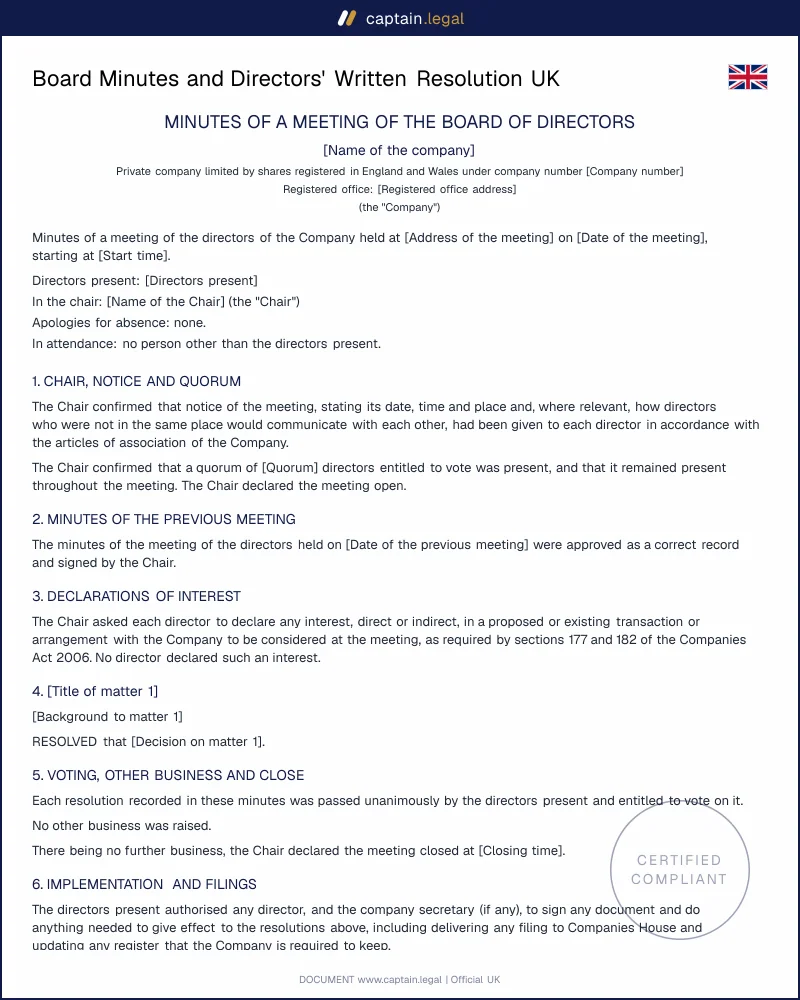
UK board minutes are the written record of what the directors of a company decided, who took part and on what basis. This template covers the three situations a private limited company registered in England and Wales actually meets: a board meeting held in person or by video, a directors' written resolution signed instead of meeting, and the record a sole director keeps of their own decisions. One questionnaire produces the right version, with the quorum, the declarations of interest, up to five numbered decisions and the signature blocks already in place. It suits founders, company secretaries and accountants preparing the paperwork for a bank, an investor or a buyer.

Compliant

2026 Legislation

50,000+ clients

trust us

Affordable

From $4.90 / doc

Secure payment

Instant download

Board Minutes UK: Directors' Meeting Minutes and Written Resolution Template

Secure payment

Fill in the template

What are UK board minutes?

Board minutes record the proceedings at a meeting of the directors: who attended, whether a quorum was present, which interests were declared and the exact wording of each decision. They are a company record, not a filing. Nothing goes to Companies House unless a decision itself triggers a form. The directors' written resolution is the alternative most small companies use from week to week. Instead of meeting, every director entitled to vote signs the same text, and under the model articles that counts as a unanimous decision of the board. A sole director, where the articles allow the company to have only one, takes decisions alone but still needs a dated, signed trace of them.

Two documents are often confused with these. A shareholders' written resolution is passed by the members under Part 13 of the Companies Act 2006 and covers matters such as changing the articles or the company name; a board resolution cannot do that job. The working rule is simple: the board decides how the company is run, while the members decide changes to the company itself. The business documents for UK limited companies on the site follow the same split.

When do you need board minutes or a written resolution?

The most frequent trigger is a bank asking for a certified board resolution before it opens an account, changes the signatories or grants a facility. Investors and buyers come next. In any due diligence the minute book is checked for the appointment of every director and the approval of each significant contract. Allotting shares is a classic board decision when the company has a single class of shares (section 550), although the existing shareholders' pre-emption rights still apply to an allotment for cash unless the articles or a special resolution disapply them. Interim dividends are decided by the directors, and the minutes should name the accounts relied on, the first thing an accountant or a liquidator asks to see.

Approving a service agreement for an executive director is routine too, and a case where the director concerned declares an interest and stays out of the vote. Changing the registered office and approving the annual accounts belong in the same record. Two edge cases deserve a mention. In a company with two directors, a conflict on one matter leaves a single director able to vote, so no quorum exists for that matter; the usual fix is an ordinary resolution of the shareholders disapplying article 14. Where the sole director is also the only shareholder and lends money to the company without a written agreement, section 231 requires the terms to be set out in writing, and the decision record is the natural place.

Key clauses included in our template

Every version is built from the same blocks:

  • Opening lines give the company's name, number and registered office, then a preamble matching the form chosen.
  • Quorum and notice are confirmed in the minutes themselves, including the case where a director waived notice under article 9 or joined by video, so the record shows a properly constituted meeting.
  • Declarations of interest get their own numbered section. The wording changes for a meeting, a written resolution or a sole director, and states that an interested director does not count in the quorum unless article 14(3) applies.
  • Up to five matters follow, each with a title, the background considered and a decision opening with "RESOLVED that".

The closing sections give any director authority to sign documents and make the Companies House filings the decisions require, then set out the record keeping rules: ten years under section 248 for minutes, and the effect of a written resolution once the last eligible director signs. Signature blocks follow for the Chair, for every eligible director (two to five) or for the sole director. If a shareholders' agreement with reserved matters makes some board decisions subject to investor consent, obtain that consent in writing before the board resolves.

How to fill out the UK board minutes template

You start with the company's name, number and registered office exactly as they appear on the Companies House register. The next question decides the shape of the document: minutes of a meeting, a written resolution, or the decisions of a sole director. For a meeting, the form asks for the date, the start and finish times, whether the directors met in person, by video or both, how notice was given, who attended, who chaired and the quorum in the articles. For a written resolution, you give the circulation date and the names of the eligible directors, from two to five, and each gets a signature block. A sole director only needs a name and the date of the decisions.

Declarations of interest come next, followed by the matters themselves. You choose how many there are, then write a short title, the background and the decision for each. For a meeting, a last step records whether the resolutions were unanimous and whether any other business came up. The preview on the right shows the final wording at every step. Once downloaded, the minutes are signed by the Chair, while a written resolution is signed by every eligible director, on paper or electronically.

Common mistakes to avoid

The commonest fault in UK board minutes is a resolution that records a discussion rather than a decision. "The board discussed the lease" proves nothing to a landlord or a bank; "RESOLVED that the Company enters into the lease on the terms presented, and any director is authorised to sign it" does. Another frequent error is a quorum that silently disappears: the conflicted director steps out, nobody counts the directors left, and the decision on that matter was never validly taken. A written resolution signed by only some of the eligible directors is not a decision at all under article 8.

After signature, a second set of mistakes appears. Some directors use a board resolution for something reserved to the shareholders, such as a change of name. Others forget the forms that follow a decision. A change of director goes on form AP01 or TM01 within 14 days under section 167G, and a new director must have verified their identity before acting; a return of allotment on form SH01 is due within one month under section 555. A new registered office takes effect only when Companies House registers form AD01, not on the date in the resolution.

Key takeaways

EVIDENCE

Minutes are kept ten years and signed by the chair

Section 248 of the Companies Act 2006 requires every company to record minutes of all proceedings at directors' meetings and keep them for at least ten years from the date of the meeting, and a failure is an offence. Under section 249, minutes authenticated by the chair of that meeting or of the next one are evidence of the proceedings, and the meeting is presumed duly held and its appointments valid until the contrary is proved.

WRITTEN RESOLUTION

Every eligible director must sign the resolution

Under article 8 of the model articles, a written resolution is a unanimous decision: each director entitled to vote on the matters must sign it or agree in writing, and together they must form a quorum. It takes effect when the last eligible director signs and can be signed electronically. If a director can vote on some matters only, put the others in a separate resolution or hold a meeting, otherwise the decision fails.

CONFLICTS

An interested director drops out of the quorum

A director must declare an interest in a proposed transaction before the company enters into it (section 177) and in an existing one as soon as reasonably practicable (section 182). Under article 14 of the model articles, that director usually does not count in the quorum or vote on the matter. In a company with two directors this leaves no quorum, so the shareholders may first need to disapply article 14 by ordinary resolution.

Frequently Asked Questions

The Act does not require a signature for minutes to exist, but section 249 attaches the evidential value to minutes authenticated by the chair of the meeting or by the chair of the next directors' meeting. In practice, the Chair signs and dates the minutes once the other directors have seen the draft. Unsigned minutes are still a record, yet a bank or a buyer will ask for a signed copy, and a dispute is much harder to win when nobody authenticated the text.

Minutes record decisions rather than create a contract, so the right question is whether the decisions themselves are valid. They are, provided the meeting was properly called, a quorum of directors entitled to vote was present and each decision falls within the board's powers under the articles. A written resolution binds the company once every eligible director has signed it. What no board document can do is take a decision reserved to the shareholders, such as amending the articles.

Ten years at least. Section 248 of the Companies Act 2006 requires minutes of directors' meetings to be kept for that long from the date of the meeting. Companies using the model articles must also keep a written record of every unanimous or majority decision for ten years from the date of the decision, which covers written resolutions. The records can be held on paper or electronically, as long as they can be printed. Most accountants simply keep the signed originals in a minute book, alongside the register of members.

Yes. Article 8 of the model articles accepts a resolution in writing signed by each eligible director or to which each has otherwise indicated agreement in writing, and the template allows signature in counterparts and by electronic means. The resolution takes effect when the last eligible director signs, not on the circulation date. A charity board follows its own governing document and trustee rules, so it needs a trustees' written resolution for charities rather than this company version.

The director declares the nature and extent of the interest to the other directors, before the company enters into a proposed transaction under section 177, or as soon as reasonably practicable for an existing one under section 182. Under article 14 of the model articles, the director is then left out of the quorum and the vote on that matter, unless article 14(3) applies, for example a permitted cause such as a personal guarantee of the company's debts. The minutes should name the director, the interest and how it was handled.

It depends on the decision. Notice of a director's appointment or departure must be given to the registrar within 14 days under section 167G, and the new director's identity has to be verified first, because form AP01 asks for their personal code. Shares allotted by the board need a return of allotment within one month. A change of registered office has no fixed deadline but only takes effect once registered. Board decisions with no external effect, such as approving a contract, need no filing at all.

You download the finished document in both formats. The Word file can be edited if a director asks for a correction before signing, while the PDF is the version to print or send for electronic signature and to keep in the minute book. The numbering, the signature blocks and the wording for the form you chose are already consistent. Other company and employment documents are listed in the full catalogue of UK legal documents.

4.5/5

22 verified reviews · England & Wales law 2026

Board Minutes UK: Directors' Meeting Minutes and Written Resolution Template
  • Immediate access to the document
  • PDF + Word download
  • Compliant with 2026 legislation
  • Reviewed by lawyers
Fill in the template
Secure payment
Updated on November 12, 2026

You might also like

Statement of Compliance Template
Director Resignation Letter UK