The Statement of Compliance is the formal declaration filed with Companies House confirming that every requirement of the Companies Act 2006 relating to registration has been met. It is one of the documents that must accompany an application to incorporate a UK company, sitting alongside the memorandum of association, the articles, and the statement of capital. Without it, the registrar will not issue a certificate of incorporation, which means the company simply does not come into existence. Most founders meet this declaration as part of form IN01, where it appears as a single tick-box backed by serious legal weight. This page explains what the statement covers, who can sign it, what happens if it is wrong, and how to produce a clean version using a Companies Act 2006 compliant template suitable for paper filing or for use alongside an electronic submission.
Compliant
2026 Legislation
50,000+ clients
trust us
Affordable
From $4.90 / doc
Secure payment
Instant download
UK Statement of Compliance Template for Companies House (IN01)
Secure payment
What is a statement of compliance?
A statement of compliance is a written confirmation, addressed to the Registrar of Companies, that the requirements of the Companies Act 2006 concerning registration of a new company have been complied with. It is the modern replacement for the statutory declaration that used to be sworn before a solicitor or commissioner for oaths under the Companies Act 1985. Since the 2006 reform, no oath, no witness, and no notarisation are required ; the declaration is a self-certification, made by a subscriber to the memorandum or by the agent acting on their behalf, in either paper or electronic form.
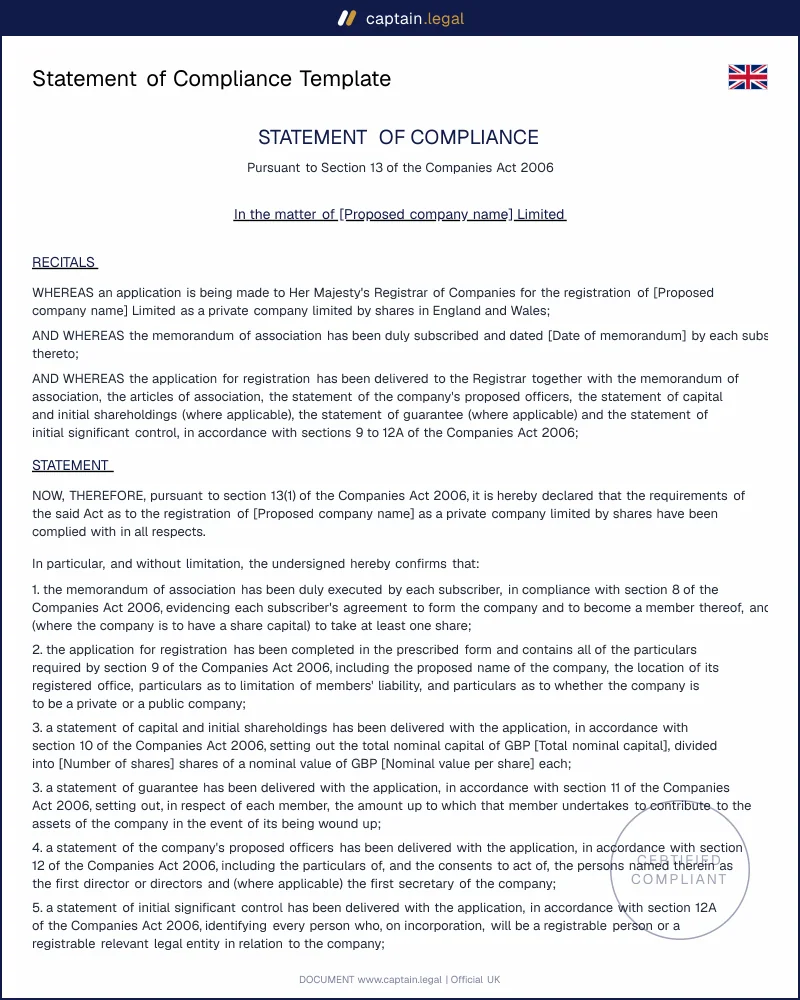
The substance is narrow but consequential. The signatory states, on the strength of the documents being filed, that the company being registered satisfies every condition the Act imposes on incorporation : a permitted name, a registered office in England and Wales, Wales, Scotland or Northern Ireland, a memorandum subscribed by at least one person, a set of articles (or reliance on the Model Articles), particulars of proposed directors and, where applicable, a secretary, a statement of capital and initial shareholdings or a statement of guarantee, and a statement of the persons with significant control. The signatory is not certifying that the business plan is sound or that the directors are suitable ; the statement is purely procedural, but the legal exposure attached to it is real. A clear set of Companies Act 2006 compliant business templates reduces the risk that a subscriber inadvertently signs off on filings that are themselves incomplete.
Legal framework
The statement of compliance is governed by section 13 of the Companies Act 2006, which provides that "the statement of compliance required to be delivered to the registrar is a statement that the requirements of this Act as to registration have been complied with" and that the registrar may accept that statement as sufficient evidence of compliance. The provision works in tandem with section 9, which lists every document an applicant must lodge with the registrar, and with sections 10 and 11, which prescribe the exact contents of the statement of capital and initial shareholdings or the statement of guarantee. Together these four sections form the statutory backbone of every UK incorporation.
Liability for a defective statement is set out in section 1112 of the Act. Knowingly or recklessly delivering a document, or making a statement, that is misleading, false or deceptive in a material particular is a criminal offence carrying a fine and, on indictment, imprisonment of up to two years. The offence applies to subscribers, directors, agents and anyone else involved in the filing. Inadvertent inaccuracies do not trigger section 1112, but reckless ones do, and the Kevin Brewer prosecution of 2018 confirmed that Companies House is willing to take individuals to court rather than treat the section as ornamental. You can read the full text of section 13 on the official UK statute book, the legislation.gov.uk reference page for section 13 of the Companies Act 2006.
The Economic Crime and Corporate Transparency Act 2023 layered new duties on top of the original framework. Since 2 May 2024, the registrar has the power to issue civil financial penalties of up to £10,000 for a wide range of Companies Act 2006 offences without needing a criminal prosecution. From 18 November 2025, every new director must complete identity verification with Companies House and produce a personal code at the point of incorporation, so a statement of compliance signed for a company whose directors have not verified is itself defective. The lawful purpose declaration introduced for confirmation statements has equivalent effect at incorporation.
When do you need this document?
The most frequent trigger is the formation of a private company limited by shares. Whether the founders file IN01 online, on paper, or through a formation agent, a statement of compliance must accompany the application or the registrar will reject the bundle. Public companies, companies limited by guarantee and unlimited companies follow the same logic with adjusted supporting statements. Limited liability partnerships use a parallel form, LL IN01, with its own statement of compliance under the Limited Liability Partnerships Act 2000 read with the Companies Act 2006 provisions applied to LLPs.
A second context is the re-registration of a company changing status, for instance a private limited company moving to public limited status under section 90 of the Act, or a public company re-registering as private under section 97. Each re-registration triggers its own statement of compliance, confirming that the conditions specific to the new status are satisfied. The two statements are not interchangeable, and re-using the original incorporation declaration in a re-registration filing is a textbook reason for rejection.
A third, narrower scenario sits in section 24 of the Act. When a company has entrenched provisions in its articles and later amends them, the amendment must be accompanied by a separate statement of compliance confirming that the conditions for variation laid down in the articles have been observed. This statement is rarely needed but, where applicable, missing it invalidates the amendment as far as Companies House is concerned. Founders setting up alongside shareholder agreements and founders' arrangements should anticipate which constitutional events will require a fresh statement and which will not.
Key clauses included in our template
The Captain.Legal Statement of Compliance template is drafted to track section 13 and the registrar's accepted wording, so that the document slots cleanly into a paper IN01 bundle or into an electronic filing made through an authorised software provider. The clauses below are the load-bearing ones.
- The identification block names the proposed company, states the form of incorporation (limited by shares, limited by guarantee, unlimited, public), and records the jurisdiction of the registered office, in line with section 9(2). A mismatch between this block and the IN01 application is the single most common ground for rejection by Companies House examiners.
- The declaration of compliance itself reproduces the operative wording of section 13(1) : a statement that the requirements of the Companies Act 2006 as to registration have been complied with. The template avoids paraphrase here on purpose. The registrar's rules under section 1068 prescribe the form, and replacing the statutory wording with a personal formulation is one of the few drafting decisions that creates real risk.
- The authoriser identification records who is making the declaration and in what capacity, mapping to the IN01 distinction between P1 (compliance delivered by the subscribers) and P2 (compliance delivered by an agent acting on their behalf). The template captures full name, residential or service address, and signature date, and reminds the agent that an agent's authority must be in place at the moment of signature, not retrofitted afterwards.
- The section 1112 acknowledgement sits at the foot of the declaration. It is not strictly required by statute, but every well-drafted statement now includes it because it forces the signatory to confront the criminal exposure attached to a false declaration. Removing this acknowledgement is a false economy — examiners read it as a signal of careless drafting.
- The identity verification reference is the post-ECCTA addition. The template provides a field for each director's Companies House personal code, which must be produced at incorporation since 18 November 2025. The statement of compliance cannot be honestly signed if any director on the IN01 has not completed verification.
How to fill out this statement of compliance
You start by selecting on Captain.Legal whether the company is being incorporated by a subscriber acting alone, by several subscribers, or by a formation agent. The template adjusts the authoriser block to match the P1 or P2 pattern used by Companies House, so the signature lines line up with the IN01 fields without manual re-typing. From there, you enter the proposed company name exactly as it appears on the application, the registered office jurisdiction, and the company type ; the document populates the identification block and inserts the correct cross-references to the Companies Act 2006 sections that apply to that type of company.
The next stage handles the people. You add each subscriber, then each proposed director, with the Companies House personal code generated during identity verification. The template flags any director without a recorded personal code, because the statement cannot be truthfully signed in their absence. Once the signature date is set, you download the document in Word or PDF depending on whether you intend to file by post, retain a counterpart for the company's statutory books, or attach a scanned copy to an electronic filing. Founders setting up the rest of their constitutional pack will usually want to combine this statement with bespoke articles of association and shareholder documents for UK companies drafted to the same standard.
Common mistakes to avoid
The first mistake is to treat the statement as a formality and sign it before the rest of the IN01 bundle is finalised. The declaration relates to the documents as filed, so any post-signature change to the articles, to the share capital, or to the directors' details makes the statement inaccurate at the moment of delivery. A second, related error is signing as agent without holding clear written authority from the subscribers. Companies House routinely accepts P2 statements at face value, but if the underlying authority is challenged later, the agent personally carries the section 1112 exposure with no easy way to deflect it onto the founders.
The third recurring failure concerns identity verification. Statements drafted before 18 November 2025 did not need to address verification at all ; statements drafted afterwards must, and a generic template silently omits the field. Filing such a template is technically a misrepresentation that all Companies Act requirements have been met. A fourth mistake is over-drafting : adding warranties about solvency, business purpose or director suitability that go beyond what section 13 requires. These extra warranties create civil liability between founders and the agent without adding anything Companies House asks for. Finally, founders sometimes try to recycle the incorporation statement when re-registering the company under section 90 or section 97. The conditions are different, the wording is different, and the registrar will reject the filing. A separate statement keyed to the re-registration provisions is the only safe approach. Reviewing the broader employment and HR pack for a newly incorporated UK company and the personal documents typically signed by directors at formation at the same time helps catch these issues before signature rather than after.
Frequently Asked Questions
13 verified reviews · 50 000+ downloads
- Immediate access to the document
- PDF + Word download
- Compliant with 2026 legislation
- Reviewed by lawyers
You might also like