Business

Director Resignation Letter UK: Resign as a Company Director (Word, PDF)

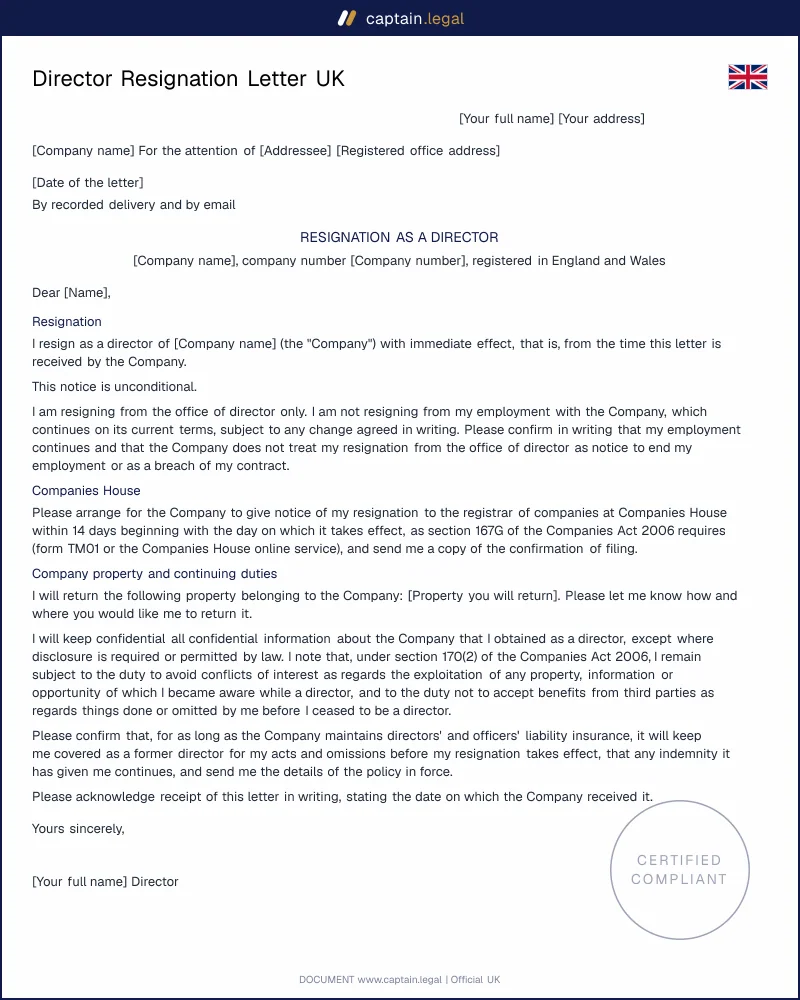
Resign from the board of a private limited company in England and Wales with a clear, unconditional notice. The letter asks the company to file form TM01 within 14 days and deals with employment, bank mandates, guarantees, property and insurance.
4.7/5— 21 reviewsEngland & Wales law 2026Instant download
Share

A director resignation letter is the written notice a director sends to a private limited company in England and Wales to step down from the board. It fixes the moment the office ends, asks the company to file the change at Companies House within 14 days, and deals with the loose ends that catch people out later: bank mandates, personal guarantees, company property and insurance cover. It suits executive directors with a service agreement, non-executives with a letter of appointment, and owner-managers who hold the office with no contract at all. Scottish and Northern Irish companies, public companies and LLPs are outside its scope.

Compliant

2026 Legislation

50,000+ clients

trust us

Affordable

From $4.90 / doc

Secure payment

Instant download

Director Resignation Letter UK: Resign as a Company Director (Word, PDF)

Secure payment

Fill in the template

What is a director resignation letter?

Legally, a director resignation letter is a notice of resignation from office addressed to the company itself, not to the shareholders and not to Companies House. Under the model articles, which many private companies formed since 2009 use, a person stops being a director as soon as the company receives that notice, or on the later date the notice gives. No board meeting is needed and nobody has to accept it. That is why the wording matters: "I would like to resign, subject to your agreement" invites an argument about whether anything happened, while an unconditional notice closes the point. Once the company has it, you normally cannot take it back without its consent.

It is not an employee's resignation letter. An executive director on the payroll holds two separate positions, and leaving the board does not by itself end the employment contract or service agreement. Nor is it the filing: form TM01 is the company's notification to the registrar, and your letter is the evidence that triggers it. Many resignations sit inside a wider exit, and the UK business templates for limited companies cover the documents that usually travel with it.

When do you need this document?

The most common trigger is a change of control. A buyer takes over the shares, the outgoing founder agrees to leave the board on completion, and the buyer's solicitors want a signed director resignation letter in the completion bundle. Founder disputes come next. The director who wants out should resign cleanly rather than stop attending, because an absent director keeps every statutory duty. Where shares change hands too, a shareholders agreement for a UK private company often contains leaver clauses that decide what happens to them.

Non-executives resign for quieter reasons: a new role with a conflict, the end of a term, a disagreement they want on record. Their letter of appointment often sets a notice period, and you can pick a resignation date that respects it. Executive directors face a sharper question. If you hold a director's service agreement for an executive role, leaving the board may count as notice to end your employment, or even as a breach, depending on the drafting.

Two edge cases deserve care. A sole director who resigns leaves the company unable to act, so the letter asks for a replacement. A director who has given a personal guarantee to a bank or landlord stays liable after resigning, so the letter raises it instead of leaving it buried.

Key clauses included in our template

The opening block identifies you, the company and its number, and states the resignation in one sentence: with immediate effect on receipt, or from the end of a chosen day "or from the time this letter is received by the Company if that is later", which stops a late delivery from becoming a backdated resignation. A separate sentence confirms the notice is unconditional. Depending on your role, the letter then keeps your employment going and asks the company to confirm it will not treat the resignation as notice or a breach, gives notice under your contract with your last working day, ends a non-executive appointment and asks for fees up to the effective time, or simply asks for unpaid expenses. Optional lines resign you as company secretary and from named board committees, and record that the letter itself does not affect your shares.

The administrative core asks the company to file within 14 days, citing section 167G, and to send you the confirmation, with a matching request under section 279G for a secretary. Where relevant, it asks the company to remove you from its bank mandates and to work on your release from any guarantee you describe.

The closing block covers company property, confidentiality "except where disclosure is required or permitted by law", the section 170(2) duties, and an optional request to keep you covered by the company's directors' and officers' insurance. A statement that you have no claim for loss of your office is optional, off by default, and carves out salary, fees, expenses and employment rights.

How to fill out this director resignation letter

You start by saying what else you are to the company: an employee, a non-executive with a letter of appointment, or a director with no contract. That answer decides which paragraphs appear, so an unpaid owner-manager never sees employment wording. The next screens collect your details, the company name, number and registered office, the addressee and the date.

Delivery and timing come together. The default combines recorded delivery with email, because a company only has to accept documents by email if it has agreed to. You then pick immediate effect or a date, and say whether another individual director will remain. Short questions follow on the secretary role, committees, bank mandates, guarantees, property and insurance, each with a help note explaining the consequence. The preview updates as you go, and the catalogue of UK legal documents lists the other templates you may need for the same exit.

Common mistakes to avoid

The first mistake is sending a director resignation letter only by email to a company that never agreed to electronic communications, then finding nobody can say when it arrived. Post a paper copy to the registered office and keep proof. The second is backdating. Directors who left informally months ago are tempted to write an old date, but a resignation cannot take effect before the company receives it. The third is treating the office and the job as one thing: an executive who resigns from the board in anger, without reading the service agreement, can hand the company an argument that he has resigned his employment too.

Personal guarantees cause the most expensive surprises. Resigning as a director does not release a guarantee, and unless the guarantee itself lets you end it by notice, usually for future debts only, in most cases only the creditor can release you. The last mistake is assuming the filing will happen. In owner-managed companies the person who should file the TM01 is often the one who just left, so check the public register about 14 days after your resignation takes effect, and remind the company in writing before contacting Companies House. Until the register is updated, suppliers and lenders may still treat you as a director.

Key takeaways

MODEL ARTICLES

Resignation takes effect when the company receives it

Under the model articles, a director ceases to hold office as soon as the company receives the notice of resignation, or on the later date the notice gives. The board does not need to accept it, and once received it cannot normally be withdrawn without the company's agreement. A resignation can never be backdated, so the letter says it takes effect on the date chosen or on receipt, whichever is later. Send a paper copy to the registered office.

SECTION 167G

The company must tell Companies House within 14 days

Since 18 November 2025, section 167G of the Companies Act 2006 requires the company to notify the registrar within 14 days beginning with the day the director ceases to hold office, on form TM01. The duty falls on the company, not on the departing director, and an unexcused failure to file is an offence. The letter asks for the filing and a copy of the confirmation, and a former company secretary is covered by a parallel notice on form TM02.

EMPLOYMENT

Leaving the board does not end your employment

An executive director holds two positions: the office of director and a contract of employment or service agreement. Resigning from the board does not by itself end the employment, but some service agreements treat it as notice or as a breach. The letter either asks the company to confirm that your employment continues, or gives notice under your contract with your last day. Any waiver of employment claims needs a settlement agreement instead.

Frequently Asked Questions

Yes, once the company receives it. Under the model articles, the resignation takes effect on receipt or on the later date stated, and the board does not need to accept it. As a unilateral notice it needs no witness and no deed, only your signature. Its requests are different: filing at Companies House, releasing a guarantee or confirming insurance cover depend on the company acting, and the filing duty under section 167G of the Companies Act 2006 stays with the company. If the company has bespoke articles, check them for any notice period or formality first.

Fourteen days, beginning with the day your resignation takes effect, using form TM01 or the online service. Resign with immediate effect on 3 March and the last day to file is 16 March. Your letter asks the company to send you the filing confirmation, the simplest way to check the deadline was met. A former secretary needs a separate notice on form TM02, with the same limit. Failing to file without reasonable excuse is an offence by the company and every officer in default, which tends to concentrate the minds of the remaining directors.

You can, but the company will then breach the rule that a private company must have at least one director, and at least one who is an individual. In practice a replacement should be appointed first. Under the model articles you can appoint one yourself by a decision of the directors while you are still in office, or the shareholders (members of a guarantee company) can do it by ordinary resolution, and the new director's identity must be verified before the appointment is notified. A resignation date a few weeks ahead gives them time. The letter explains the position and asks the company to arrange an appointment without delay. If nobody acts, the Secretary of State can direct the company to appoint a director within one to three months.

No. The office of director and a contract of employment are separate, so leaving the board leaves your job in place unless you also give notice. Read your service agreement first, because some treat resigning as a director without the board's consent as notice from you, or as a breach. The template handles both routes: it asks the company to confirm that your employment continues, or gives notice under your contract with your last day. An agreement to waive employment claims belongs in a settlement agreement under UK employment law, never in a resignation letter.

Only if the company or a buyer has asked for it, typically on a share sale. The statement in this template is narrow: it covers compensation for loss of your office as a director and nothing else, and a carve-out keeps your salary, fees, expenses and, for employees, every right connected with the employment. That scope matters because, under section 203 of the Employment Rights Act 1996, most statutory employment claims can only be given up through a settlement agreement meeting strict conditions, or through ACAS conciliation. If you think you may have a claim, leave the statement out.

The letter downloads as an editable Word file and as a PDF. Word helps if the company's solicitors want a change before completion of a sale; the PDF is the version to sign and send. Keep a signed copy, the proof of postage or delivery, and the covering email. Together they answer the question most later disputes turn on: when the company received the notice. If you sit on the boards of several group companies, prepare one letter per company, since each one files its own notice at Companies House.

4.7/5

21 verified reviews · England & Wales law 2026

Director Resignation Letter UK: Resign as a Company Director (Word, PDF)
  • Immediate access to the document
  • PDF + Word download
  • Compliant with 2026 legislation
  • Reviewed by lawyers
Fill in the template
Secure payment
Updated on November 12, 2026

You might also like

Online Shop Terms and Conditions UK
Memorandum of Association Template