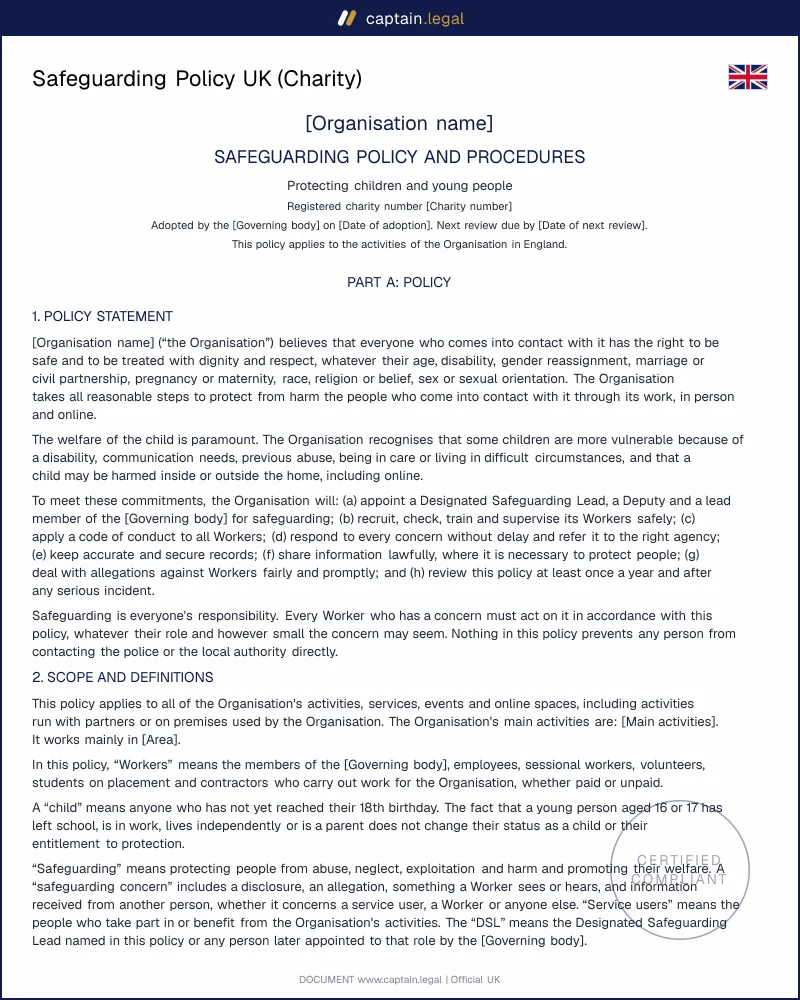
There is no single "Safeguarding Act". The framework is a patchwork, and the policy has to reflect each piece. For charities, the starting point is the Commission's guidance, which expects trustees to appoint a safeguarding lead, risk-assess every role for criminal record checks, publish their policies and review them at least once a year and after any serious incident. The Charity Commission guidance on safeguarding and protecting people is the benchmark your trustees will be measured against if something goes wrong.
For children, the Children Act 1989 gives the local authority its duty to make enquiries under section 47 where it suspects significant harm, and Working Together to Safeguard Children explains how voluntary organisations fit into local arrangements, including the rule that the Local Authority Designated Officer (LADO) is informed within one working day of an allegation against someone who works with children. For adults, section 42 of the Care Act 2014 defines the adult at risk and the local authority's enquiry duty, and the Care and support statutory guidance lists the ten types of abuse and neglect that the template reproduces.
Recruitment sits under the Safeguarding Vulnerable Groups Act 2006 and Part V of the Police Act 1997. Since 1 September 2026, supervision no longer takes a volunteer out of regulated activity if they work with children often enough or overnight. Section 35 of the 2006 Act obliges a regulated activity provider to refer to the DBS anyone it removes from regulated activity for harm or relevant conduct. The Crime and Policing Act 2026 adds a personal duty to report suspected child sex offences, which applies once section 85 is brought into force; the template is drafted for that switch. Information sharing rests on the UK GDPR and paragraph 18 of Schedule 1 to the Data Protection Act 2018. Wales, Scotland and Northern Ireland run separate procedures, so the policy is scoped to England.

 England & Wales law 2026