Non-Profit

Club Constitution UK: Unincorporated Association Constitution Template

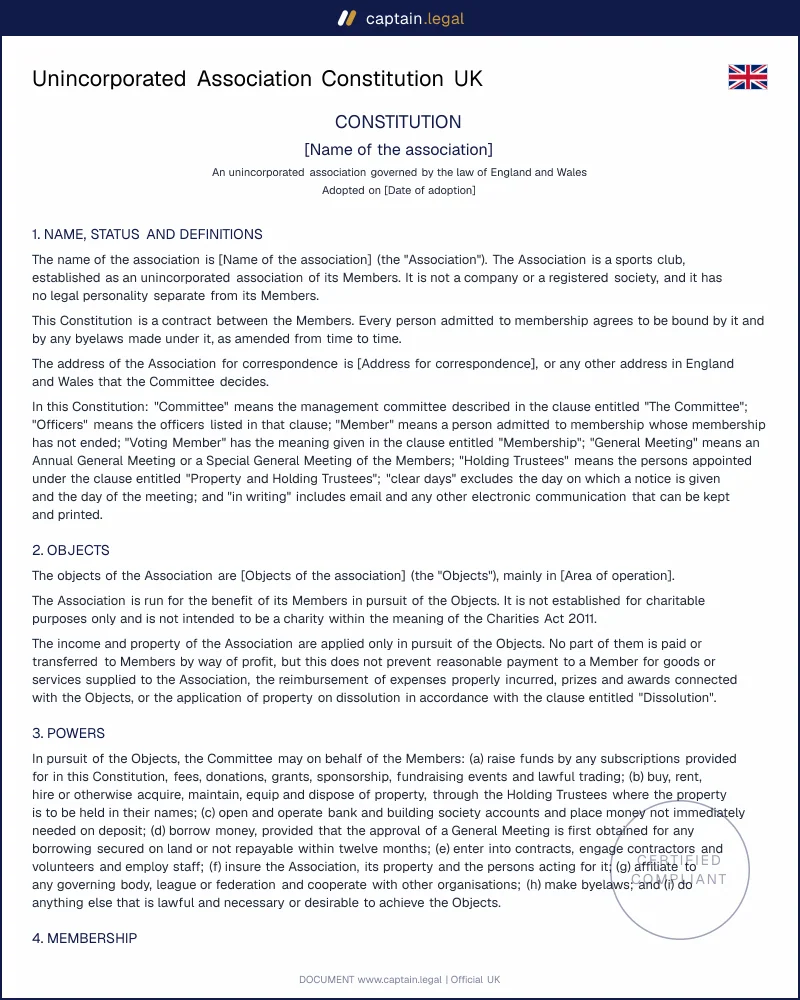
Constitution for a sports club, social club, residents' association, community group or hobby society in England and Wales that is not a charity: membership, committee, meetings, finance, holding trustees, optional bar rules and dissolution, in Word and PDF.
4.7/5— 18 reviewsEngland & Wales law 2026Instant download
Share

A club constitution UK groups rely on is the written rulebook of an unincorporated association: the sports club, social club, residents' association, community group or hobby society that has members, a committee and a bank account but no company behind it. This template is drafted for associations based in England and Wales that are run for their members rather than as charities. It sets out who can join, how the committee is elected, how meetings work, who signs cheques, who holds the clubhouse lease and what happens to the money if the club closes. Banks, funders and leagues usually ask to see a signed constitution, and members rely on it when a dispute about subscriptions, discipline or elections comes up.

Compliant

2026 Legislation

50,000+ clients

trust us

Affordable

From $4.90 / doc

Secure payment

Instant download

Club Constitution UK: Unincorporated Association Constitution Template

Secure payment

Fill in the template

What is a club constitution in the UK?

An unincorporated association is not a legal person. In Conservative and Unionist Central Office v Burrell the Court of Appeal described it as two or more people bound together for common purposes that are not business purposes, by mutual undertakings set out in rules that say who controls the organisation and its funds, which people can join or leave at will. Those rules are the constitution, and in law they are a contract between the members. No statute prescribes their form, which is why so many clubs run on a typed page written decades ago.

That freedom has a cost. Because the association cannot own property or sign a contract in its own name, someone always does it personally: the treasurer who opens the account, the trustees who hold the lease. A good club constitution in the UK decides in advance who acts, within what limits and with what indemnity. It differs from a charity's governing document, confined to charitable purposes for the public benefit, and from the articles of a company or a CIO, which create a separate legal person. If the members want limited liability and land in the group's own name, a company limited by guarantee or, for a charitable group, a CIO constitution for charitable groups is the better route.

When do you need this document?

The most common trigger is the bank. Opening an account in a group's name almost always requires a constitution naming the officers and the signing rules. Grant applications are the second: community funds and local authorities want evidence that money will be controlled by more than one person and that assets will not simply be shared out if the group folds.

Newly formed groups adopt it at the founding meeting, so that the first committee is elected under agreed rules. Older clubs reach for it when an informal arrangement breaks down, typically after a disputed expulsion or election. A residents' association needs one before a landlord or council will recognise it, and a sports club usually needs one to affiliate to its league.

Two situations deserve care. A club taking a lease of a clubhouse needs the holding trustee clauses in place before completion, because the landlord will contract with named individuals. A club that wants to run a bar needs the licensing rules written in before it applies for a certificate, since the rules go with the application.

Key clauses included in our template

The template is built in nineteen clauses, eighteen when the club does not supply alcohol, and the numbering adjusts itself. The core of the document covers what members fight about most:

  • Membership comes in one class of voting members or in three categories (Full, Junior and Social), with parental consent for under 18s and a register kept by the committee.
  • Subscriptions are fixed at the AGM, written as a fixed amount, or dropped altogether; arrears suspend voting and can end membership after fourteen clear days' notice.
  • Expulsion follows a fair procedure: written allegations, a hearing, a two-thirds committee vote and an appeal to a panel of three members with no involvement in the case.
  • Where property is involved, two to four adult holding trustees hold land, leases and investments on trust for the members and act only on committee resolutions.
  • On dissolution the surplus is divided equally among voting members or given to a similar body or a charity, as you choose.

Around that core sit the committee rules (officers, co-option capped at one third, quorum, conflicts of interest), general meetings with optional online attendance, two signatories for every payment, a choice between an independent examiner, two members or no outside check of the accounts, limits on members' liability with an indemnity for those who act for the club, insurance, data protection under the UK GDPR (a website privacy policy for UK GDPR is the natural companion if the club collects data online), byelaws, disputes and amendment by a two-thirds majority.

How to fill out a UK club constitution

The questionnaire on Captain.Legal opens with the name of the association, its address and the area where it operates. You then choose the type of group and write the objects, starting each with "to". The help text warns you if the objects look wholly charitable, because that changes the document you need.

From there the form asks about membership categories and the minimum voting age, then how subscriptions are set; the amount appears only if you choose a fixed figure. The next screens cover the officers, the size and quorum of the committee, the notice period and quorum for general meetings, the number of members who can force a special meeting and whether members may join online. Finance comes next: the financial year end and who checks the accounts. The last questions deal with the bar, the destination of any surplus on dissolution, the adoption date and the names of the chair and secretary who sign.

The preview on the right updates as you answer, and clauses that do not apply drop out with the numbering corrected. Approve the final text at a members' meeting, minute the vote (an AGM minutes template shows the usual structure) and keep the signed copy with the club records.

Common mistakes to avoid

The mistake we see most often is a home-made UK club constitution that claims the club owns its pavilion. It cannot. Land and leases sit with individuals, and adopting a constitution transfers nothing: a separate deed or transfer, and for registered land an application to HM Land Registry, is still needed. A close second is objects copied from a charity's governing document, which can turn a members' club into an unregistered charity without anyone noticing. Clubs also set a general meeting quorum they never reach; pick a realistic number and rely on the adjourned meeting rule.

Committees often sign contracts in their own names without authority, assuming the club will pay. Between members, the template limits each member's exposure, but it cannot stop a supplier suing the person who signed, so only sign what the committee has approved and insure. Licensed clubs forget to notify the licensing authority within 28 days after changing their rules, which is an offence for the secretary under section 82 of the Licensing Act 2003. Finally, a club that already has rules must adopt the new text under the amendment procedure of the old ones, not at a meeting called at short notice.

Key takeaways

PROPERTY

The club cannot own its clubhouse in its own name

An unincorporated association has no legal personality, so land, leases and investments are held by individual holding trustees on trust for the members. No more than four people can hold land (section 34 of the Trustee Act 1925), and they must be adults. Adopting the constitution transfers nothing: a separate deed or transfer is needed, an application to HM Land Registry for registered land, and often the landlord's consent for a lease.

CHARITY TEST

Wholly charitable objects make the group a charity

Under section 1 of the Charities Act 2011, a body established for charitable purposes only is a charity whatever it calls itself, and amateur sport and community development are charitable purposes. A club run for its members' benefit is not. If every object is charitable and for public benefit, use a charity constitution instead, and register with the Charity Commission once gross income exceeds five thousand pounds a year.

LIABILITY

Whoever signs a contract can be sued personally

The rules can limit what each member owes to sums due under the constitution, but that limit only works between members. A treasurer or chair who signs a lease, a loan or a supplier contract is normally liable to the other party. The template lets only people authorised by the committee commit the club, indemnifies them from club funds and requires suitable insurance, including employers' liability cover if anyone is employed.

Frequently Asked Questions

Yes, between the members it operates as a contract. Each person admitted agrees to the rules, and a court can enforce them, for example by setting aside an expulsion made without a fair hearing. It does not bind outsiders in the same way. A supplier who contracted with the treasurer can still pursue the treasurer personally, which is why the template restricts who may commit the club and gives those people an indemnity from club funds. For land, the legal title still has to be put in the names of the holding trustees by deed.

Both formats are available once the questionnaire is complete. The Word version suits clubs that want to add the logo before the founding meeting, while the PDF is the cleaner copy for the bank, the league and the noticeboard. Keep one signed original with the minutes of the meeting that adopted it. If the club later needs related paperwork for meetings, the full UK document catalogue lists every template by category.

It takes effect when the members approve it at a meeting, so the practical delay is the notice period. A brand new group can adopt it at its founding meeting the same evening. An existing club must follow its current rules, typically 14 or 21 clear days' notice with the full text of the proposal attached, before the vote. The bank then needs the signed copy to update the account mandate. A licensed club must also send the amended rules to the licensing authority within 28 days after the change.

Not if it is a genuine members' club. Registration only concerns charities, meaning bodies whose purposes are all charitable and for the public benefit. A club that exists for its members' enjoyment or can share its assets among members on dissolution is not established for charitable purposes only. The picture changes when the objects are entirely charitable, for instance amateur sport open to everyone in the area: the group is then a charity and must register once its income passes the statutory threshold. The UK nonprofit templates include constitutions for that case.

The holding trustees own the legal title, on trust for the members under the constitution. Members have no individual share they can sell or take with them. The template allows two to four trustees, the maximum for land, who act only on committee resolutions. When a trustee dies or resigns, the committee picks a replacement, the chair and secretary sign the deed and the Land Registry entry is updated. Leases often need the landlord's consent before a new trustee takes over, so check the lease before the change.

They can. Because the club has no separate identity, whoever signs a contract or orders goods is normally the party liable to the supplier. The template reduces the risk in three ways: nobody may commit the club without committee authority, those who act within that authority are indemnified from club funds, and the committee arranges suitable insurance, including employers' liability cover if the club employs staff. The indemnity is only as good as the club's funds, so large building projects are often a reason to incorporate.

Dissolution needs a two-thirds majority at a general meeting called on proper notice. The committee then collects the assets and pays the debts and the costs of winding up. Under the template you choose in advance what happens to the remainder: equal shares for the voting members at the date of the resolution, or a gift to a similar body or a charity. Grant-funded groups usually pick the second option. Assets given on special terms, such as a grant that must be repaid, follow those terms.

4.7/5

18 verified reviews · England & Wales law 2026

Club Constitution UK: Unincorporated Association Constitution Template
  • Immediate access to the document
  • PDF + Word download
  • Compliant with 2026 legislation
  • Reviewed by lawyers
Fill in the template
Secure payment
Updated on November 12, 2026

You might also like

Trustee Appointment Letter UK
Charity Conflict of Interest Policy