Business

Terms of Business UK: B2B Terms and Conditions for Services Template

Standard terms of business for a UK service provider selling to businesses under the law of England and Wales: orders, charges, payment and late payment interest, liability cap, IP, confidentiality, data protection and termination, with an order acceptance form.
4.6/5— 17 reviewsEngland & Wales law 2026Instant download
Share

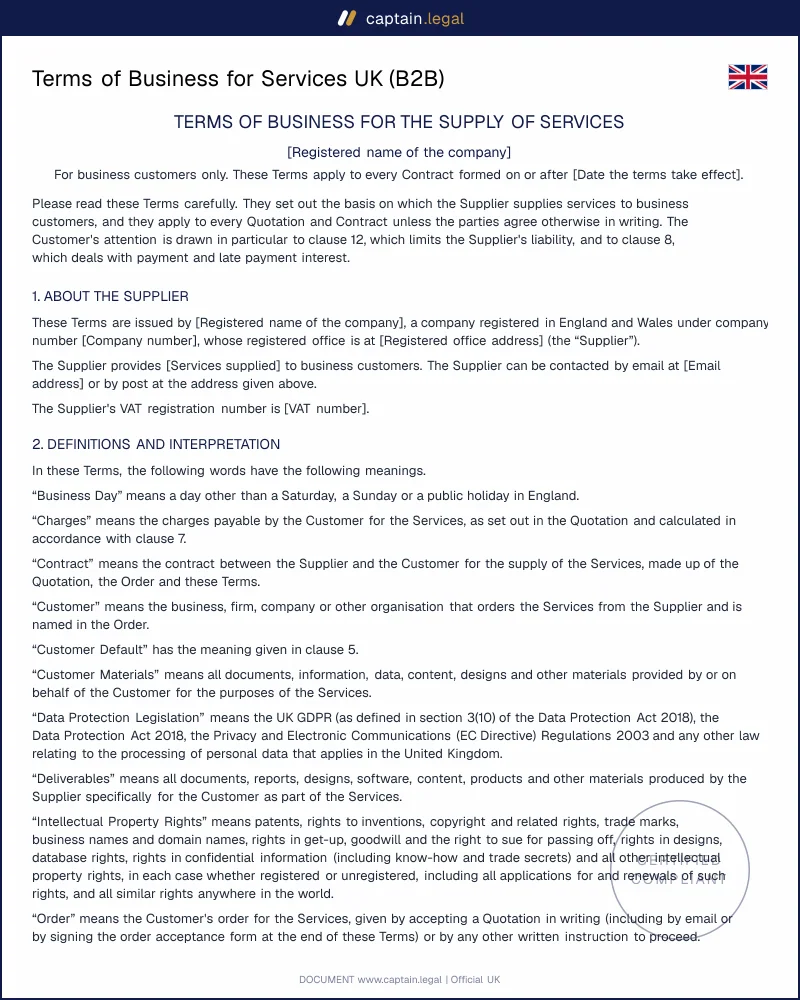
Terms of business UK service providers send with their quotes decide who carries the risk when a job goes wrong, when invoices fall due and who owns the finished work. This template is written for consultants, agencies, freelancers, professional firms and trades who sell services to other businesses under the law of England and Wales. You choose your legal form, how you charge, your payment term, the liability cap and who owns the deliverables, and the wizard builds a set of B2B terms and conditions for services with 23 clauses and an order acceptance form. Prices and scope stay in your quotation, so one document covers every customer.

Compliant

2026 Legislation

50,000+ clients

trust us

Affordable

From $4.90 / doc

Secure payment

Instant download

Terms of Business UK: B2B Terms and Conditions for Services Template

Secure payment

Fill in the template

What are terms of business in the UK?

Terms of business are the standard contract terms a supplier offers to every customer, as opposed to a contract negotiated line by line for one deal. English law treats them as part of the contract only if they are incorporated before the contract is made, which in practice means sending them with the quotation and getting the customer to accept that quotation in writing. The quotation says what you will do and for how much; the terms say what happens around it, from late payment to termination. Nothing about price is hard-coded, so the same terms work for a fixed-price project, hourly work or a monthly retainer. Other company documents, from articles to a shareholders' agreement, sit in the UK business templates section.

The key word is business. Clause 3 asks the customer to confirm it is buying in the course of its business. A consumer buying services gets non-excludable rights under Chapter 4 of Part 1 of the Consumer Rights Act 2015, and a B2B document cannot reflect those rules properly. If you sell goods online to the public, use our online shop terms and conditions for consumers instead.

When do you need terms of business for services?

The obvious moment is when you start quoting for work in writing. A marketing consultancy sending a proposal, a software house issuing a statement of work and an electrician pricing a shop fit-out face the same problem: without their own terms, the contract is whatever the email chain says, plus the implied terms of the 1982 Act. A second trigger is the customer's purchase order. Larger buyers often send POs printed with their own conditions, and under the "last shot" approach in Butler Machine Tool v Ex-Cell-O the last set of terms put forward before performance tends to win. Terms that exclude purchase order conditions, and that form the contract only when you confirm or start work, put you back in control.

Retainers are another strong case, because a monthly fee needs rules on what it covers, whether unused hours roll over and how much notice ends the deal. Professional firms have a regulatory reason too: the Provision of Services Regulations 2009 require a provider to give business customers its legal status, address, VAT number, professional body and any compulsory insurance details. One edge case deserves a warning. If you are an individual who will work under a client's direction for months, the off-payroll rules make a UK contractor agreement drafted around IR35 the better fit.

Key clauses included in our template

The clauses below are the ones that change outcomes when a relationship turns sour.

  • Formation comes first: a quotation is only an invitation, the customer's order is the offer, and the contract forms when you confirm in writing or begin work, so a purchase order cannot slip its own conditions in.
  • On money, you pick a payment term in days, with statutory interest under the 1998 Act, a bar on set-off, a 10 Business Day window to dispute an invoice and a right to suspend work on 7 days' notice once an undisputed sum is 14 days overdue.
  • Where should liability stop? You choose between total charges, charges for the last 12 months or a fixed insured amount, and loss of profit and indirect loss are excluded for both sides, while the care and skill duty of section 13 stays in place.
  • Ownership of the deliverables either passes to the customer once paid for, with your existing tools licensed rather than transferred, or stays with you under a perpetual licence. Confidentiality lasts five years, and for pre-contract talks you can pair it with a mutual or one-way UK NDA.
  • A data protection clause sets out the Article 28 processor terms of the UK GDPR as a fallback.

Termination works by notice without reason for ongoing work, or immediately for unremedied material breach or insolvency (subject to section 233B), with a payment rule for each route. A deposit is a payment on account credited against your invoices rather than a forfeit, which keeps it clear of the penalty rule in Cavendish Square Holding v Makdessi.

How to fill out these UK terms of business

You start by choosing your legal form: limited company, LLP, sole trader or partnership. The wizard then asks only for the matching details, such as the registered number and office for a company or the business address for a sole trader, and whether you trade under a different name, because the Companies Act 2006 requires both names to appear. Next come your contact email, a short description of your services and the date from which this version applies.

The VAT and professional questions decide whether your VAT number appears and whether a paragraph on your professional body and compulsory insurance is added. Then you choose how you charge; if pricing varies from job to job, leave the basis to each quotation and the terms keep all three regimes. The remaining screens cover the deposit, payment term, notice period, liability cap, ownership of the work, portfolio use, non-solicitation of staff and whether disputes go to mediation before court. The preview updates as you answer.

Common mistakes to avoid

The most expensive mistake is sending your UK terms of business after the job has started. Terms first seen on an invoice usually come too late to be part of the contract, and the customer can argue that only the quotation and the implied terms apply. Attach them to the quotation, refer to them in it and keep the signed order acceptance form or the confirming email. A close second is setting a liability cap you are not insured for. A token cap on a large project is exactly what courts strike down under UCTA, leaving you with unlimited liability.

Payment terms cause the next round of problems. Suppliers who agree 90 days to win a big client forget that the 1998 Act lets statutory interest start at day 60 unless the longer term is not grossly unfair, and Parliament is considering a Commercial Payments Bill that would cap most terms at 60 days. When an invoice is overdue, chase it in writing and, if needed, send a letter before action for an unpaid debt before issuing a claim. Finally, check the ownership choice against your business model. An agency that assigns all rights but reuses its own code or templates must keep those tools out of the assignment, which is why the template excludes Supplier Materials.

Key takeaways

INCORPORATION

Your terms only count if sent before the order

Standard terms bind a business customer only if they were brought to its attention before the contract was made. Send them with every quotation and treat the customer's written acceptance as the offer, which you accept by confirming in writing or starting work. Otherwise a purchase order printed with the buyer's own conditions can win the battle of the forms, because the last terms put forward before performance usually prevail.

LIABILITY CAP

A cap must pass the UCTA reasonableness test

Under the Unfair Contract Terms Act 1977, liability for death or personal injury caused by negligence can never be excluded, and any cap in written standard terms must be reasonable, with the supplier bearing the burden of proof. Courts look at the resources and insurance available to the supplier. A token cap does not shrink to a fair figure when it fails: it falls away completely, leaving the supplier with unlimited liability.

LATE PAYMENT

Statutory interest applies to every late invoice

The Late Payment of Commercial Debts (Interest) Act 1998 lets a supplier claim interest at 8 per cent above the Bank of England base rate on overdue business invoices, plus a fixed sum for recovery costs that rises with the size of the debt. Where the agreed payment term is longer than 60 days, interest can still run from day 60 unless that longer term is not grossly unfair to the supplier.

Frequently Asked Questions

They can be. Signature is not required for a contract between businesses in England and Wales; what matters is that the terms reached the customer before the contract was made and that it accepted the quotation on that basis. An email saying "please go ahead" in reply to a quotation with the terms attached is usually enough. The order acceptance form, signed by both sides, also gives you the written signature that section 90(3) of the Copyright, Designs and Patents Act 1988 requires for an assignment of copyright, and the opening paragraph draws attention to the liability clause.

Neither. The terms are built for business customers, and consumer contracts for services fall under the Consumer Rights Act 2015, which overrides several clauses here and requires different remedies. They are also written for a supplier established in England and Wales: Scotland and Northern Ireland have their own contract law. A business customer based elsewhere, including in Scotland, can still agree that the law of England and Wales governs the contract and that its courts have exclusive jurisdiction, as clause 23 provides. If you also sell to the public, look through our full catalogue of UK legal documents for consumer-facing documents.

Yes, both formats are available once you finish the questionnaire. Keep the Word file if you expect to adjust wording for a sector or add a schedule of standard rates; the PDF is easier to attach to quotations and publish on your website. When you update the terms, change the effective date in the wizard. Contracts formed before that date stay on the earlier version, so keep a dated copy of every version you have used.

You choose the number of days, counted from the invoice date, and thirty is common for services. If the customer pays late, you can claim statutory interest at 8 per cent above base rate under the 1998 Act, plus the fixed recovery sum and reasonable collection costs. Disputed invoices must be challenged within 10 Business Days, and the undisputed part is still due on time. Once an undisputed amount is 14 days overdue, you can suspend work after 7 days' written notice.

Only if you process personal data for the customer, for example running its mailing list or hosting its customer database. You are then a processor, and Article 28(3) of the UK GDPR requires a contract covering instructions, confidentiality, security, sub-processors, assistance, deletion and audits. Clause 11 contains those obligations as a fallback. It cannot contain the detail of each job, so your quotation must state what data you handle, whose it is, why and for how long, unless you sign a separate agreement that takes precedence.

Your right to walk away is narrower than the contract suggests. Under section 233B of the Insolvency Act 1986, once a customer company enters administration, liquidation or a similar procedure, a clause allowing you to terminate because of that event stops working, and you cannot demand old arrears before continuing supply. You can still terminate with the office-holder's consent or the court's permission on grounds of hardship. The template makes its termination rights subject to section 233B, so contact the administrator early and agree how new work will be paid for.

4.6/5

17 verified reviews · England & Wales law 2026

Terms of Business UK: B2B Terms and Conditions for Services Template
  • Immediate access to the document
  • PDF + Word download
  • Compliant with 2026 legislation
  • Reviewed by lawyers
Fill in the template
Secure payment
Updated on November 12, 2026

You might also like

UK LLP Agreement Template
Data Processing Agreement UK (UK GDPR Article 28)