Create my document
Login

Choose country

SingaporeSingaporeChoose country
Business

Recover Unpaid Debts With a Statutory Demand SG

Statutory demand drafted to s.125(2)(a) IRDA 2018, the pre winding-up step for debts over S$15,000. Compliant Word and PDF for creditors.
4.9/531 reviews50 000+ downloadsInstant download
Share

A letter of demand is the written request that opens almost every debt recovery matter in Singapore, and a statutory demand is its formal cousin: the instrument that, once ignored, lets a creditor ask the High Court to wind up a debtor company. Both are used by suppliers, contractors, landlords, professional firms and lenders chasing a liquidated sum that is due and payable. This template covers the ordinary commercial letter of demand and the statutory demand served under section 125(2)(a) of the Insolvency, Restructuring and Dissolution Act 2018, the step that precedes a winding-up application. It is built for creditors who want to apply real pressure without instructing solicitors for the first move.

Most disputes settle at this stage. A properly drafted demand puts a hard deadline on the debtor, records the sum owed with precision, and signals that the creditor is prepared to escalate. Get the drafting wrong, and the same document can expose you to an injunction and an adverse costs order.

Compliant

2026 Legislation

50,000+ clients

trust us

Affordable

From $4.90 / doc

Secure payment

Instant download

Recover Unpaid Debts With a Statutory Demand SG

Secure payment

Fill in the template

What is a letter of demand and a statutory demand?

A letter of demand is a private, non-court document. It states the sum owed, the basis of the debt, and a deadline for payment, and it warns of the consequences of non-payment. There is no statutory form and no filing: it is a contractual and tactical instrument, and its force comes from the credibility of the threat behind it. Solicitors' firms send them on letterhead precisely because that credibility often moves a reluctant payer.

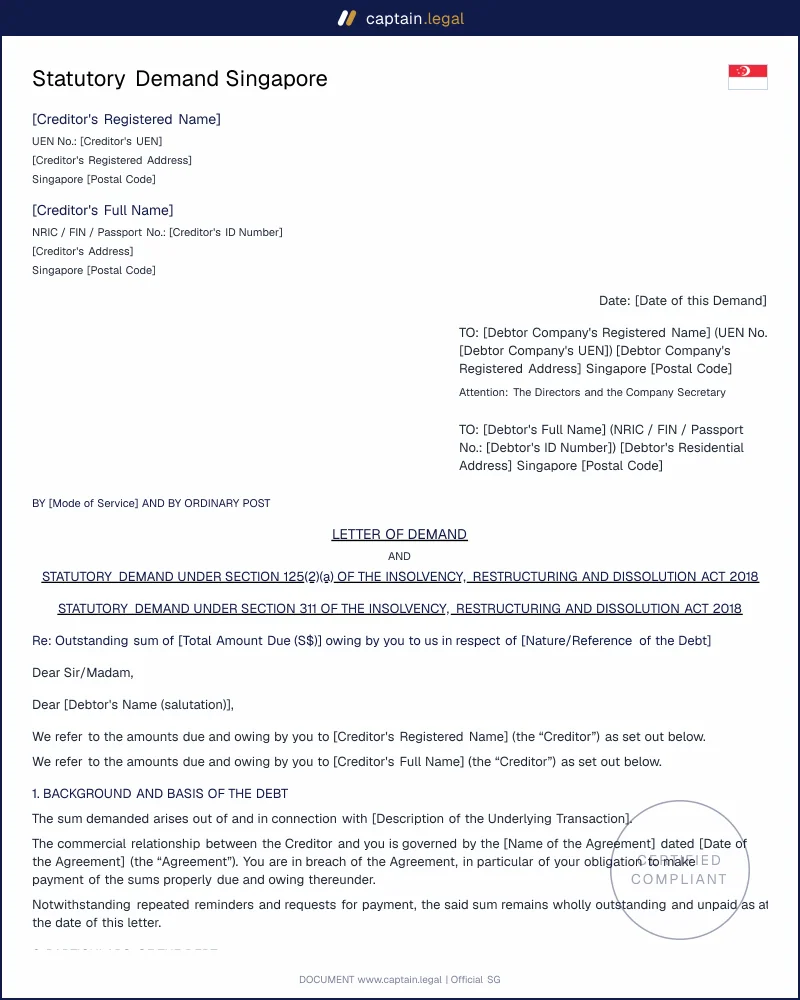
A statutory demand is different in character. It is the formal written demand that triggers the deeming provision in section 125(2)(a) IRDA. Once a creditor serves a statutory demand for a debt exceeding S$15,000 and the company neglects to pay, secure, or compound the debt within three weeks, the company is deemed unable to pay its debts, giving the creditor prima facie grounds to petition for winding up. The word "statutory" is what matters: this demand is not just a stern letter, it is the pre-litigation gateway to insolvency proceedings. A practical point that catches many creditors out is that, unlike a personal bankruptcy demand against an individual, a corporate statutory demand under the IRDA has no prescribed form. The content and the manner of service are what determine its validity, not a court template. You can read more about the wider recovery toolkit in our Singapore debt acknowledgement and IOU template, which is often the document a creditor wishes it had obtained before the dispute arose.

2

When do you need this document?

The clearest case is an undisputed invoice that has aged past its payment terms, where reminders have gone unanswered and the debtor is a company you suspect can pay but will not. Here the statutory demand is the sharpest tool available, because the mere prospect of a winding-up application, which becomes a matter of public advertisement, tends to concentrate a director's mind faster than any letter. A supplier owed more than S$15,000 on clean paperwork is the textbook user.

An ordinary letter of demand, without the statutory escalation, suits smaller sums, ongoing commercial relationships you would rather preserve, and debts you may want to send to mediation or the Small Claims Tribunals. It is also the right first move where the amount is close to the threshold and you would prefer not to commit to insolvency proceedings. Landlords chasing arrears sit in a distinct lane: rent recovery has its own dedicated route, and our letter of demand for rent arrears under the Distress Act is drafted for that scenario rather than the general commercial demand.

Two edge cases deserve flagging. First, where the debt is disputed on substantial grounds, serving a statutory demand is dangerous: the debtor can obtain an injunction restraining the winding-up application and pursue you for costs and, in a bad case, damages for abuse of process. Sue in the ordinary courts, obtain judgment, and only then demand. Second, where the claim is for unliquidated damages, the sum is not yet ascertained and cannot found a statutory demand until a court or the parties have fixed it.

3

Key clauses included in our template

  • The identification of the parties captures the debtor company's full registered name, its UEN, and its registered office address exactly as recorded with ACRA, because service and the eventual application both turn on getting these right. The creditor's own name and address for payment and correspondence are stated with equal care.
  • The statement of the debt breaks the sum down by invoice, contract or transaction, so the demanded amount is a liquidated sum rather than a round figure open to challenge. This precision is what protects the demand from the partial-payment defence recognised in Sun Electric.
  • The legal basis of the debt identifies the contract, the services rendered, or the judgment relied on, giving the debtor no room to claim confusion about what is owed and why. A demand that cannot point to a clear cause of debt invites a dispute.
  • The statutory demand wording states expressly that the demand is made under section 125(2)(a) IRDA and that failure to pay, secure or compound within three weeks will be treated as a deemed inability to pay debts. This is the language that converts a letter into a statutory instrument.
  • The payment, security or compounding options mirror the statute, offering the debtor the three routes the Act recognises, because a demand that only offers "pay in full" is narrower than the law requires and easier to attack.
  • The service and evidence provisions direct how the demand is left at or sent to the registered office and prompt the creditor to retain proof, since a demand you cannot prove you served is worthless when the application is heard.
4

Regional considerations

Singapore is a single unified jurisdiction, so there are no state or provincial variations of the kind found in federal systems; the IRDA applies uniformly across the Republic. What varies is the debtor's constitution, not the geography. A demand against a Private Limited company governed by the Companies Act 1967 is the standard case this template addresses, and the sum and service rules described above apply directly.

The position shifts for other entity types. A Limited Liability Partnership registered under the Limited Liability Partnerships Act 2005 can be wound up under provisions applied to LLPs, but the internal liability and structure differ from a company, so the demand should name the LLP correctly and not treat it as a Pte Ltd. Where the debtor is a sole proprietor or an individual, the corporate statutory demand is the wrong instrument entirely: personal debts run through the bankruptcy regime, which does use a prescribed form and its own S$15,000 threshold, and a creditor should not confuse the two tracks.

Registered charities and companies limited by guarantee add a further wrinkle, since a winding-up application against a body with charitable status can attract regulatory attention beyond the ordinary commercial dispute. Before serving a statutory demand on a non-profit body, a creditor should check the entity's status and consider whether the governance framework behind our Singapore non-profit and associations documents reveals a more appropriate contact or dispute channel. In every case, the debtor's correct registered particulars are drawn from the ACRA record, and the demand rises or falls on their accuracy.

5

How to fill out this letter of demand

You begin by choosing whether you need an ordinary letter of demand or the escalated statutory demand, because the template adjusts the wording and the warnings accordingly. From there you enter the debtor company's registered name, UEN and registered office exactly as they appear on the ACRA record, then set out your own particulars as the creditor. The next step is the debt itself: you itemise each invoice, contract or transaction so the total reads as a precise liquidated sum rather than an estimate, and you state the legal basis for each component.

The template then inserts the operative deadline, three weeks for a statutory demand under section 125 IRDA, and the three statutory options of pay, secure or compound. You choose a method of service to the registered office and the document generates a clean Word and PDF version you can put on letterhead or send as is. A closing prompt reminds you to retain evidence of service, since that proof is what your winding-up application will later stand on. If, before serving, you realise you would rather formalise repayment than escalate, the loan agreement between individuals template offers a settlement route.

6

Common mistakes to avoid

The most damaging error is serving a statutory demand on a genuinely disputed debt. Directors who receive a demand over a debt they contest in good faith can, and routinely do, apply to restrain the winding-up application and recover their costs, and the creditor who over-reached ends up paying for the privilege. If there is a real dispute, the ordinary courts come first and the demand comes only after judgment. A close relative of this mistake is using the instrument for unliquidated damages: until the amount is fixed, there is no sum to demand.

Precision failures come next. Getting the debtor's registered name or UEN wrong, understating or overstating the debt, or leaving the arithmetic open to a partial payment that drops the balance under S$15,000 can each sink the demand, the last point being the direct lesson of Sun Electric. Creditors also forget that a corporate demand has no prescribed form and either copy a personal bankruptcy template or omit the express reference to section 125 IRDA, weakening the document's statutory character. Finally, many creditors serve the demand and keep no record of how or when, which leaves them unable to prove service when it matters most. Careful drafting and disciplined service are what separate a demand that recovers money from one that recovers nothing.

Key takeaways

IRDA trigger

A statutory demand opens the winding-up door

A letter of demand is private and tactical, but a statutory demand is the formal gateway under section 125(2)(a) of the Insolvency, Restructuring and Dissolution Act 2018. If it is properly served and then ignored, it gives you prima facie grounds to ask the General Division of the High Court to wind up the debtor company for inability to pay debts.

Thresholds

S$15,000 debt and three-week clock

The statutory demand route only bites if the debt exceeds S$15,000 and it is a liquidated sum that is due and payable. After service, the company has three weeks to pay, secure, or compound the debt. If it neglects to do so within that period, the IRDA deeming provision treats the company as unable to pay its debts.

Drafting risk

No fixed form, but mistakes can backfire

Unlike some court documents, a corporate statutory demand under the IRDA has no prescribed form, so validity turns on what you write and how you serve it. A demand that is unclear on the sum, basis, or deadline, or is served improperly, can be attacked. Get it wrong and you may face an injunction stopping reliance on it and an adverse costs order.

Frequently Asked Questions

The template itself is a demand, not a contract, so "binding" is the wrong lens. What matters is that it is legally effective: when drafted to the requirements of section 125(2)(a) IRDA and properly served on a debtor company owing more than S$15,000, it triggers the deeming provision if the company neglects to pay, secure or compound the debt within three weeks. Its legal force comes from the statute, not from the debtor's agreement. A letter of demand, by contrast, carries no statutory consequence on its own; its value is tactical and evidential, showing the court and the debtor that you demanded payment before escalating.

The debt must exceed S$15,000 for a company. This threshold was raised from the earlier S$10,000 when the IRDA commenced, aligning corporate demands with the personal bankruptcy figure. The sum must be a liquidated debt that is due and payable, not a claim for damages still to be assessed. Be careful with the arithmetic, because the Court of Appeal in Sun Electric confirmed that a debtor who pays part of the debt within the three-week window, reducing the balance below S$15,000, will not be deemed unable to pay its debts. Multiple creditors cannot pool smaller debts to reach the threshold: each creditor must individually exceed it.

A statutory demand gives the debtor company three weeks, that is 21 days, from the date of service to pay, secure or compound the debt to the creditor's reasonable satisfaction. If the company neglects to act within that period, it is deemed unable to pay its debts under section 125(2)(a) IRDA, and the creditor may then file a winding-up application in the General Division of the High Court. An ordinary letter of demand has no statutory period, so the creditor sets the deadline, commonly 7 or 14 days. If the debtor pays after the 21 days but before the application is filed, the default is cured and the winding-up route falls away, so the creditor should accept payment rather than proceed.

The template is delivered in both Microsoft Word and PDF. The Word version lets you drop the demand onto company or firm letterhead, adjust the recovery figures and tailor the covering language, while the PDF gives you a clean, final document ready to serve. Keeping the editable Word file matters here, because the same matter may need a follow-up letter or a corrected demand if particulars change, and you will want to reissue quickly.

No rule requires a solicitor to serve a statutory demand, and many creditors send them without one. The value of a well-drafted template is that it puts the statutory wording, the correct threshold and the service prompts in front of you so the demand is effective on its own terms. That said, judgment matters: if the debt is disputed, if the sum is close to the threshold, or if the debtor is likely to fight, the risk of an injunction and a costs order rises, and legal advice before serving is prudent. The demand is a serious instrument, and its power is exactly why it should not be fired carelessly.

No. Unlike the demand used against an individual in the bankruptcy regime, a corporate statutory demand under section 125 IRDA has no mandatory form. What governs its validity is the substance: the correct identification of the debtor, a precise liquidated sum above the threshold, the legal basis of the debt, the express statement that the demand is made under the IRDA, and proof of proper service on the registered office. The template supplies each of these elements, which is what gives the document its statutory character even without an official form.

If the company has neither paid nor secured nor compounded the debt, it is deemed unable to pay its debts, and the creditor may file a winding-up application against it in the High Court. This is a serious escalation: the application is advertised, which alone often prompts a solvent company to negotiate. The creditor must nominate a licensed insolvency practitioner as liquidator and place a deposit with the Official Receiver. Because the consequences reach beyond the immediate debt, the statutory demand is best treated as a genuine last step before litigation rather than a routine reminder, and the underlying commercial relationship, captured in your Singapore business contracts and agreements, should inform whether escalation is worth it.

4.9/5

31 verified reviews · 50 000+ downloads

Recover Unpaid Debts With a Statutory Demand SG
  • Immediate access to the document
  • PDF + Word download
  • Compliant with 2026 legislation
  • Reviewed by lawyers
Fill in the template
Secure payment
Updated on July 11, 2026

You might also like

Independent Contractor Agreement
First Board Resolutions Singapore