
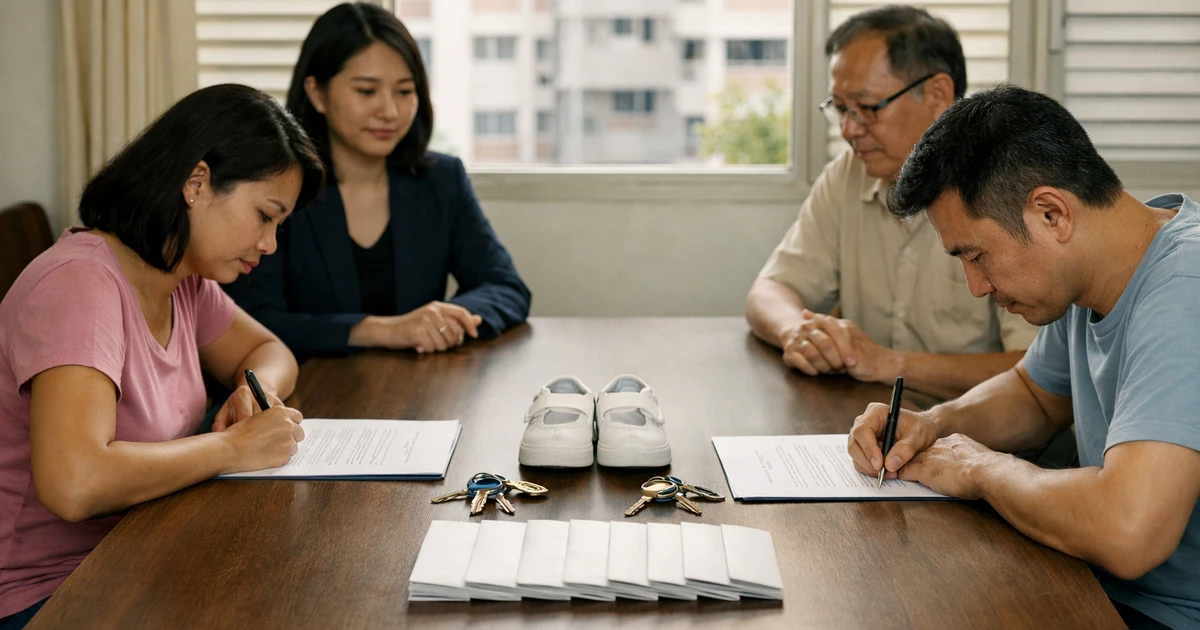
Couples who stop living together in Singapore often wait years before anyone files for divorce, and what they agree in that gap tends to shape the divorce itself. A deed of separation is the private agreement that records when the separation began and who lives where and pays what in the meantime. The question has new practical weight: on 1 October 2026, higher income and asset thresholds for civil legal aid took effect, and matrimonial matters are among the most common cases the Legal Aid Bureau handles. Whoever drafts the deed, the rules on what it can do stay the same.
What a deed of separation does in Singapore
Separating couples often confuse three different arrangements. A divorce ends the marriage through the Family Justice Courts. Judicial separation is a court order too, but the marriage continues. The private deed sits outside the court system: it is a contract signed and sealed by both spouses in front of witnesses, and nobody files it anywhere. Its two jobs are to fix the date of separation in writing and to settle the interim arrangements on the home, money and children. The wider range of family and divorce documents for Singapore covers the agreements that usually sit around it.
When one spouse files for divorce on three years' separation with consent, or four years without it, the court needs evidence of when the couple began living apart, and a document signed at the time carries far more weight than two conflicting memories. The Family Justice Courts keep their powers over assets, maintenance and children whatever the spouses sign. A separation agreement is therefore persuasive rather than final. Its weight depends on the subject: strong on dividing assets, much weaker on arrangements for the children.
Legal framework
Divorce in Singapore rests on a single ground under the Women's Charter 1961: the marriage has irretrievably broken down. The facts that prove it are set out in section 95A, and two of the six turn on separation. The Family Justice Courts' guide to the requirements for getting a divorce explains that you can file three years after the date of separation if your spouse agrees, or four years after it without consent, and that couples can be separated while living together if they maintain different households. Since 1 July 2024, a sixth fact allows divorce by mutual agreement, supported by a written agreement, as soon as both spouses agree that the marriage has broken down.
What the courts do with a private agreement comes from case law. In AUA v ATZ [2016] SGCA 41, a dispute over a deed of separation, the Court of Appeal held that a properly concluded agreement on dividing matrimonial assets generally deserves significant weight, as a factor under section 112(2)(e) of the Charter, unless there are good and substantial grounds to think that holding the parties to it would be unjust. The same judgment is far more cautious about children, whose welfare is the overriding objective. Agreements on custody or care and control are presumed unenforceable unless the parent relying on them shows they serve the child's best interests, which is why a parenting plan built around the child's routine is worth the effort. For maintenance, sections 118 and 119 of the Charter, as summarised in WWQ v WWR [2025] SGHCF 3, let the court vary an agreement once satisfied of a material change in circumstances.
Legal aid and maintenance enforcement: what changed
The Ministry of Law's announcement raises the income threshold for civil legal aid, together with the asset threshold for civil legal aid and criminal defence aid, and expects up to 1,000 more people to benefit each year. The Legal Aid Bureau gives advice on Singapore law, represents clients in civil proceedings and lists help with drafting a deed of separation among its services. Help is limited to Singapore Citizens and Permanent Residents who pass a means test, and representation in court also requires a merits test. The new thresholds change who qualifies for help, not what the agreement can lawfully say.
The second change concerns money after signing. Since 1 July 2026, the third phase of the Maintenance Enforcement Process covers every application to enforce a maintenance order made under the Women's Charter, the Guardianship of Infants Act, the Administration of Muslim Law Act and the Maintenance of Parents Act. Maintenance Enforcement Officers handle these applications through conciliation, can obtain information from banks and public agencies, and report to the Family Justice Courts. The process is built around court orders, and a deed is a contract, not a maintenance order. Where payments stop, the receiving spouse can file a maintenance application, and if both sides agree at the court's maintenance mediation, the terms are recorded before a judge as a consent order that the process then covers.
Children, the home and the CPF accounts
The matrimonial home is usually the hardest point, because it is often an HDB flat bought partly with CPF savings. Any transfer or sale of an HDB flat remains subject to the Housing & Development Board's approval, and CPF monies to the CPF Board's requirements, so the deed can record what the spouses intend but cannot promise an outcome the authorities have not approved. The interim question is simpler: who stays, when the other moves out, and who pays the mortgage instalments, conservancy charges and utilities in the meantime. The spouse who leaves often needs a room or a flat quickly, and a written tenancy agreement for an HDB flat or condo avoids a second dispute, this time with a landlord.
Children need the most careful drafting. Singapore practice distinguishes custody, meaning the major decisions on education, religion and healthcare, from care and control, meaning where the child lives day to day, and from access for the other parent. A deed can deal with all three, plus passports, travel and the sharing of child-related tax reliefs. Both parents remain responsible for maintaining their children whatever the deed says, and the court will not sanction an agreement that leaves a child without adequate support. A clause giving up child maintenance in exchange for a bigger share of the flat is the kind of term the court will not follow.
How to prepare a deed of separation with Captain.Legal
On Captain.Legal, the Singapore deed of separation template is built through a guided questionnaire, and the text takes shape on screen as you answer. You start with the date of the deed, both spouses' names, identity numbers and addresses, and the place and date of the marriage. The next step fixes the date of separation and asks whether you still live under the same roof; if you do, the deed adds wording that treats you as leading wholly separate lives. For the home, you choose between an HDB flat, private property and a rented home, then say who stays, whether it is sold or already vacated, with a move-out date and the spouse who pays the outgoings. Free-text fields record the division of the home and other matrimonial assets, joint accounts and, if you wish, CPF terms.
Spousal maintenance goes to the wife or to the husband, though under section 113 of the Charter a court can order it for a husband only if he is incapacitated. It can be a monthly sum, a lump sum, a nominal amount that keeps a later claim open, or nothing. If there are children, you choose joint or sole custody, give care and control to one parent or share it, then describe access, passports, tax reliefs, child maintenance and extraordinary expenses. The deed includes clauses confirming that the Family Justice Courts keep their powers, a reconciliation clause and a statement on independent legal advice. You review the full text, download it in Word and PDF, and sign and seal it in front of your witnesses.
Common mistakes with separation agreements
The most frequent problem is a vague separation date. Couples write "sometime after Chinese New Year" or leave the date blank, then argue about it when the divorce timetable depends on it. Another is staying in the same flat while still sharing meals, money and a bedroom: the deed says the spouses are separated, the facts say otherwise, and the court looks at the facts. In XTR v XTQ [2026] SGHCF 11, the High Court rejected a husband's claim that the couple had lived apart since an agreed trial separation: their later messages and conduct showed a reconciliation. Spouses also skip full and frank disclosure of bank balances, shares or a business, which hands the other side grounds to attack the asset terms later.
The mistake with the longest tail concerns death rather than divorce. The CPF Board states that divorce does not revoke a CPF nomination, and that wills are not revoked upon divorce either, so a separated spouse can remain a beneficiary for years without anyone intending it. The deed leaves each spouse free to make a new will and review nominations, but nothing changes until someone acts. Making a will under Singapore's Wills Act and filing a fresh CPF nomination soon after signing closes that gap. Insurance nominations deserve the same review, because they sit outside both the will and the CPF scheme.
Frequently asked questions
Is a deed of separation legally binding in Singapore?
Yes, as a contract between the spouses, provided both sign it freely and after honest disclosure of their finances. The limit is the Women's Charter: the Family Justice Courts keep their powers over matrimonial assets, maintenance and the children, and no clause can remove them. Courts give significant weight to an agreement on assets unless holding the spouses to it would cause injustice, can vary maintenance terms after a material change in circumstances, and assess child arrangements afresh against the child's welfare. Terms signed under pressure or on false financial information can be set aside.
How long do we need to be separated before filing for divorce in Singapore?
On the separation facts, the period is three years of living apart if your spouse consents to the divorce and four years if not, counted from the date of separation. Divorce by mutual agreement has no minimum period apart, but it needs a written agreement that the marriage has irretrievably broken down. You generally cannot file within the first three years of marriage without the court's permission. A signed deed recording the separation date is the simplest evidence of when the clock started.
Can the maintenance in our deed be changed later?
Yes, in two ways. The spouses can agree a change in writing signed by both, and a deed of variation of maintenance records the new amount cleanly. Failing agreement, either spouse can ask the court to vary the terms, which it does once satisfied that there has been a material change in circumstances since the agreement was made, such as a job loss or a serious illness. Courts do not lightly reopen terms the spouses negotiated, so a minor change is unlikely to be enough.
Can I get legal aid to draft a separation deed?
Possibly, if you are a Singapore Citizen or Permanent Resident. The Legal Aid Bureau lists help with drafting separation deeds and wills among its services, and a file is opened once you pass the preliminary means test. You must make full and frank disclosure of your means, and failing to do so is a criminal offence. Court proceedings also require a merits test. If you do not qualify, you can prepare the deed with the questionnaire and have a lawyer review it.
In what format do I receive the deed, Word or PDF?
You download the finished deed in Word and PDF. The Word version lets you adjust wording before signing, for example to name a specific bank account or insurance policy, while the PDF gives you a fixed copy for printing. The document is not filed with any court or registry. Each spouse signs and seals in front of their own witness, whose name, NRIC or FIN and address appear in the execution block, and each keeps a signed original.
What happens to the deed if we get back together?
The Captain.Legal deed provides that it ends if you resume living together as husband and wife with the shared intention of a permanent reconciliation, although anything already done under it stands. A short, temporary attempt does not end it by itself, which protects spouses who try again for a few weeks and then part. A lasting return to living together will also bear on the separation period the court looks at later.