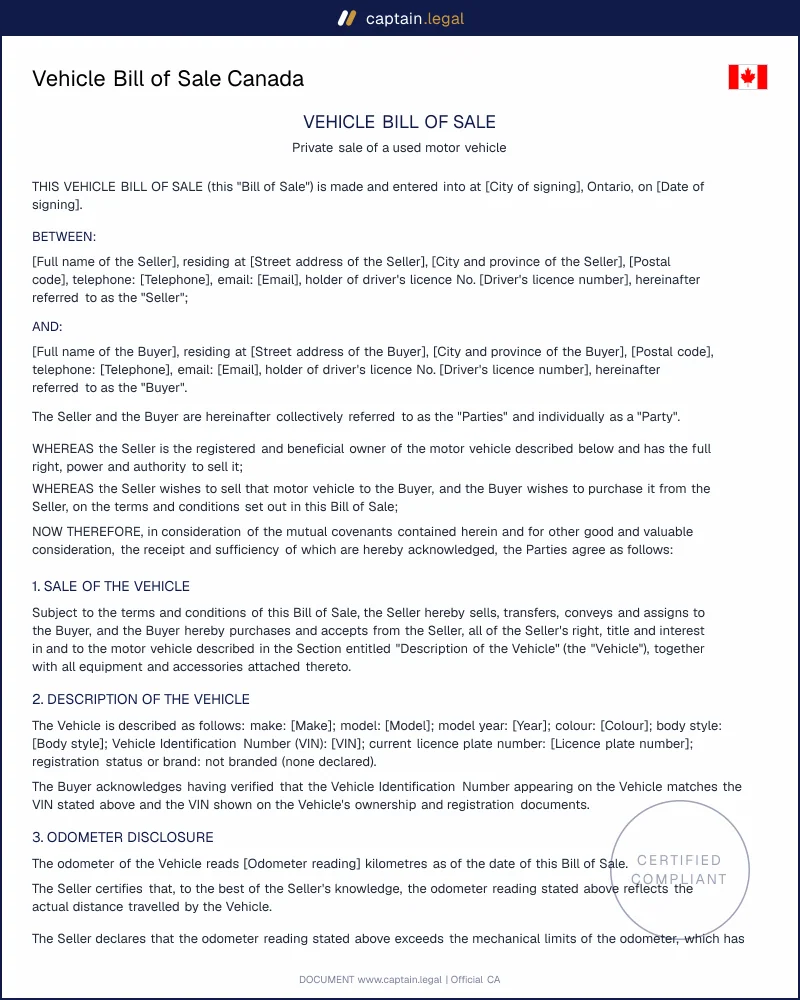
Ontario places the heaviest duty on the seller. Under the Highway Traffic Act, a private seller must provide the buyer with a Used Vehicle Information Package showing registration history, recorded odometer entries, Ontario lien information and the Canadian Red Book wholesale value used to compute tax. Failing to supply it is a provincial offence carrying a fine, and ServiceOntario will not process the transfer without it. The buyer has six days from the date of purchase to register, retail sales tax is charged at thirteen per cent on the higher of the sale price and the book value, and a Safety Standards Certificate obtained from a licensed inspection centre remains valid for thirty-six days. A vehicle can lawfully be sold as is, but the buyer cannot put plates on it until it passes.
British Columbia runs everything through ICBC. The parties complete the Transfer/Tax Form (APV9T) in full with original signatures, the seller detaches and signs the vehicle registration portion of the APV250, and the buyer takes both to an Autoplan broker within ten days. Provincial sales tax on a private passenger vehicle starts at twelve per cent and rises for higher-value vehicles, and it is calculated on the greater of the price paid and the average wholesale value, so writing a low number on the bill of sale buys nothing except an audit. A vehicle arriving from outside the province must pass a Designated Inspection Facility inspection first.
Alberta is the lightest touch in the country. Transfers happen at a private registry agent using the province's standard bill of sale, there is no provincial sales tax on the transaction, and GST does not apply between private individuals, which makes the bill of sale the sole financial record of the deal. The registry runs a Personal Property Registry search as part of the transfer, and a live lien will halt it until discharged. Vehicles coming from another jurisdiction need an out-of-province inspection before registration.
Saskatchewan and Manitoba both use insurer-run counters. In Saskatchewan the buyer brings the SGI Bill of Sale or Letter of Gift together with the Transfer of Ownership section completed on the Certificate of Registration, and PST is charged on the greater of price and wholesale book value. Manitoba uses a Transfer of Ownership Document printed on the reverse of the registration card, signed by both parties, and Manitoba Public Insurance will not register the vehicle without a valid Certificate of Inspection. Retail sales tax follows the same greater-of rule.
Atlantic Canada and Quebec diverge again. Nova Scotia, New Brunswick, Prince Edward Island and Newfoundland and Labrador process transfers through their motor vehicle registries with HST assessed on private sales in most cases. Quebec sits outside this template entirely: transfers run through the SAAQ with both parties normally attending, and article 1726 of the Civil Code of Québec imposes a warranty against latent defects that article 1733 prevents a seller from excluding where he knew about the problem. The rest of the Canadian personal and family document library follows the same common-law scope.