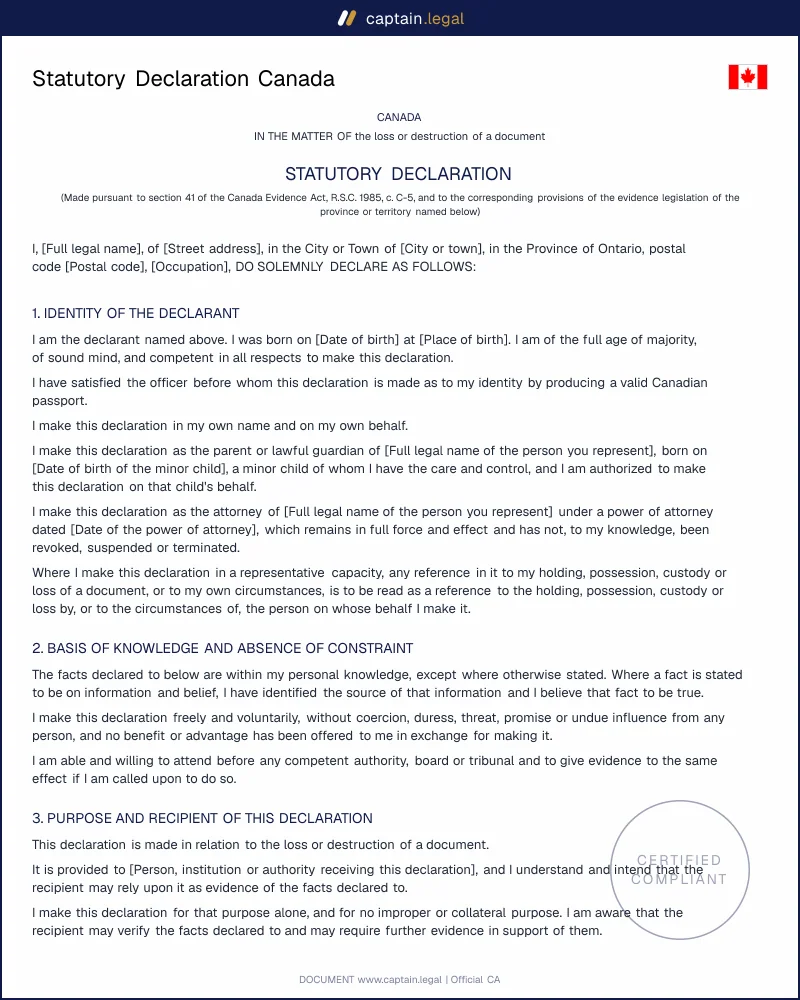
The governing text is section 41 of the Canada Evidence Act, RSC 1985, c. C-5, which fixes both the form of words and the list of people who may receive a declaration: any judge, notary public, justice of the peace, provincial court judge, recorder, mayor or commissioner authorized to take affidavits, plus any other functionary authorized by law to administer an oath. The declaration must be made voluntarily, in attestation of the execution of a writing, deed or instrument, of the truth of any fact, or of an account rendered in writing, a category broader than most declarants assume. The federal text sits with the Justice Canada text of section 41 of the Canada Evidence Act on solemn declarations.
A second layer is provincial, because the officials who take the declaration draw their authority from provincial statutes: Ontario's Commissioners for Taking Affidavits Act, RSO 1990, c. C.17, which makes lawyers and licensed paralegals in good standing commissioners by virtue of office, British Columbia's Notaries Act, RSBC 1996, c. 334 and Evidence Act, RSBC 1996, c. 124, and Alberta's Notaries and Commissioners Act, SA 2013, c. N-5.5. The jurat must match the province where the declaration is taken, not the province where it will be used.
False content is punished on a graded scale. A false statement made with intent to mislead is perjury under section 131 of the Criminal Code and carries up to fourteen years under section 132. Without that intent, a knowingly false statement falls under section 134 as a summary offence, while section 138 catches a document that only purports to have been properly taken. The same execution discipline runs through our personal and family templates for the common-law provinces.