Personal & Family

Cancel a Power of Attorney in Canada the Right Way

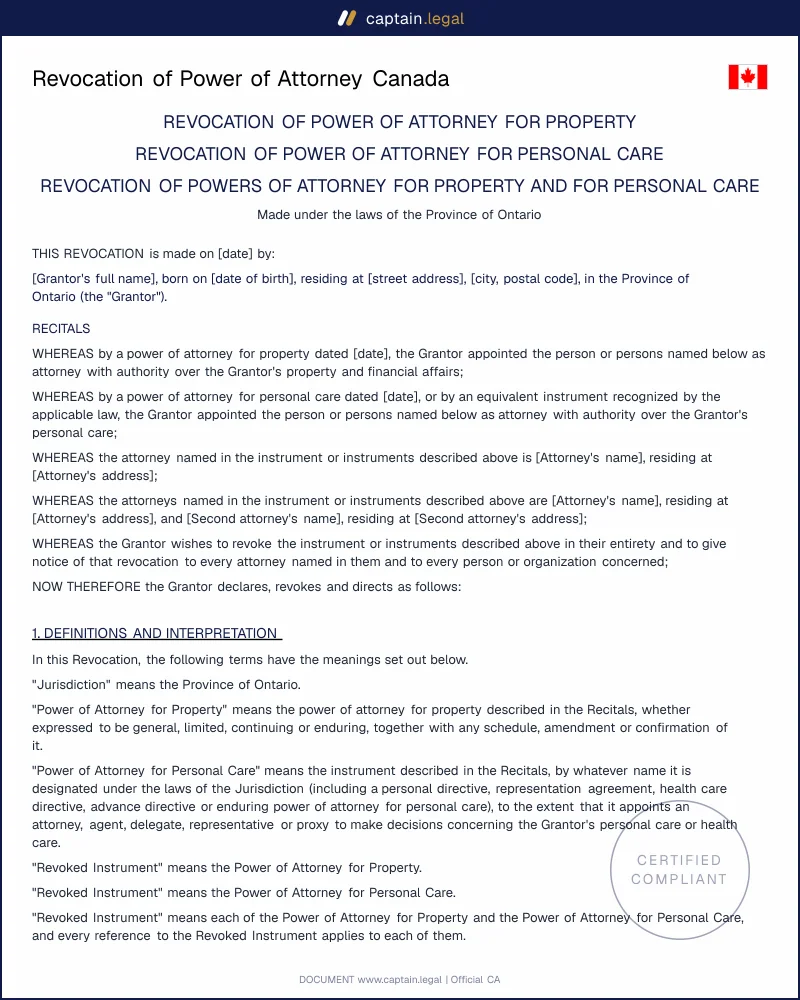
Revocation drafted to Ontario SDA s.12(2) and BC Power of Attorney Act s.28: two-witness execution, notice to each attorney and to banks. Word and PDF.
4.6/5— 25 reviews50 000+ downloadsInstant download
Share

A revocation of power of attorney is the signed document a capable adult uses to cancel an existing power of attorney for property or for personal care and to withdraw the authority of the person named as attorney. It serves grantors in Canada's common-law provinces who have lost confidence in an attorney, separated from a spouse they appointed, or want a fresh appointment. The document ends the mandate under provincial statute and creates a dated record you can serve on your former attorney, your bank and every institution holding a copy of the old instrument. Our template is drafted to the execution rules of each common-law province, with Ontario, British Columbia and Alberta as reference regimes.

Compliant

2026 Legislation

50,000+ clients

trust us

Affordable

From $4.90 / doc

Secure payment

Instant download

Cancel a Power of Attorney in Canada the Right Way

Secure payment

Fill in the template

What is a revocation of power of attorney?

In Canadian law a power of attorney is a form of agency: the grantor (the "donor" in Alberta, the "adult" in British Columbia) authorizes another person to act in his or her name. Because agency rests on continuing consent, the grantor can withdraw it at any time while mentally capable, and the revocation is the instrument that records that withdrawal. It can cancel a continuing or enduring power of attorney for property, which survives incapacity and covers bank accounts, investments, real estate and tax filings, or a power of attorney for personal care, which covers health, housing and daily living decisions. These are separate instruments, and revoking one leaves the other in force. When you are replacing an attorney, the revocation usually sits alongside a new continuing power of attorney for property template signed at the same meeting.

A revocation is not a resignation, which comes from the attorney, nor an automatic termination, which the statute triggers on the grantor's death or the appointment of a guardian. It is also more than a letter to the bank, which stops one institution from accepting the document but ends nothing elsewhere. Estate lawyers therefore draft it as a standalone instrument, executed with the same formalities as the original power.

When do you need this document?

The most common trigger is a loss of trust in the attorney: unexplained withdrawals, an attorney who refuses to share statements, or a relative using the power to push decisions the grantor never agreed to. The revocation should be signed promptly, before capacity can be questioned, and served with a written demand for an accounting.

Relationship breakdown comes next. Many people name a spouse as attorney and forget the appointment until the marriage ends. Ontario does not cancel a spouse's authority on separation, so a revocation of power of attorney is usually signed at the same time as a separation agreement drafted to the Divorce Act.

Some revocations are purely practical. Owners of rental property often revoke when they hand daily management to a professional under a property management agreement for a Canadian rental, to avoid two people holding overlapping authority over the same tenancy.

One edge case deserves attention: the power signed at a bank branch. Institutions often ask customers to sign their own internal form, and in Ontario, under section 12(1)(d), that new continuing power can revoke a carefully drafted earlier one. A formal revocation followed by a fresh appointment restores the plan you intended.

Key clauses included in our template

  • The identification of the grantor and of the instrument being revoked states your full legal name, address and the exact date of the original power, with the names of the attorneys and witnesses. Banks compare these details against the copy on file, so a revocation describing the wrong document will be ignored.
  • The scope of revocation lets you cancel the entire power or only one attorney among several. Where co-attorneys were appointed, the clause states whether the remaining attorney may act alone, since Ontario's section 7(4) makes joint action the default.
  • The general revocation clause optionally cancels every prior power for property, every prior power for personal care, or both. Choose this option carefully, because a sweeping clause can wipe out a personal care appointment you meant to keep.
  • The effective date is stated expressly. In British Columbia it can be postponed under section 28(4).
  • The demand to the former attorney directs him or her to stop acting, return the original and all certified copies, and hand over the records an attorney must keep, under Ontario Regulation 100/96 or section 19(1)(d) of the British Columbia Act.
  • The schedule of third parties lists every bank, brokerage, land registry office, insurer and care facility that must receive a copy, with the date and method of delivery.
  • The execution block carries signature lines for the grantor and two witnesses, with a declaration that neither witness falls within a category disqualified by statute.

Provincial considerations

Ontario applies the strictest execution standard. The revocation must be signed before two witnesses, and section 10(2) of the Substitute Decisions Act, 1992 excludes the attorney and the attorney's spouse or partner, the grantor's spouse or partner, the grantor's child or a person treated as one, anyone with a guardian of property or of the person, and anyone under eighteen. Ontario keeps no central registry of powers of attorney, so direct notice to each institution is the only real protection. Revoking a power for personal care has a further effect: health decisions then fall to the next substitute decision-maker listed in section 20 of the Health Care Consent Act, 1996. A spouse removed as attorney still ranks in that list unless the couple is living separate and apart.

British Columbia focuses on notice rather than witnessing. Under section 28(2) of the Power of Attorney Act, written notice to each attorney is mandatory and triggers the revocation. Section 29(2)(d)(i) also ends a spouse's authority automatically when the marriage or marriage-like relationship ends, unless the instrument says otherwise under section 29(3). Third parties who deal with the attorney without knowledge of the revocation are protected by section 31(3), which is why delivery to banks cannot wait. Personal care runs through a representation agreement, revoked separately under the Representation Agreement Act, RSBC 1996, c 405.

Alberta requires the revocation to be in writing and signed while the donor understands its nature and effect, under section 13(1)(a) of the Powers of Attorney Act. The Act sets no witnessing formula for the revocation itself, yet practitioners still have it witnessed by an independent adult, because capacity challenges before Alberta courts turn on evidence of the signing. Personal care is handled through a personal directive under the Personal Directives Act, RSA 2000, c P-6, which needs its own instrument.

How to fill out this revocation of power of attorney

You start by selecting your province, which sets the statutory references, the witnessing block and the notice wording. The form then asks which power you are cancelling (property, personal care or both) and the date it was signed. Copy the names of the attorneys and witnesses exactly as they appear on the original; small spelling differences are a frequent reason banks reject a revocation.

Next, you choose between a total revocation and the removal of a single attorney, then set the effective date and indicate whether a new power is being signed at the same time. The template builds the schedule of third parties and generates a covering notice for each institution, along with the demand to the former attorney.

Sign the final document in front of two independent witnesses, even in a province that does not strictly require them. Keep the signed original somewhere safe, send a copy to your former attorney by a method that proves delivery, and file the remaining copies with each institution on the schedule.

Common mistakes to avoid

The most frequent error is destroying the original power and assuming the job is done. Certified copies stay in circulation, and banks keep honouring them until they receive written notice. The second mistake is choosing the wrong witnesses. Grantors often ask an adult child or the new attorney to witness, both disqualified in Ontario, which hands the former attorney an argument that the original power still stands. A third trap is forgetting that property and personal care are separate instruments: revoking one leaves the other untouched unless the revocation of power of attorney says otherwise.

Timing is the other recurring problem. Families tend to wait until the grantor's memory is already declining, at which point the former attorney can challenge capacity and the dispute lands before a judge. Sign while capacity is clear and, if there is any doubt, obtain a medical note dated the same day. Finally, many grantors notify the main bank and forget a brokerage, a credit union or the Canada Revenue Agency. If your attorney was registered with the CRA as your representative, that authorization is a separate record and must be cancelled directly with the agency.

Key takeaways

LEGAL FORM

Use the same signing rules

A revocation works only if the grantor is mentally capable and signs a written cancellation that matches the formalities of the original power of attorney. In Ontario, Substitute Decisions Act, 1992 sections 12(2) and 10 point to two qualified witnesses for property powers, with section 53(2) applying the same approach to personal care.

SCOPE

Cancel only the authority named

Property and personal care powers are separate documents. Cancelling one does not automatically cancel the other, so the revocation should clearly identify the instrument being withdrawn. If a new attorney is taking over, the safer workflow is to sign the revocation and the replacement power at the same meeting, creating a clean dated record.

NOTICE

Notice makes the change real

After signing, the revocation must reach the people and institutions that may rely on the old power: each former attorney, banks, investment firms and anyone holding a copy. British Columbia Power of Attorney Act section 28 makes an enduring power revocation effective when written notice is given, or on a later date stated in the notice.

Frequently Asked Questions

In British Columbia, yes: section 28(2) of the Power of Attorney Act makes written notice to each attorney mandatory, and the revocation only takes effect once notice is given. In Ontario and Alberta notice is not a condition of validity, but an attorney who has not been told can keep acting, and institutions dealing with him or her in good faith are generally protected. Deliver a copy by registered mail or courier, keep proof of delivery, and include a written demand to return the original and any certified copies.

Yes, provided it meets your province's formal requirements and you had capacity when you signed it. In Ontario it must be in writing and executed before two qualified witnesses under section 12(2) of the Substitute Decisions Act, 1992. In British Columbia it must be in writing and notified to each attorney, and in Alberta it must be in writing and signed while you understand its effect. No court filing or notarization is needed for validity.

Legally, it takes effect once properly signed in Ontario and Alberta, and once notice reaches the attorney in British Columbia, unless you set a later date. Protection against third parties depends on delivery, and processing times vary from one institution to the next. Serve every institution within the same week you sign and ask each one to confirm in writing that the old power has been removed from your file. Our personal and family legal templates for Canada cover the replacement documents you may need.

Only if he or she still understands what the revocation does. A dementia diagnosis does not remove capacity automatically; capacity is assessed for the specific decision and at the moment of signing. Ontario courts ask whether the grantor understands the property involved and that the attorney's authority is being withdrawn, while British Columbia presumes capability under section 11 until the contrary is shown. A physician's letter dated the day of signing is the best protection against a later challenge.

It depends on the province. In British Columbia, section 29(2)(d)(i) of the Power of Attorney Act ends a spouse's authority when the marriage or marriage-like relationship ends, unless the instrument provides otherwise. Ontario has no equivalent rule, so a former spouse keeps full authority under the Substitute Decisions Act, 1992 until you revoke the power in writing. Banks rarely know the date of separation, so a served revocation is the only reliable way to cut off access.

You download the completed revocation in Word and PDF as soon as you finish the questionnaire. The PDF is ready to print and sign before your witnesses, while the Word file lets your lawyer adjust the wording for unusual cases. The covering notices for third parties appear as separate pages, so you can print one for each institution on your list. Other documents are available in the full catalogue of Canadian legal documents.

4.6/5

25 verified reviews · 50 000+ downloads

Cancel a Power of Attorney in Canada the Right Way
  • Immediate access to the document
  • PDF + Word download
  • Compliant with 2026 legislation
  • Reviewed by lawyers
Fill in the template
Secure payment
Updated on October 13, 2026

You might also like

Power of Attorney Canada
Renunciation of Executor Canada