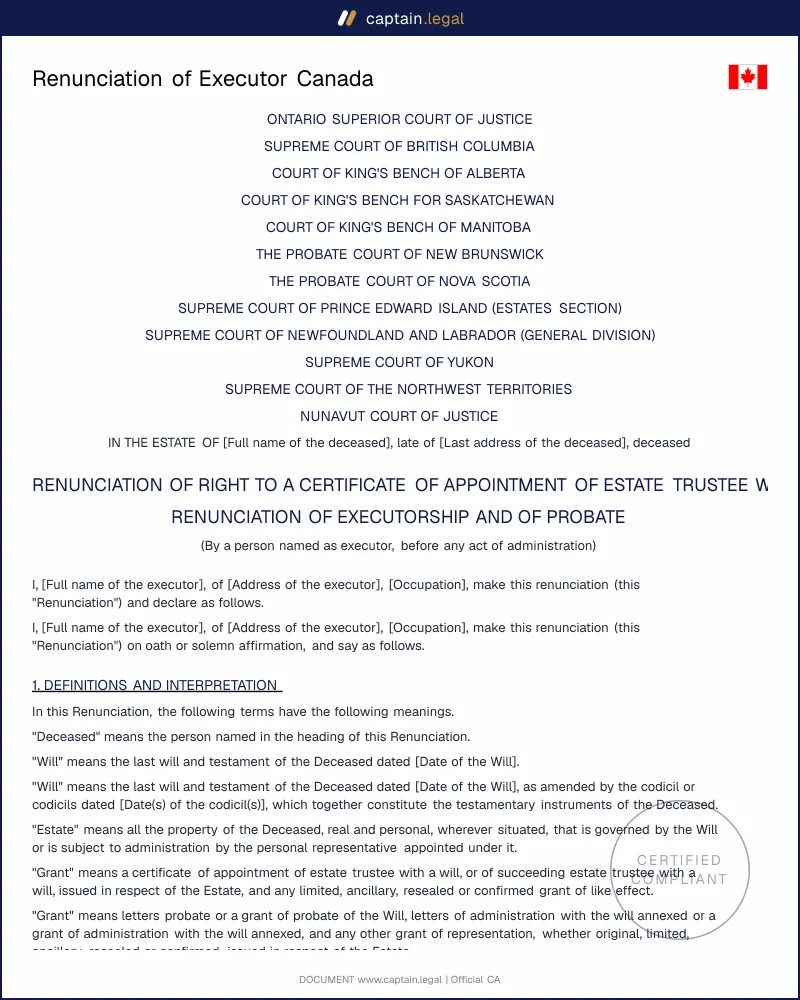
Estate administration is provincial, so there is no federal statute on renunciation. The rules come from succession legislation, court rules and common-law authority. An executor's title flows from the will at death, but the nominee may refuse it until they accept, and acceptance can be express or implied by conduct. Taking possession of assets, writing cheques on the deceased's accounts or listing the house all count as intermeddling, and an executor who has intermeddled can no longer renounce. The only exit is then a court application under section 37 of Ontario's Trustee Act, R.S.O. 1990, c. T.23, or section 158 of British Columbia's Wills, Estates and Succession Act, S.B.C. 2009, c. 13 (WESA).
In Ontario, Rule 74.04(1)(e) of the Rules of Civil Procedure, R.R.O. 1990, Reg. 194 requires the applicant for a certificate of appointment to file a renunciation from every living person named as estate trustee who is not applying. Since April 1, 2024, that renunciation is made on Form 74G, Renunciation and Consent, published on the Ontario Court Forms page listing Form 74G and the other Rule 74 estate forms. In British Columbia, Rule 25-1(4) of the Supreme Court Civil Rules treats an executor as having renounced once a Form P17 Notice of Renunciation is filed. Alberta works through the Surrogate Rules, Alta Reg 130/1995, whose GA forms replaced the former NC series in June 2022, read with the Estate Administration Act, SA 2014, c E-12.5.
Two further rules apply everywhere. A renunciation covers the whole office; you cannot keep the real estate and renounce the investments. A retraction before the grant is possible only with the court's approval and where it serves the estate, so treat the signature as final. Quebec is outside this framework, since the Civil Code of Québec replaces the executor with a liquidator under its own rules.