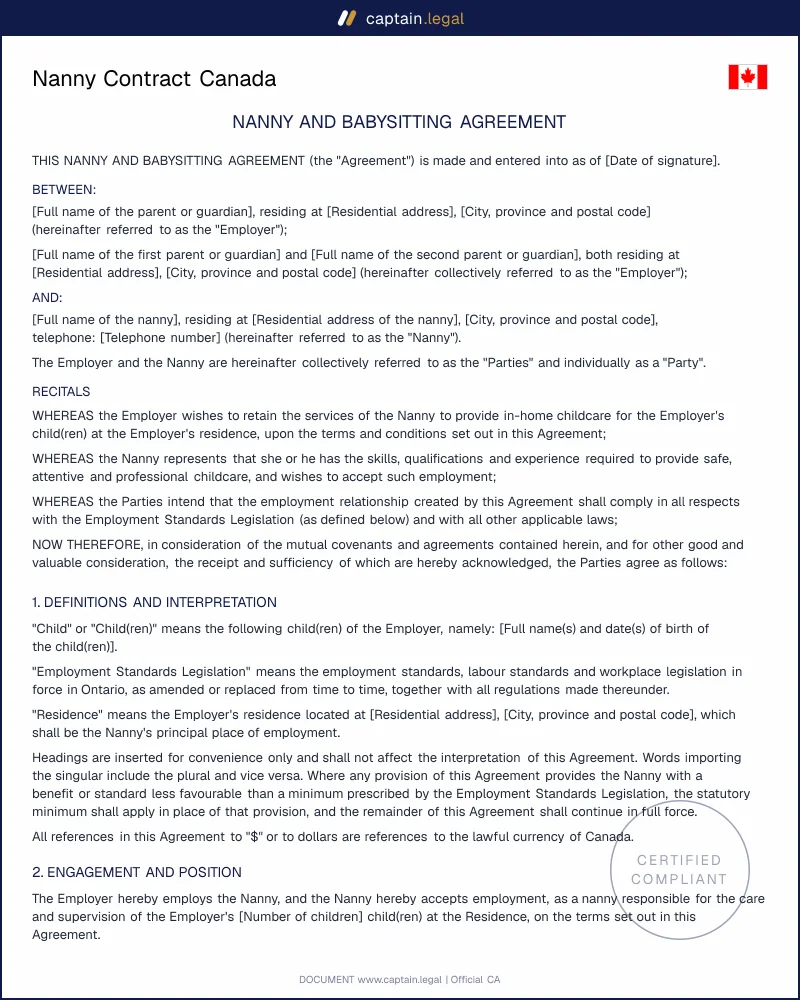
Ontario treats nannies as domestic workers with full coverage under the Employment Standards Act, 2000: minimum wage, overtime after 44 hours in a work week, public holiday pay, vacation pay and statutory notice based on length of service. The written particulars required by section 19 of O. Reg. 285/01 are the household's core compliance step, and the same regulation caps what a householder may treat as wages when a private room or meals are provided. Household employment sits outside the industries automatically covered by the WSIB, so families wanting injury protection apply for optional insurance rather than assuming a home policy responds.
British Columbia layers three obligations. The written contract under section 14 must state duties, hours, wages and room and board charges, the household must be registered under section 15, and WorkSafeBC registration becomes mandatory once a caregiver works eight or more hours a week, or fifteen hours for before and after school care. Overtime begins after eight hours in a day and forty in a week, a tighter threshold than Ontario's. The Infants Act recognizes a mature minor's own consent to treatment, so the emergency clause is drafted to inform rather than override an older child.
Alberta takes a different route on hours. Domestic employees are excepted from the standard overtime rule of eight hours a day and forty-four a week, and live-in domestic employees may be paid a monthly minimum rate that can be pro-rated where the parties agree on part-month work. That flexibility makes the written schedule more important, not less, because no statutory overtime backstop catches the evenings that pile up.
Across Saskatchewan and Manitoba, special rules govern sitters and live-in care providers, and weekly hours thresholds decide how much of the general regime applies, so the contract should record real hours rather than an approximation. The Atlantic provinces apply their own labour standards acts with the same structure of notice, vacation pay and holiday pay. Quebec stands apart under the Civil Code of Québec, the Act respecting labour standards and CNESST oversight, and is not covered by this template. Households recruiting from abroad add a federal layer of work permit and caregiver immigration rules whose intake windows open and close, so status is confirmed before the job offer is signed.