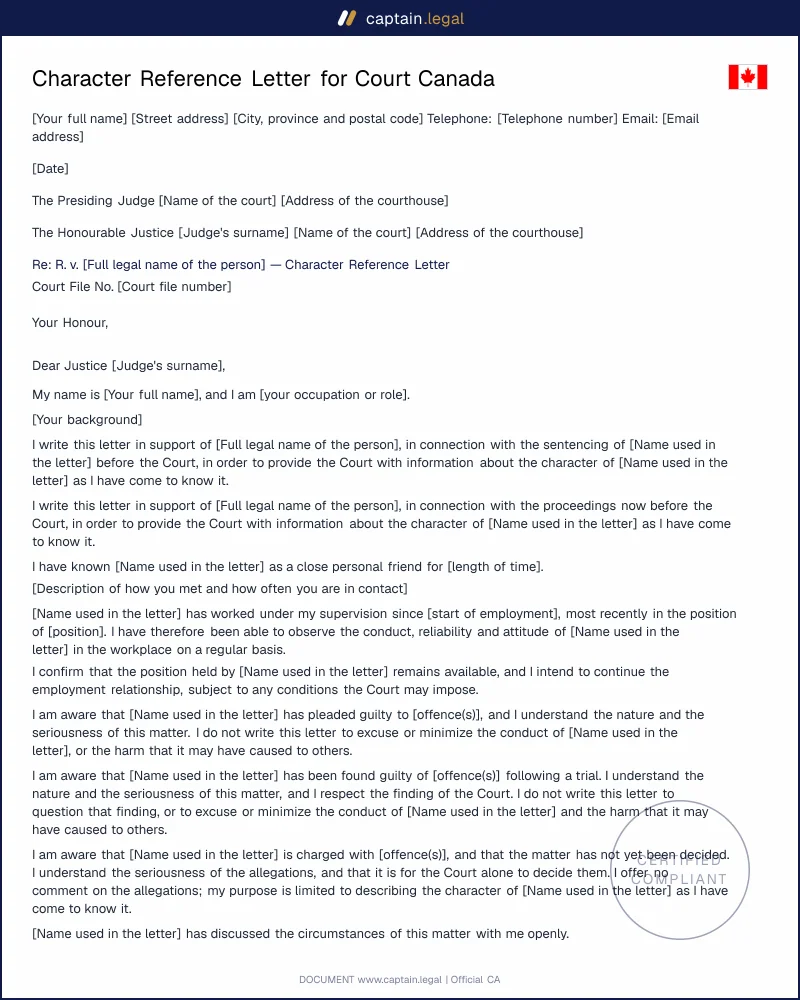
Ontario sentences most criminal matters in the Ontario Court of Justice, while jury trials and offences listed in section 469, such as murder, proceed in the Superior Court of Justice. Letters are filed by defence counsel at the hearing, often tabbed in a sentencing brief, rather than mailed to the courthouse. The Court of Appeal held in R. v. Morris, 2021 ONCA 680 that evidence of anti-Black racism and its effect on an offender can be relevant to sentence, and letters from community organizations frequently support that evidence. Form letters copied from one model and signed by several people carry little weight, so each letter should read like its author.
British Columbia handles most sentencings in the Provincial Court of British Columbia, with the Supreme Court of British Columbia hearing the most serious indictable matters. The Provincial Court opened its first Indigenous sentencing court, the First Nations Court in New Westminster, in 2006, and Elders and community members take part in those hearings. Letters from Elders, band staff, treatment providers and employers commonly support submissions under section 718.2(e). The Crown can test anything a letter asserts, so writers should stick to what they have seen first hand.
Alberta renamed its Provincial Court the Alberta Court of Justice in 2022, and the superior trial court is the Court of King's Bench of Alberta. A letter still addressed to the "Provincial Court of Alberta" looks out of date and suggests the writer never checked the file. The Court of Appeal of Alberta uses starting-point sentencing, confirmed in R. v. Arcand, 2010 ABCA 363, under which the judge begins from a benchmark for the offence and then adjusts for the offender's circumstances. Reference letters are part of the material that justifies moving below that starting point.
Nova Scotia shaped national practice through R. v. Anderson, 2021 NSCA 62, where the Court of Appeal held that sentencing judges must take into account evidence of systemic and historical anti-Black racism when sentencing African Nova Scotian offenders. That evidence often takes the form of an Impact of Race and Culture Assessment, supported by letters from church leaders, mentors and community organizations. Letters that describe the accused's community ties in concrete terms fit naturally into this framework.