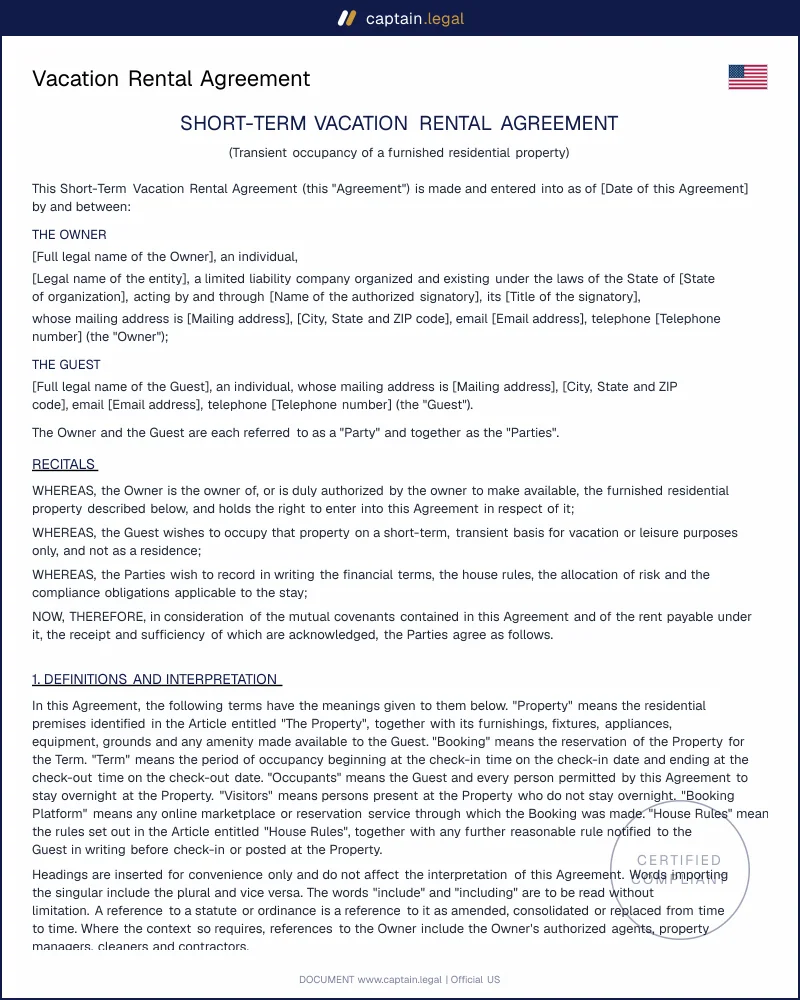
California treats stays under thirty consecutive days as transient for occupancy tax, and Civil Code §1940(b) keeps them outside the landlord-tenant chapter. Cross that line and the guest gains tenancy rights only a formal unlawful detainer can undo, which is why the template hard-codes a checkout date and blocks silent extensions. Occupancy tax is set locally, so the San Francisco rate differs from Palm Springs. Coastal properties carry a further layer, since the Coastal Commission has treated local bans inside the coastal zone as development needing a permit.
Florida licenses vacation rentals through the Department of Business and Professional Regulation whenever a dwelling is rented more than three times a year for periods under thirty days. State sales tax of 6 percent applies to rentals of six months or less, with county tourist development tax stacked on top. The preemption at §509.032(7)(b) bars cities from newly banning vacation rentals or setting minimum stay lengths, while ordinances adopted on or before June 1, 2011 survive intact. Florida also gives owners a quick remedy: §82.035, Florida Statutes lets law enforcement remove a transient occupant on a sworn affidavit, with no eviction suit.
Texas has no statewide permit. Hotel occupancy tax under Tax Code chapter 156 applies to stays under thirty days, with the permanent resident exemption at §156.101, and cities add their own tax under chapter 351. Austin, Dallas, and San Antonio all require registration, with zoning limits that differ block by block. Deed restrictions are the battleground, and Tarr v. Timberwood Park Owners Association remains the authority that a residential purposes covenant alone does not prohibit short-term rental.
New York is the strictest market in the country. Multiple Dwelling Law §4(8) reserves Class A buildings for occupancy of thirty days or more, and §121 penalizes advertising an unlawful stay. Inside the city, Local Law 18 requires registration with the Office of Special Enforcement, the host must be present, and no more than two guests may stay at once. Anything at thirty days or longer falls outside the regime and belongs in another instrument from the US real estate template library.