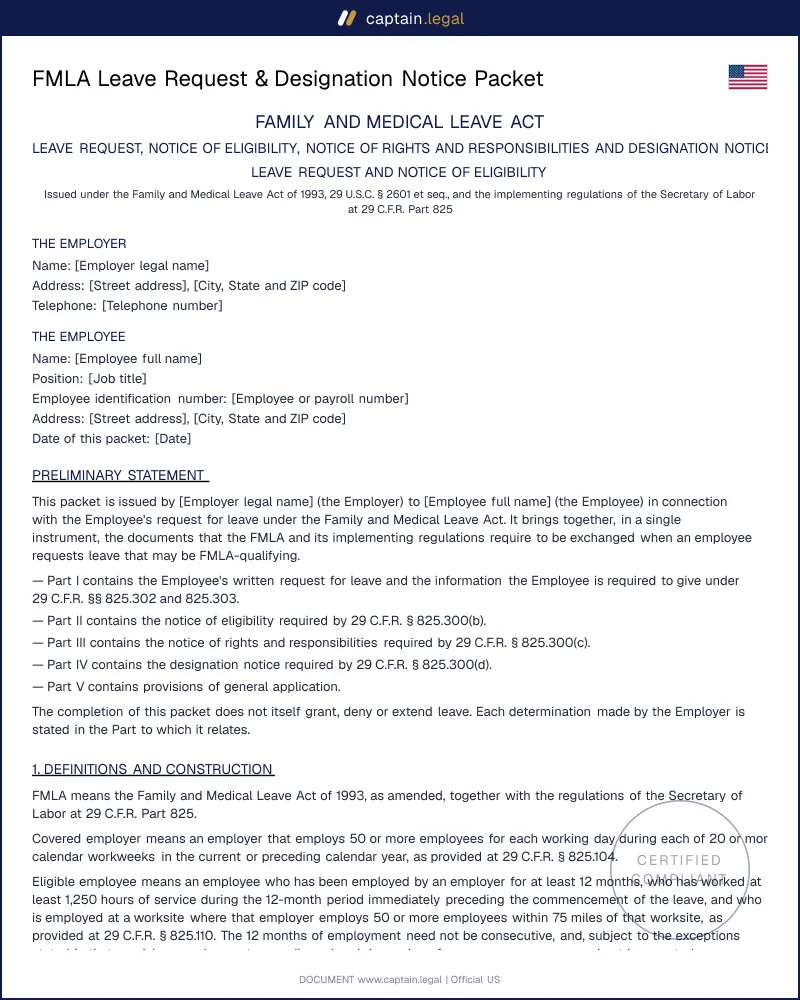
California stacks three regimes on one absence. The California Family Rights Act, at Gov. Code §12945.2, reaches employers with five or more employees and defines family more broadly than federal law, covering parents in law, grandparents, siblings and a designated person. Pregnancy disability leave under Gov. Code §12945 is separate and does not run concurrently with CFRA bonding leave, so an employee can chain up to four months of PDL onto twelve weeks of CFRA.
New York splits the analysis. Paid Family Leave under Workers' Compensation Law Article 9 funds bonding, family care and military exigency leave, but not the employee's own serious health condition, which routes to statutory disability benefits instead. Different forms, different carriers. FMLA runs concurrently only where the employer designates it, and many New York employers discover after the fact that twelve weeks of paid bonding leave never touched the federal entitlement.
Washington operates Paid Family and Medical Leave under RCW Title 50A, with 12 weeks of family or medical leave, 16 combined and 18 where pregnancy causes incapacity. State job protection carries its own eligibility test, which does not match the federal one, so an employee can be protected by one statute and not the other.
Massachusetts runs a broader program under M.G.L. c. 175M: 12 weeks of family leave, 20 weeks of medical leave and 26 weeks to care for a covered servicemember, with written notice to new hires due within 30 days of the start date. Colorado administers FAMLI under C.R.S. §8-13.3-501 et seq., with job protection attaching after 180 days. In states with no paid program, including Texas, Florida and Georgia, the federal packet is the whole framework.