Employment

Background Check Disclosure Form | 15 USC 1681b(b)(2)

Lawyer-drafted disclosure and authorization built to 15 U.S.C. 1681b(b)(2), with pre-adverse action letter and CA, NY, IL, WA fair chance wording.
4.6/513 reviews50 000+ downloadsInstant download
Share

A background check disclosure and authorization form is the two-part document a US employer hands an applicant before ordering a consumer report: a standalone written disclosure stating that a report may be obtained for employment purposes, and a separate signed authorization permitting the employer to procure it. Federal law treats those as two distinct obligations, and the first one is where most employers get sued. This template packages the disclosure required by 15 U.S.C. §1681b(b)(2), the applicant authorization, and the pre-adverse action letter that follows when a report threatens the hire. It is drafted for HR managers, recruiters, staffing agencies and owner-operators who screen candidates in more than one state and need fair chance wording that shifts with the jurisdiction.

Compliant

2026 Legislation

50,000+ clients

trust us

Affordable

From $4.90 / doc

Secure payment

Instant download

Background Check Disclosure Form | 15 USC 1681b(b)(2)

Secure payment

Fill in the template

What is a background check disclosure and authorization form?

The disclosure is a notice, not a contract. It tells the applicant, in plain language, that the employer may obtain a consumer report from a third-party screening company and may use it in deciding whether to hire, retain, promote or reassign. The statute requires that notice to appear "in a document that consists solely of the disclosure." Courts read that word literally. The authorization is the applicant's written permission, and it is the piece that makes the request for the report lawful under §1681b(b)(2)(A)(ii). Both must exist before the report is ordered, never after.

Two documents get confused with this one. A job application collects information from the candidate directly and answers to Title VII, the ADA and state fair chance statutes; it must not carry the FCRA disclosure inside it. An adverse action notice comes later, once the report has arrived and the employer is weighing a rejection. A narrower cousin also deserves attention: when the employer commissions personal interviews about the applicant's character or reputation, the report becomes an investigative consumer report under §1681a(e), and §1681d adds a second written notice due within three days. A routine criminal and employment verification search is not an investigative consumer report, but a reference-calling assignment often is.

2

When do you need this document?

Any time a third-party screening company pulls the record, the form is required. That covers criminal history searches, county and federal court checks, driving records, verifications of education and past employment, and credit reports where state law still permits them. Most employers now deliver it at the conditional offer stage, the safer default even outside states that mandate that timing. Staffing agencies need it twice over, because the agency and the client company can both qualify as users of the report.

Contractor and volunteer screening trips people up. A report ordered on a 1099 worker through a consumer reporting agency is still a consumer report, and courts have treated it as employment purposes in most postures, so the disclosure applies even without an employment relationship. Volunteer placements involving children or vulnerable adults usually sit under both the FCRA and a separate state screening mandate with its own consent form. Our 1099 independent contractor agreement built for US misclassification risk covers the engagement itself.

Two edge cases justify a second look. Continuous criminal monitoring, where a vendor alerts the employer whenever a new record appears on a current employee, is a fresh report each time and needs authorization language broad enough to cover it. A search the employer runs itself on a free court portal falls outside the FCRA, since no consumer reporting agency is involved, though state fair chance timing still bites.

3

Key clauses included in our template

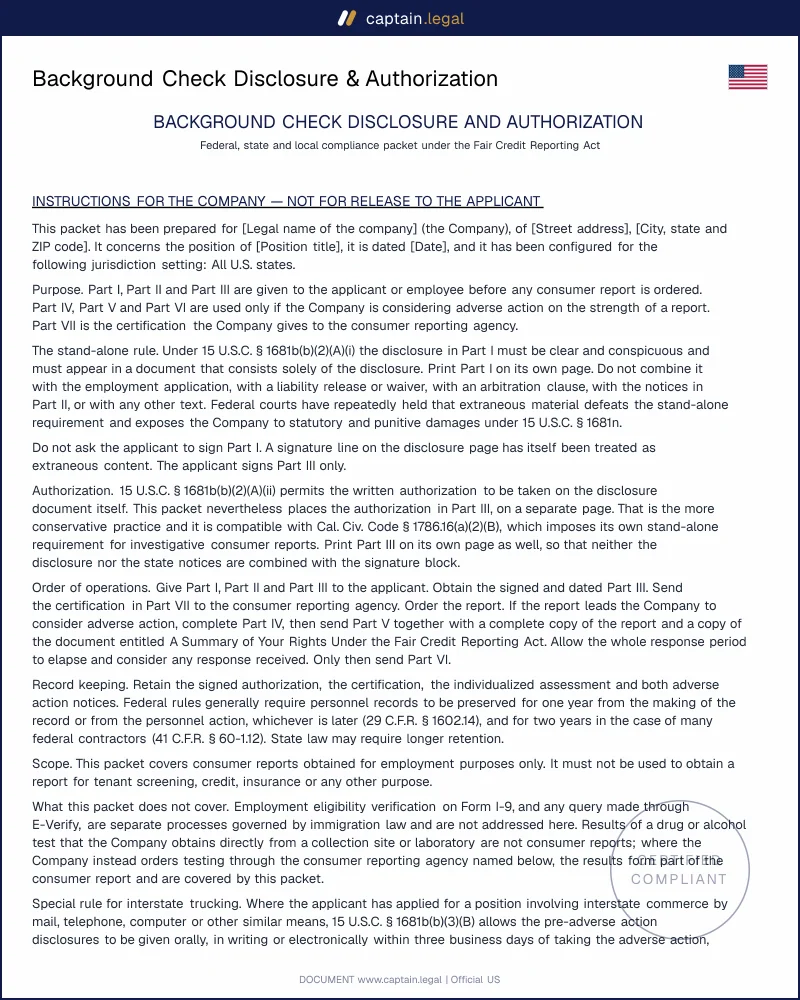
  • The standalone disclosure page carries the statutory notice and nothing else. No liability release, no at-will language, no state notices, no application text. It includes the short description of nature and scope that Walker permits, so the applicant knows what is being searched without the page turning into a rights summary.
  • The written authorization sits on its own page, names the screening company with its address and website, and covers the initial report plus, at the employer's option, reports obtained during employment for retention or promotion decisions. It carries the free copy request box as a separate check box, which Cal. Civ. Code §1786.16(a)(2) requires on the form itself.
  • The state notice annex is a distinct document, which is exactly what Gilberg demands. It holds the California ICRAA summary, the New York Correction Law Article 23-A notice, the Washington fair chance notice and the other state text that used to be crammed onto one page.
  • The pre-adverse action letter transmits the report copy and the federal rights summary, states that no final decision has been made, and opens the dispute window under §1681b(b)(3). The holding period is configurable, because several states set a floor that federal practice does not.
  • The final adverse action notice lists the screening company's contact details, states that the company did not make the decision, and sets out the right to a free copy within sixty days and the right to dispute accuracy, as §1681m(a) requires.
4

State-specific considerations

California runs two statutes in parallel. The Investigative Consumer Reporting Agencies Act, at Cal. Civ. Code §1786.16, requires its own disclosure stating the purpose, the scope, the agency's name and website, plus the copy request box. The Fair Chance Act, at Gov. Code §12952, bars criminal history inquiry before a conditional offer and requires an individualized assessment before rejection. Amended regulations at 2 CCR §11017.1, effective October 1, 2023, turned that assessment into a reasoned, evidence-based determination and gave applicants at least five business days to answer a preliminary decision notice. Job ads announcing "no felons" are independently unlawful.

New York applies Correction Law Article 23-A and the eight-factor analysis of §753 to any conviction-based rejection, while GBL §380-c adds state notice duties. New York City goes further under NYC Admin. Code §8-107(11-a), amended by Local Law 4 of 2021: the criminal portion runs separately and only after a conditional offer, and the position stays open at least three business days after the Fair Chance Notice.

Illinois combines the Job Opportunities for Qualified Applicants Act, 820 ILCS 75, with the 2021 amendments to the Human Rights Act at 775 ILCS 5/2-103.1: an interactive assessment, then a preliminary notice and a final notice, each with its own content list and a five-business-day response window.

Washington rewrote its rules through EHB 1747, codified at RCW 49.94, effective July 1, 2026 for employers with fifteen or more employees and January 1, 2027 for smaller ones. Criminal history cannot be requested until after a conditional offer, arrest records and juvenile adjudications are largely off limits, and the employer must deliver a written notice together with the Attorney General's Fair Chance Act guide. Blanket disqualification policies are now prohibited outright in Washington.

Texas imposes no statewide ban-the-box rule on private employers, which is where national forms go sloppy in the other direction. Austin's Fair Chance Hiring Ordinance still reaches employers of fifteen or more inside city limits, and Tex. Bus. and Com. Code §20.05 caps how far back a screening agency may reach for candidates below a salary threshold.

5

How to fill out this background check disclosure and authorization form

You start by naming the hiring entity exactly as it appears on the conditional offer letter drafted for US federal and state labor rules, because a mismatch gives a plaintiff's lawyer an easy inconsistency. Next you select the state where the applicant will work, and the form loads the matching fair chance annex and holding period. Then you enter the screening company's legal name, address, telephone number and website, which the authorization and both adverse action notices reuse automatically.

The scope selector comes next. You tick the searches you actually order, from county criminal to motor vehicle records, and the nature-and-scope paragraph rewrites itself to match. Employers planning periodic rechecks turn on the ongoing reports option here. Finally you export the packet as separate files: disclosure, authorization, state annex, pre-adverse letter, final notice. Do not merge those files into a single PDF before signature, because merging is precisely what Gilberg condemned. The applicant signs the authorization only, and the signed copy is filed alongside the rest of the hiring paperwork listed in our employee onboarding checklist with I-9 and payroll sequencing.

6

Common mistakes to avoid

The classic error is the all-in-one form: disclosure, authorization, liability release and state notices stapled into one signature page. That single choice has funded a decade of class actions. Close behind it is running the criminal search too early, before any conditional offer, which is lawful in Texas and unlawful in California, New York City, Illinois and Washington. A third failure is the rejection email sent the day the report lands, with no pre-adverse action letter and no report copy attached. That skips §1681b(b)(3) and destroys the applicant's chance to dispute an inaccurate record.

Two quieter mistakes cause as much damage. Employers reuse a five-year-old authorization to rerun a check on a current employee, then discover the original wording never mentioned reports obtained during employment. And hiring managers write up the rejection in categorical terms, "any theft conviction disqualifies," which contradicts every individualized assessment requirement on the books. Keep the written assessment factual and job-specific, and align the wording with the job application form built to Title VII and state fair chance rules you already use. Groups screening unpaid help should check the nonprofit and volunteer template library too, since volunteer consent rests on a different footing.

Key takeaways

FCRA format

Disclosure must be a standalone document

The FCRA requires a clear, conspicuous written disclosure that a consumer report may be obtained for employment purposes, and it must appear in a document that consists solely of that disclosure (15 U.S.C. 1681b(b)(2)). Do not tuck it into a job application or surround it with extra language like waivers. Courts read “solely” literally, and that is where many employers get sued.

Authorization

Get written permission before ordering

The authorization is separate from the disclosure: it is the applicant’s written permission that makes the request lawful under 15 U.S.C. 1681b(b)(2)(A)(ii). Both steps must happen before you order the report, not after a search is already running. The template is structured as a two-part process so HR, recruiters, and staffing teams can document compliance consistently across roles.

Adverse action

Pre-adverse action comes before a rejection

If the report may lead you to deny the job (in whole or in part), the process does not jump straight to rejection. Under 15 U.S.C. 1681b(b)(3), you must first provide the applicant a copy of the report and the Summary of Your Rights Under the Fair Credit Reporting Act, then wait a reasonable period before taking adverse action. This is why a pre-adverse action letter is packaged with the form.

Frequently Asked Questions

The authorization is binding once signed, and it supplies the permissible purpose that §1681b(b)(2)(A)(ii) requires before a screening company may release a report. The disclosure is not a contract at all; it is a statutory notice, and its legal effect comes from correct delivery rather than from agreement. The template follows the current federal text and the state statutes reproduced in the annex, creates no employment relationship, and waives no applicant right.

Better not. §1681b(b)(2)(A)(i) protects only the disclosure, and Walker confirmed that the authorization need not be standalone. Plaintiffs still argue that a signature line, a date field and consent language add extraneous content to the disclosure page, so separating them removes an argument at no cost. The template prints two files, and an e-signature flow can present them as two consecutive screens with separate acknowledgments.

Federal law says a reasonable period and sets no number. Federal Trade Commission staff guidance has long treated five business days as defensible, and that is the template default. States add their own floors: California and Illinois give the applicant at least five business days to answer the preliminary notice, and New York City keeps the position open at least three business days after the Fair Chance Notice. Follow the longer rule when both apply. Sending the final notice within a day of the pre-adverse letter is the fastest route to a willfulness claim.

Yes. The packet downloads as editable Word files and print-ready PDFs, one per component, so the disclosure stays separate from the authorization and the state annex. The Word versions take your letterhead and let you adjust the scope paragraph when your search panel changes. High-volume employers send candidates the PDFs and keep the Word files as masters. Other hiring documents sit in the complete US legal document catalog.

If the original authorization covers reports obtained throughout employment, and the applicable state permits that scope, no. If it was silent, yes. California is strictest here, and employers have been caught relying on hiring-stage consent to justify an annual driving record pull years later. The template carries an explicit ongoing reports option so the question is settled at hire rather than argued afterward.

Under §1681m(a): the name, address and telephone number of the screening company; a statement that the company did not make the decision and cannot explain it; the right to a free copy of the report from that agency within sixty days; the right to dispute accuracy or completeness; and confirmation that adverse action was taken based in whole or in part on the report. Several states add a copy of the individualized assessment to that federal list.

4.6/5

13 verified reviews · 50 000+ downloads

Background Check Disclosure Form | 15 USC 1681b(b)(2)
  • Immediate access to the document
  • PDF + Word download
  • Compliant with 2026 legislation
  • Reviewed by lawyers
Fill in the template
Secure payment
Updated on September 6, 2026

You might also like

Employment Verification Letter Template
Employee Onboarding Checklist