Business

Startup Advisor Agreement | Rule 701 & 409A Compliant

Startup advisor agreement drafted to SEC Rule 701, IRC 409A and 8 Del. C. 157. FAST tiers, 24-month vesting, present-tense IP assignment. Word and PDF.
4.8/514 reviews50 000+ downloadsInstant download
Share

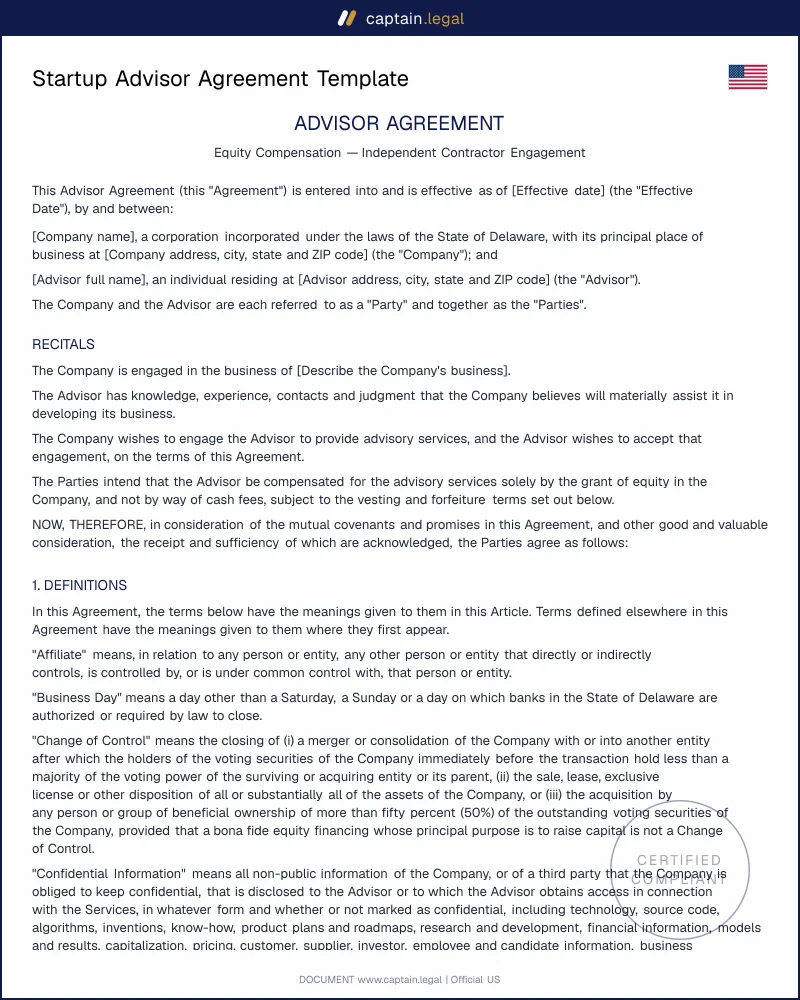
A startup advisor agreement records what an advisor does for a company and what equity that person earns in exchange, usually a fraction of one percent vesting monthly across two years. Founders reach for it when an experienced operator starts giving real input and the relationship needs terms before anyone argues about the cap table. Our template follows the FAST structure (Founder/Advisor Standard Template) that US venture counsel recognize on sight: tiered equity, an optional three month cliff, a present assignment of intellectual property, and unambiguous independent contractor status. It is drafted to Delaware corporate law and to the federal securities and tax rules governing compensatory equity, in Word and PDF.

Compliant

2026 Legislation

50,000+ clients

trust us

Affordable

From $4.90 / doc

Secure payment

Instant download

Startup Advisor Agreement | Rule 701 & 409A Compliant

Secure payment

Fill in the template

What is a startup advisor agreement?

A startup advisor agreement is a short services contract paired with an equity grant. The advisor commits to a defined engagement, commonly two to five hours a month of calls, introductions and document review, and the company commits stock or options that vest while it lasts. No cash moves. That single fact drives the drafting, because equity consideration pulls in securities law, tax law, and corporate authorization rules a plain consulting contract never touches.

Founders confuse this document with three neighbors. A consulting agreement buys deliverables for money and prices scope, milestones, and invoices. A board seat creates fiduciary duties and a vote, while an advisory board carries neither. Founder equity belongs in a co-founder agreement covering vesting and IP assignment, since founder stock is issued at formation and vests across four years rather than two. An advisor described as a director in any document risks being treated as one, so the template states expressly that the advisor holds no board seat, no voting rights, and no authority to bind the company.

2

When do you need this document?

The clearest trigger is the moment an informal mentor starts doing work. A former VP of sales who has worked your pipeline, rewritten your outbound sequence, and opened two accounts is no longer a friendly contact. Paper the relationship before the fourth call, because equity talks get harder once the advisor believes a number was agreed. Fundraising is the second trigger. Investors read the cap table line by line, and an unexplained 2 percent sitting with a name nobody can describe is a diligence problem, particularly alongside a post-money SAFE issued under Regulation D where the dilution math has to reconcile.

Technical founders use the document to buy commercial judgment, commercial founders to buy architecture review, and regulated startups to buy someone who has cleared a regulator before. Two edge cases deserve care. An advisor who still works full time for a large employer is almost certainly bound by an invention assignment covering side activity, so ask for written confirmation that the engagement is permitted. An advisor based abroad raises withholding and local securities questions the standard form does not resolve.

3

Key clauses included in our template

  • The scope of services is written as a commitment rather than a sentiment. Instead of "provide advice as needed," it fixes a monthly hour band, a meeting cadence and named deliverables, which is what makes non performance provable later.
  • The equity grant follows the FAST tiers, from roughly 0.25 percent for a standard engagement to 1 percent for expert involvement at idea stage, expressed as a percentage of fully diluted capitalization and converted to a fixed share number at grant. Both figures appear, because only the share count binds.
  • The vesting schedule runs monthly across 24 months with an optional three month cliff. Vesting stops the day the engagement ends, and the company keeps a repurchase right over unvested stock at original cost.
  • The independent contractor clause confirms the advisor controls the manner and means of the work, receives no benefits, and carries self employment tax on income recognized under section 83.
  • The intellectual property assignment transfers, in the present tense, whatever the advisor creates during the engagement, with a carve out for pre existing work listed in a schedule and licensed rather than assigned.
  • The termination clause lets either side exit on 30 days written notice, with no severance and no acceleration, and with confidentiality, assignment and non solicitation surviving.
4

State-specific considerations

Delaware governs the template because most venture backed startups incorporate there. Under 8 Del. C. §157, only the board may grant rights and options over stock, and the grant must fix the consideration and the terms, so a startup advisor agreement signed by a founder alone creates no valid grant. A board resolution or a §141(f) unanimous written consent has to follow the same week. Section 152 requires the board to find the consideration adequate, and services already rendered qualify while future services do not. Founders who skip the consent discover the gap in diligence, when counsel refuses to certify the cap table.

California adds two layers. The state compensatory exemption at Corporations Code §25102(o) requires a notice filing, and California courts void post engagement restrictive covenants under Business and Professions Code §16600, a prohibition extended to agreements formed elsewhere by §16600.5. Non compete language aimed at a California advisor is dead on arrival, so the template limits itself to confidentiality and a narrow non solicitation of employees. Classification is the other pressure point: Labor Code §2775 presumes employee status unless the engagement meets the ABC test or a listed exemption.

New York enforces reasonable restrictive covenants but reads them narrowly against the drafter, and the Freelance Isn't Free Act (Labor Law article 44) requires a written contract for independent contractor engagements above a statutory threshold. Equity only arrangements sit in an uncertain corner of that statute, one more reason to keep everything in writing.

Texas enforces a non solicitation clause only if it is ancillary to an otherwise enforceable agreement under Business and Commerce Code §15.50, which means the confidentiality obligation must be real and supported by actual disclosure of proprietary information. With no state income tax, the entire burden on exercise falls at the federal level. Massachusetts applies the Noncompetition Agreement Act (M.G.L. c. 149 §24L) to independent contractors as well as employees, garden leave pay included.

5

How to fill out this startup advisor agreement

You start by naming the company and confirming the state of incorporation, which drives the governing law clause and the corporate authorization language. Next comes the engagement tier: the form asks about company stage and expected involvement, then proposes the matching FAST percentage, which you can override with any number already agreed. You then pick the instrument, restricted stock or a nonqualified option, and the form adjusts the tax notices, the repurchase mechanics and the 83(b) reminder.

The vesting block is prefilled at 24 months monthly, with the cliff as a toggle rather than a default. You then describe the services, prompted for hours, cadence and deliverables rather than one vague line. The final screens cover confidentiality duration, the schedule of pre existing intellectual property, notice addresses and signature blocks. Edit the Word file to negotiate wording, generate the PDF for signature, and store the board consent with it.

6

Common mistakes to avoid

The most expensive mistake is granting equity with no vesting, or with vesting that keeps running after the advisor goes quiet. Advisors fade for innocent reasons, a new job or a busy quarter, and an unvested grant hands away real ownership for two months of calls. The second is quantity. Ten advisors at 1 percent each costs a tenth of the company before the first engineer signs an offer letter, which distorts every later round and complicates the shareholder agreement covering preemptive rights and transfer restrictions.

Third, founders sign and never obtain the board approval that actually creates the grant, leaving an advisor who believes they own stock and a company whose records disagree. Fourth, the strike price gets set casually, at par value or at a number recalled from the last round, which invites a 409A assessment against the advisor personally. Get a current valuation before you sign, not after. Fifth, the services description stays vague, so when the relationship stalls there is no standard against which to terminate.

Key takeaways

EQUITY BASICS

Set the work and vesting upfront

This agreement ties specific advisor services to a defined equity grant, typically a fraction of 1% that vests monthly over 24 months (often with an optional three-month cliff). It is meant for light, ongoing help like 2 to 5 hours a month of calls, intros, and document review, with no cash payments. Clear terms now prevent later cap table fights.

SEC RULE 701

Keep the equity grant inside Rule 701

Advisor equity is treated as an offer and sale of securities, so the company needs an exemption under the Securities Act of 1933. Rule 701 (17 C.F.R. §230.701) generally covers compensatory grants under a written plan or contract, but two pitfalls matter: the recipient must be a natural person (not the advisor’s LLC), and the services must be bona fide and not fundraising.

TAX & IP

Avoid 409A penalties and lock in IP

Because advisors are not employees, their options are nonqualified stock options, not ISOs under IRC 422(a)(2). Set the exercise price at fair market value on the grant date; discounted options can trigger IRC 409A and a 20% additional tax plus interest. If using restricted stock at the idea stage, the advisor must file an 83(b) election within 30 days. Use present-tense IP assignment so title actually transfers.

Frequently Asked Questions

The FAST bands remain the reference most founders and investors use. An idea stage company typically grants around 0.25 percent for a standard engagement of monthly calls, 0.5 percent for a strategic advisor who opens doors, and up to 1 percent for expert involvement. Later stage companies grant far less for the same commitment, often 0.1 percent or below. Total advisor allocation usually stays between 1 and 3 percent.

Yes. It is an ordinary services contract supported by consideration on both sides, advisory services against equity, and enforceable like the other instruments in the business contracts and incorporation catalogue. The equity grant carries a second requirement: the board must approve the issuance and record it, because the corporation acts through its board. Sign the agreement, adopt the board consent, update the cap table. Skip the middle step and the advisor holds a contractual promise rather than shares.

Both appear, and the choice tracks valuation. At formation, restricted stock is common because the shares cost almost nothing, the advisor files an 83(b) election within 30 days, and later appreciation is taxed as capital gain. Once a priced round sets a real valuation, a nonqualified stock option becomes standard, since the advisor pays nothing at grant. Incentive stock options are unavailable either way, because section 422 reserves them for employees.

Serve the 30 days written notice the agreement provides. Vesting stops on the termination date, unvested shares are forfeited or repurchased at original cost, and the advisor keeps only what has vested. This is why monthly vesting and the three month cliff matter: an advisor who disengages in month four leaves with a small fraction. Confidentiality, the assignment and any non solicitation obligation continue afterwards.

Usually not. The confidentiality article covers the same ground as a standalone mutual NDA: the definition of confidential information, permitted disclosures, return or destruction of materials, and the federal whistleblower immunity notice. A separate instrument makes sense in one situation, when you are about to disclose something far more sensitive than the advisory role contemplates, such as unfiled patent material or clinical data. A targeted NDA signed first gives a cleaner record.

Yes, both formats come with every generation. The Word file is fully editable, which matters because advisor terms get negotiated more often than founders expect, particularly the services description and the treatment of a change of control. The PDF is the clean signature copy. Most users edit in Word, exchange the draft with the advisor, then produce the final PDF for signature and file it with the board consent.

This startup advisor agreement takes under fifteen minutes to complete once you know the tier and the instrument. Vesting commences on the date the parties select, often the signature date, though it can run from the start of the informal relationship if the board consent says so. The corporate step sets the pace: schedule the consent the same week, because the grant date for 409A purposes is the date of board approval, not of signature. Related forms sit in the full US template catalogue.

4.8/5

14 verified reviews · 50 000+ downloads

Startup Advisor Agreement | Rule 701 & 409A Compliant
  • Immediate access to the document
  • PDF + Word download
  • Compliant with 2026 legislation
  • Reviewed by lawyers
Fill in the template
Secure payment
Updated on September 4, 2026

You might also like

Business Purchase Agreement Template
Partnership Agreement Template