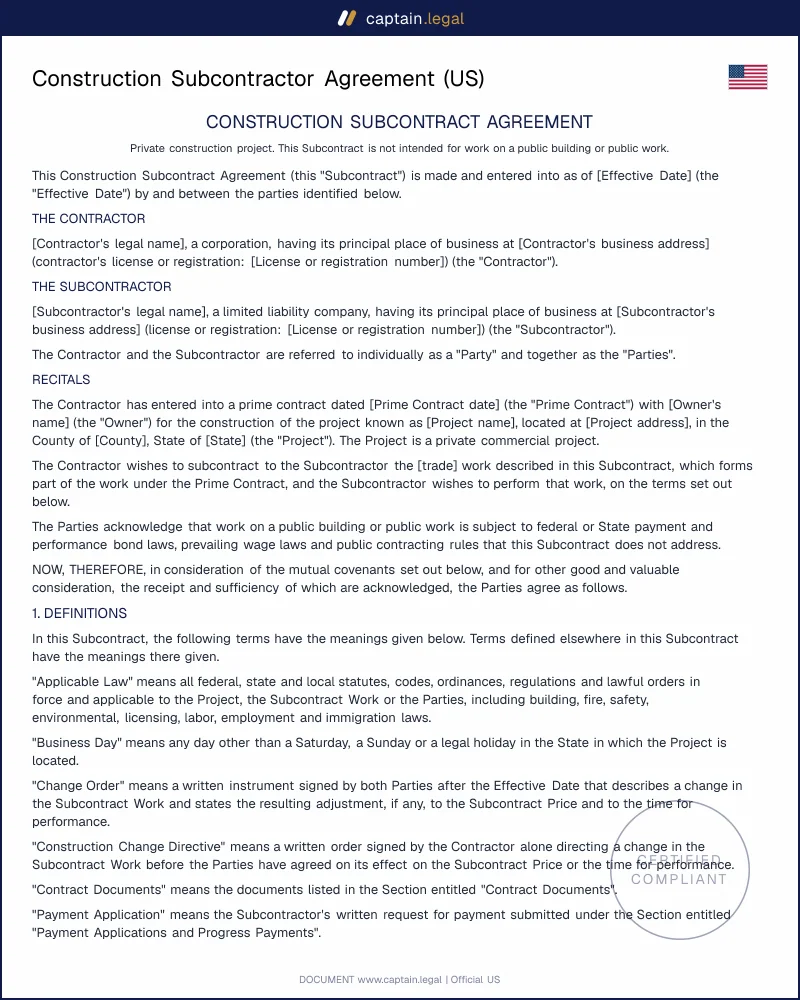
The opening clauses identify the parties with their license numbers, the owner, the project address and county, and the date of the prime contract. Contract documents are listed by drawing number and date, with an order of precedence: change orders first, then the subcontract, then the prime contract, then specifications over drawings. The flow-down clause binds the subcontractor to the prime contract for its scope only, while the subcontract prevails over any inconsistent prime contract term. A seven-day notice rule for claims protects the contractor's own deadlines toward the owner.
Pricing adapts to your choice. A lump sum comes with a schedule of values; unit prices allow an equitable adjustment when a quantity moves by more than twenty-five percent; time and materials carries rates, a markup and a cap. Payment applications go in monthly, and the contractor pays within seven days after the owner pays it. With pay-when-paid, the default, an outside date in days fixes the latest payment even when the owner is slow. The pay-if-paid option shifts the owner's insolvency risk to the subcontractor and falls back to pay-when-paid wherever State law refuses to enforce it. Optional retainage cannot exceed what the owner retains or what State law allows.
Protection clauses complete the form. Lien waivers follow the statutory format where your State prescribes one. You set the insurance limits, and the contractor and the owner become additional insureds with a waiver of subrogation. Indemnity is limited to the subcontractor's negligence, and the warranty period is yours to set. Backcharges need 48 hours' notice, a defaulting trade gets three business days to start its cure and seven days from the notice to finish it, and termination for convenience excludes profit on work never performed. Disputes go to mediation, then to court or arbitration.

 US law 2026