Create my document
Login

Choose country

United StatesUnited StatesChoose country
Business

Cease and Desist Letter | Lanham Act & State-Law Ready

Cease and desist letter drafted to 15 U.S.C. 1117(a) willfulness rules, Tex. Civ. Prac. & Rem. Code 73.055 and Fla. Stat. 770.01 notice. Word & PDF.
4.8/514 reviews50 000+ downloadsInstant download
Share

A cease and desist letter is a formal written demand ordering another party to stop a specific course of conduct, with notice that litigation follows if it continues. US businesses use it against trademark infringement, copyright piracy, trade secret misuse, defamation, and breach of contract. It is not a court order and carries no coercive power of its own. The value sits elsewhere. The letter creates a dated record of notice, opens the door to enhanced damages when the recipient keeps going anyway, and in several states satisfies a statutory pre-suit demand a defamation claim cannot survive without. Written properly, it ends the dispute in weeks. Written carelessly, it hands your opponent a lawsuit in a forum of their choosing.

Compliant

2026 Legislation

50,000+ clients

trust us

Affordable

From $4.90 / doc

Secure payment

Instant download

Cease and Desist Letter | Lanham Act & State-Law Ready

Secure payment

Fill in the template

What is a cease and desist letter?

A cease and desist letter is pre-litigation correspondence that identifies unlawful conduct, demands it stop by a stated date, and reserves every remedy available to the sender. Practitioners also call it a demand letter or a notice of infringement, but the mechanics never change: you name the conduct, the legal basis, the deadline, the consequence.

Do not confuse it with a cease and desist order. An order comes from a court or a regulator such as the Federal Trade Commission, and ignoring one exposes the recipient to contempt. A letter is private correspondence. Its recipient can throw it away and face nothing beyond the lawsuit you then have to file. It also differs from a DMCA takedown notice, sent to a hosting provider under 17 U.S.C. §512(c)(3) rather than to the infringer, and from a demand letter for unpaid invoices, which chases a liquidated sum instead of stopping conduct. Many disputes call for both, combined in one document.

2

When do you need this document?

The most frequent trigger is a competitor using a name, logo, or product design close enough to yours to confuse customers. A rights holder who stays silent risks a laches or acquiescence defense, and every month of delay weakens the confusion argument. If the dispute grew out of a licensing relationship, review the trademark license agreement drafted to Lanham Act quality-control rules first, since a lapsed license changes the demand entirely. Right behind trademark comes content theft: a photograph lifted from your site, a syllabus copied verbatim, descriptions scraped by a drop-shipper.

Departing employees generate the third wave. Someone leaves with a client list, starts calling accounts, and the covenant they signed suddenly matters. A letter quoting the exact clause of a non-compete and non-solicitation agreement and naming the accounts contacted produces compliance far more often than a vague warning about loyalty. Defamation is the fourth: a fabricated review, a false accusation posted publicly, a former partner telling suppliers you are insolvent.

Two edge cases separate a practitioner's letter from a generic download. Section 230 of the Communications Decency Act immunizes the platform, so a demand aimed at a review site instead of the author accomplishes nothing. And harassment by a debt collector calls for the cease-communication notice at 15 U.S.C. §1692c(c) of the Fair Debt Collection Practices Act rather than a general demand, because the statutory route creates liability the moment the next call is placed.

3

Key clauses included in our template

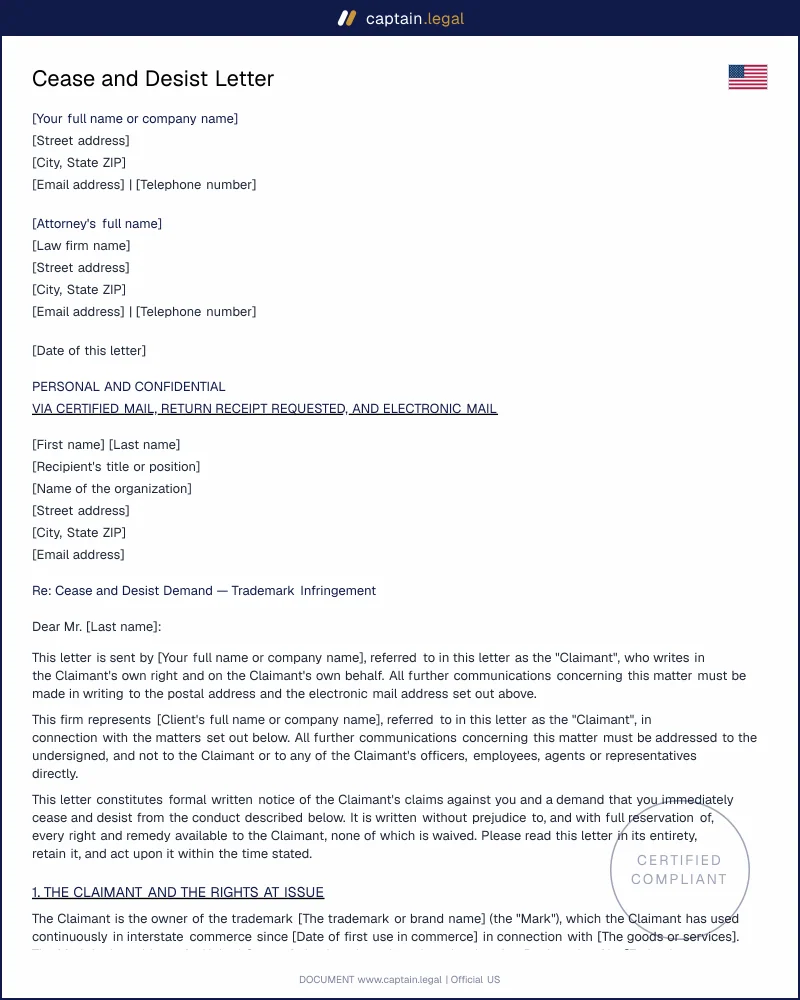
  • The identification of the parties and the protected right opens the letter and does the heaviest work. A trademark demand states the registration number and the classes covered, a copyright demand the work and any registration number, a contract demand the clause breached. Vagueness lets the recipient reply that they have no idea what you mean.
  • The factual recitation of the infringing conduct sets out dates, URLs, screenshots referenced by exhibit letter, and the channel where the conduct occurred. Keep it clinical and free of adjectives, because it is the paragraph most likely to be quoted back in a filing.
  • The statement of the legal basis ties each fact to a statute or common-law element. This is where §1114, §501, the DTSA, or the state defamation standard appears, drafted so a judge reading the letter later sees a claim that was understood from the start.
  • The operative demand states exactly what must happen: stop the use, remove the listings, destroy inventory, transfer the domain, publish a retraction. Ambiguous demands produce partial compliance and a second round of correspondence.
  • The compliance deadline and written confirmation requirement fixes a date and asks for signed acknowledgment. Ten to fourteen days is the practical standard, shorter where inventory is moving.
  • The reservation of rights and settlement legend closes the letter, preserving all remedies and framing the communication under Federal Rule of Evidence 408. Never let this paragraph slide into a threat of criminal prosecution.
4

State-specific considerations

California treats a good-faith demand letter as protected prelitigation speech under the litigation privilege of Cal. Civ. Code §47(b), which is why recipients rarely succeed in suing over one. That protection has a hard edge. In Flatley v. Mauro the California Supreme Court held that a letter threatening criminal exposure to extract payment was extortion as a matter of law, stripped of the privilege and of the anti-SLAPP shelter at Code of Civil Procedure §425.16. Defamation senders should also note Civil Code §48a, which requires a correction demand within twenty days of a newspaper or broadcast publication and otherwise limits recovery to special damages.

New York amended its anti-SLAPP regime through Civil Rights Law §§70-a and 76-a to cover communications connected to any issue of public interest, with attorney fee recovery for a successful movant. A letter threatening meritless litigation over a critical review can end with the sender paying the recipient's counsel.

Texas imposes the strictest sequence of the four. Under the Defamation Mitigation Act at Tex. Civ. Prac. & Rem. Code §73.055, a claimant who fails to request a correction, clarification, or retraction within ninety days of learning of the publication loses exemplary damages, and the request must identify the statement with particularity and allege its defamatory meaning. The Texas Citizens Participation Act at §27.003 adds an aggressive dismissal mechanism with a sixty-day motion deadline. A Texas letter over speech should read as a statutory retraction request from the first line.

Florida requires five days written notice specifying the allegedly false statements before any civil action for libel or slander, under Fla. Stat. §770.01. Courts applying Florida law have extended that requirement to online publishers and bloggers, so an informal email that skipped the statutory format can bar the case outright. The anti-SLAPP statute at §768.295 adds fee exposure for suits filed to chill protected speech. Comparable traps exist in most states, and the state selector across our US business contract templates accounts for them.

5

How to fill out this cease and desist letter

You begin by selecting the claim type, because the whole document reconfigures from that single choice. Trademark loads the Lanham Act citations and the registration fields, defamation loads the retraction language and the state pre-suit requirements, breach of contract loads the notice-and-cure structure keyed to the clause you quote. From there you enter sender and recipient details, including a registered agent where the recipient is a corporation, since a demand sent to a marketing address is the most common reason it never reaches decision-makers.

Prompts then collect dates, locations, and evidence references and assemble them into numbered paragraphs suitable for an exhibit list. You choose your state, and the deadline, damages language, and statutory notice wording adjust accordingly. Last comes the remedy: stop the conduct, removal, destruction, domain transfer, retraction, or an accounting of profits. Download follows in editable Word and signed PDF. If confidential information is also in play, the non-disclosure agreement template with trade secret provisions belongs in the same file.

6

Common mistakes to avoid

The most damaging error is threatening criminal charges to force a civil settlement. It converts a protected demand into potential extortion in California and elsewhere, and it breaches professional conduct standards when counsel signs. Close behind sits the overstated claim: demanding removal of material that is plainly fair use exposes a copyright sender to liability for misrepresentation under 17 U.S.C. §512(f).

The third mistake is procedural. Senders skip certified mail, rely on an email that lands in spam, then cannot prove notice when they need to establish willfulness. The fourth is the impossible deadline: ordering a retailer to clear nationwide inventory in forty-eight hours guarantees non-compliance and looks unreasonable to a judge. The fifth is the one nobody anticipates. A repeated demand campaign can hand the recipient a declaratory judgment action in their home state, turning you into a defendant on their calendar. Send one clear letter, then act on it.

Key takeaways

Notice record

A letter is leverage, not an order

A cease and desist letter is private pre-lawsuit correspondence, not a court or agency order. The recipient can ignore it, and nothing happens automatically until you file suit. Its value is the dated record of notice and a clear demand to stop by a stated deadline. That record can strengthen your position if the conduct continues after notice.

Trademark damages

Document notice to support willfulness

For trademark disputes under the Lanham Act, what you put in writing can affect money later. The excerpt flags 15 U.S.C. §1117(a): continued use after documented notice is classic evidence of willfulness, which can open the door to enhanced damages. That means your letter should identify the conduct, cite the right basis (often §1114 or §1125(a)), and make the stop-date unmistakable.

Forum risk

Your letter can trigger a race to court

Drafting style can backfire. Under the Declaratory Judgment Act (28 U.S.C. §2201) and cases like MedImmune v. Genentech, an accused party facing a real, immediate threat may sue first for a declaration of non-infringement. And Trimble v. PerDiemCo warns that repeated, escalating letters can create jurisdiction hooks in the recipient’s home forum. One careless threat can hand them the venue.

Frequently Asked Questions

No. It is private correspondence, not a court order, and the recipient commits no offense by ignoring it. What it does is create legally significant notice. From receipt onward, continued conduct is deliberate, which supports enhanced damages under 15 U.S.C. §1117(a) for trademarks and willful statutory damages under 17 U.S.C. §504(c)(2) for copyright. Binding force arrives only with an injunction, and the letter makes that application look reasonable rather than premature.

Ten to fourteen calendar days is the working standard for commercial disputes, measured from receipt rather than the date on the letter. Shorten it to five or seven days where infringing inventory is selling, and extend it to thirty where compliance requires rebranding or a domain transfer. Statutory periods override your preference: Florida requires five days notice before a defamation suit under Fla. Stat. §770.01, and Texas ties exemplary damages to a retraction request within ninety days of publication.

You choose between escalation and filing, and filing is usually the better answer. A second letter mostly teaches the recipient that your deadlines are negotiable. Before filing, gather proof of delivery, screenshots dated after the deadline, and sales data showing continued infringement, since that record supports a willfulness finding. Platform enforcement runs in parallel: marketplace complaints often produce removal faster than litigation, and your unanswered letter is the exhibit behind them.

Both formats come with every download. The Word file is fully editable, which matters because most senders adapt the recitation for a second recipient in the same matter or add exhibit references after gathering screenshots. The PDF is the signature-ready version you mail certified with return receipt requested. Keep that receipt with your copy, since proof of delivery converts a demand into documented notice. The same dual-format download applies across the catalog of US legal document templates.

Only against the author. Section 230 of the Communications Decency Act immunizes the platform hosting the review, so a demand sent to a review site achieves nothing. Identify the reviewer, confirm the statement is a verifiable false assertion of fact rather than opinion, and satisfy your state's pre-suit requirements first. Truthful negative reviews are protected, and anti-SLAPP statutes in California, New York, Texas, and Florida shift fees when a demand becomes a meritless suit.

It does not. Limitation periods run from the wrongful act regardless of correspondence, and defamation periods are unforgiving: one year in New York under CPLR §215(3), two years in Texas and Florida. A costly pattern is the sender who trades letters for months, believes the matter is being negotiated, then finds the claim expired. Diary the limitation date the day you draft the letter. Only a written tolling agreement signed by both parties pauses the clock.

4.8/5

14 verified reviews · 50 000+ downloads

Cease and Desist Letter | Lanham Act & State-Law Ready
  • Immediate access to the document
  • PDF + Word download
  • Compliant with 2026 legislation
  • Reviewed by lawyers
Fill in the template
Secure payment
Updated on August 1, 2026

You might also like

Business Purchase Agreement Template
Terms of Service Template