
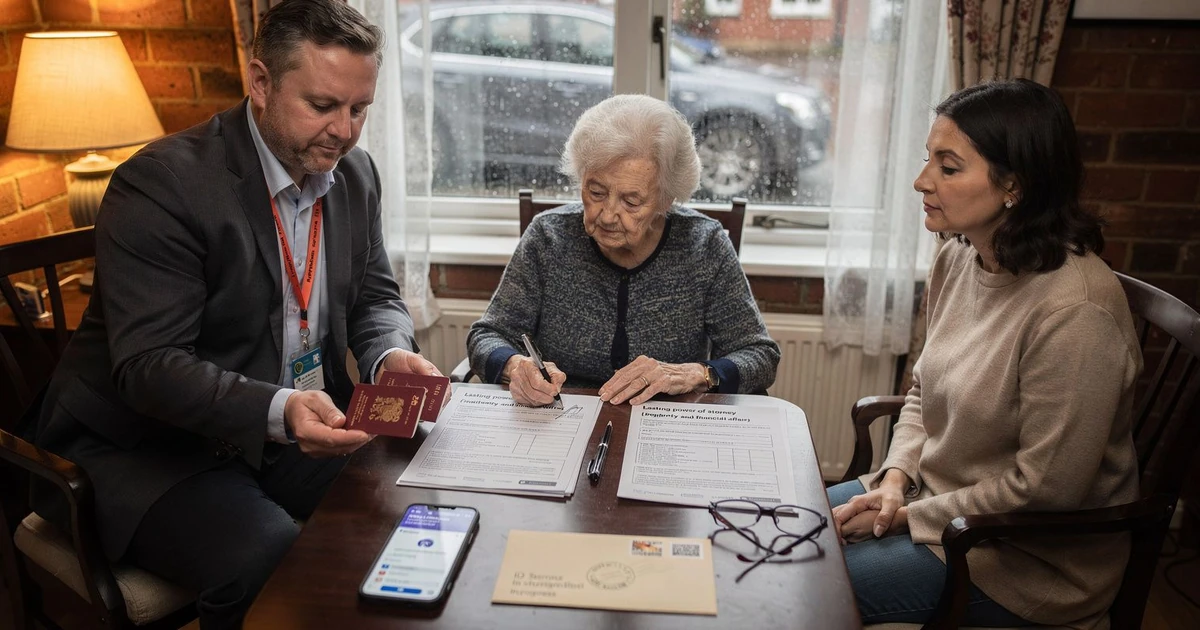
A lasting power of attorney lets you choose who will manage your money or make decisions about your care if you lose the capacity to do it yourself. The Powers of Attorney Act 2023 is set to move that process online, with identity checks at the point of registration and a larger role for the Office of the Public Guardian (OPG). The reform is law, but most of it still depends on commencement regulations, and the paper route remains the legal route until they are made. This guide explains what the Act changes, what stays exactly the same, and why nobody in England and Wales should wait for the digital service before putting both LPAs in place.
What is changing for a lasting power of attorney
Two types of LPA exist, and the reform does not touch that split. A property and financial affairs LPA covers bank accounts, bills, pensions and property, and the donor can allow it to be used as soon as it is registered. A health and welfare LPA covers medical treatment, care and where the donor lives, and it only operates once the donor lacks capacity for the decision in question. Both are made by the donor, who appoints one or more attorneys, and both need an independent certificate provider to confirm that the donor understands the document and is not under pressure.
What the 2023 Act changes is the machinery around those documents. It allows an LPA to be made digitally, on paper or through a mix of the two, moves the duty to notify named people from the applicant to the OPG, opens up the objection process, and makes identity verification a condition of registration. It also stops attorneys applying to register an LPA on the donor's behalf. The logic matches the reform of will-making, where the rules on signatures and witnesses still decide validity while Parliament debates change, as our guide to valid wills in England and Wales under the current rules explains.
Legal framework: from the 2005 Act to the 2023 reform
The foundation is the Mental Capacity Act 2005. Section 9 defines the LPA and requires it to be registered before anyone can use it, section 11(7)(a) confines a health and welfare LPA to decisions the donor can no longer make, and section 11(8) withholds any authority to give or refuse consent to life-sustaining treatment unless the LPA expressly provides for it. Schedule 1 sets the formalities, and the detail sits in The Lasting Powers of Attorney, Enduring Powers of Attorney and Public Guardian Regulations 2007 (SI 2007/1253), which prescribe the forms, the certificate provider rules and the waiting period before registration.
The Powers of Attorney Act 2023 received Royal Assent on 18 September 2023. It works almost entirely by amending Schedule 1 to the 2005 Act. A new paragraph 10A lets regulations impose requirements to establish or verify the identity of people involved in an application, and an application that fails them will not be accepted. Other amendments restrict registration to the donor, transfer notifications to the OPG and allow evidence of a registered LPA to take electronic form. Only one part took effect quickly: since November 2023, chartered legal executives can certify copies of a power of attorney under section 3 of the Powers of Attorney Act 1971.
Everything else waits for commencement regulations made by the Lord Chancellor under section 3 of the 2023 Act. Until they are made, the 2007 Regulations govern every application, with paper forms, wet-ink signatures and the four-week waiting period. The GOV.UK guidance on making and registering a lasting power of attorney sets out the process in force for each new application.
Identity checks: who, how and why
Fraud drives the change. Under the paper system, the OPG sees a signed form and a certificate, but it has no reliable way to confirm that the person named as donor actually signed, or that the certificate provider exists. Identity verification closes that gap at the moment it matters, before the LPA is registered and becomes usable.
The Act leaves the detail to regulations: who must be checked, which documents count, and whether a check can be done online, in person or through a professional. Commentary on the OPG's design work has pointed to checks on donors and certificate providers first, but the power in paragraph 10A is wide enough to reach anyone named in the LPA, so the final list will only be known once the regulations are laid. The online route is expected to run through GOV.UK One Login, the sign-in already used for the OPG's existing digital services, with an improved paper route kept for people who cannot use the internet.
In practice, the check will add a step, not a new legal test. A donor still needs capacity, the certificate provider still has to be independent and suitably qualified, and an identity check will not cure a document signed under pressure or out of order. It confirms who signed. It does not confirm that the donor understood what they were signing.
What stays the same when the process goes online
The substance of an LPA survives the reform untouched. The donor must have capacity when making it, which is why a diagnosis of dementia or a stroke is so often the moment families discover they have left it too late. The certificate provider must have known the donor personally for at least two years or have relevant professional skills, and cannot be a family member of the donor or of an attorney. The attorneys' duties under the 2005 Act do not change either: they must follow the statutory principles and act in the donor's best interests.
The choices that shape how an LPA works in practice also carry over. Attorneys can be appointed to act jointly, or jointly and severally, and a replacement attorney keeps the document alive if a first choice dies or withdraws. On a health and welfare LPA, the decision on life-sustaining treatment remains the most important box on the form. Some donors pair it with an advance decision to refuse specific medical treatment, and the two documents need to read consistently, because a later LPA covering the same treatment can override an earlier advance decision.
Registered LPAs and the Use an LPA service
The Act does not revoke anything. An LPA registered under the existing rules stays valid, and the office copies the OPG has issued keep their effect. For many families the most visible digital change already exists: the Use a lasting power of attorney service, launched in July 2020, lets donors and attorneys create an access code that a bank or care provider can use to view a summary of the LPA online. Access requires a GOV.UK One Login account and an activation key. Some older LPAs fall outside the service, and for those the paper original and certified copies remain the only evidence an attorney can show.
One edge case catches business owners. A property and financial affairs LPA lets the attorney deal with the donor's shares, but it does not make the attorney a company director. Under the model articles, a directorship ends when a registered medical practitioner gives a written opinion that the director has become incapable of acting and may remain so for more than three months. Owner-managers should check their company's articles of association alongside their LPA, so the business does not stall when the attorney has authority over the shares but nobody can sign for the board.
Preparing both LPAs on Captain.Legal
Captain.Legal offers the two LPAs as separate documents, because the law treats them separately. The property and financial affairs LPA structured on the LP1F form walks you through the donor's details, the attorneys and how they act together, any replacement attorney, and the choice of when attorneys may start acting. It also covers any restrictions or guidance, the people to be told about the LPA, and the certificate provider section.
The health and welfare LPA template for England and Wales follows the same logic, with the life-sustaining treatment choice set out explicitly so the donor makes it deliberately rather than by default. Each document downloads in Word, for checking names and wording, and in PDF for the signing meeting. The signed documents then go to the OPG for registration under the rules in force at that date. If the digital service and identity checks are live when you apply, the content you prepared still carries across, because the questions an LPA has to answer do not change.
Common mistakes while the reform is pending
The costliest mistake is waiting. Donors who hold off for the online service risk losing capacity before it arrives, and at that point no LPA can be made at all. The family is then left with an application to the Court of Protection for a deputy, which is slower, more expensive and takes the choice of decision-maker out of the donor's hands. The second mistake is signing in the wrong order. The donor signs first, then the certificate provider, then the attorneys, and the OPG rejects forms that break the sequence.
The third mistake is choosing a certificate provider who is not eligible, often a relative or an attorney's partner. The fourth is making only the financial LPA and assuming it covers care decisions, which it never does. The fifth, for attorneys, is planning to register the LPA later, after the donor's condition worsens. Once the 2023 Act's registration rules take effect, only the donor will be able to apply, so an unregistered LPA should be registered while the donor can still do it.
Frequently asked questions
Is a lasting power of attorney made on paper still legally valid?
Yes. Until the commencement regulations under the Powers of Attorney Act 2023 are made, the paper process under the Mental Capacity Act 2005 and the 2007 Regulations is the legal route for every application. An LPA made on the prescribed form, signed in the correct order and registered by the OPG is fully valid, and the 2023 Act does not revoke registered LPAs. What matters is registration: until the OPG registers the document, no attorney can use it, however carefully it was prepared.
Do identity checks apply to LPAs that are already registered?
No. The identity requirement introduced by paragraph 10A of Schedule 1 to the Mental Capacity Act 2005 attaches to applications to register an LPA. A document the OPG has already registered keeps its effect, and the attorneys do not need to go back through a verification process to keep using it. The position is less certain for an LPA signed under the old rules but not registered when the new rules start, since the transitional provisions will decide it, so signed LPAs should be registered without delay.
Can an attorney still register my lasting power of attorney?
Under the existing rules, yes: Schedule 1 to the 2005 Act lets either the donor or an attorney apply for registration. Once the relevant provisions of the Powers of Attorney Act 2023 take effect, only the donor will be able to apply. That change is deliberate, since it pushes registration to a point where the donor still has capacity and any error on the form can be put right. Donors who have signed an LPA but never registered it should not leave it to their attorneys to do later.
How long does the OPG take to register an LPA?
The law fixes a minimum, not a maximum. Under the 2007 Regulations, the OPG cannot register an LPA until four weeks have passed from the date it gave notice of the application, which leaves time for objections. The OPG publishes its overall processing times on GOV.UK, and they include that statutory period. A form sent back for a signing error loses its place, which is the main reason to check every page before posting it.
Can I download the LPA templates in Word or PDF?
Yes. The property and financial affairs LPA with attorney powers and restrictions and the health and welfare version both download in Word and PDF. The Word file lets you check names, addresses and any instructions before printing, and the PDF gives a clean copy for signature. Remember that the LPA has no legal effect until it has been signed in the prescribed order and registered, so the download is the first step, not the last.
Do I need both a health and welfare and a property and financial affairs LPA?
Most people should make both. The two documents cover different decisions and are registered separately, so a financial attorney has no authority over medical treatment or care, and a health and welfare attorney cannot touch bank accounts. Many donors appoint the same people on both, which keeps decisions joined up, but the choice is free. Making them together also means one signing meeting, one certificate provider and one set of checks.