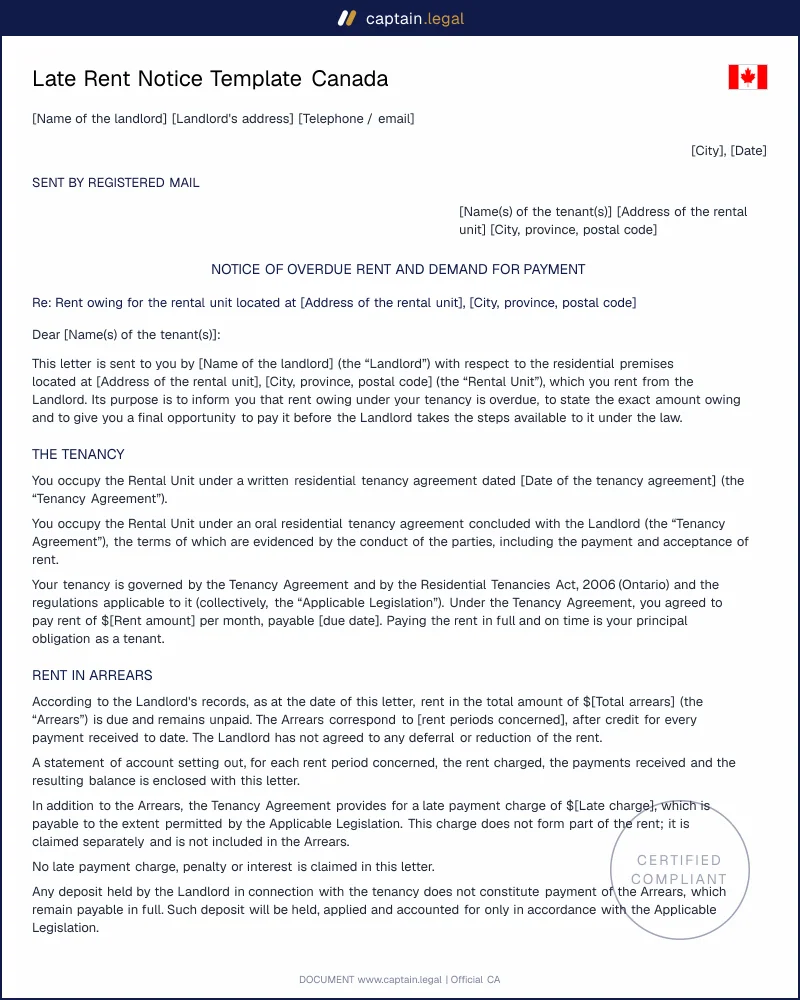
Residential tenancies fall under provincial jurisdiction through the property and civil rights power in section 92(13) of the Constitution Act, 1867. No province requires a reminder before a statutory notice, so the document is a tool of evidence and good practice, and every term it contains must stay within the statute. Quebec, a civil-law jurisdiction where article 1971 of the Civil Code of Québec governs resiliation for unpaid rent, is outside the scope of this template.
In Ontario, the Residential Tenancies Act, 2006, S.O. 2006, c. 17 sets the rules. Section 59 allows a notice of termination for non-payment, and the Fighting Delays, Building Faster Act, 2025 (Bill 60) cut the minimum period for monthly and yearly tenancies from 14 days to 7 days. Under the regulation adopted with Bill 60, persistent late payment, a separate ground under section 58, includes rent received more than seven days late at least three times within six months. Section 134 bars any charge beyond lawful rent, so late fees are unlawful, apart from the dishonoured cheque charge allowed by O. Reg. 516/06. The Ontario e-Laws consolidation of the Residential Tenancies Act, 2006 gives the current text.
British Columbia's Residential Tenancy Act, S.B.C. 2002, c. 78 requires rent to be paid when due even if the landlord is in breach (section 26). Alberta's Residential Tenancies Act, S.A. 2004, c. R-17.1 treats non-payment as a substantial breach and, under section 29(4), cancels the 14-day notice if the tenant pays everything owed before the termination date.