Create my document
Login

Choose country

United StatesUnited StatesChoose country
Personal

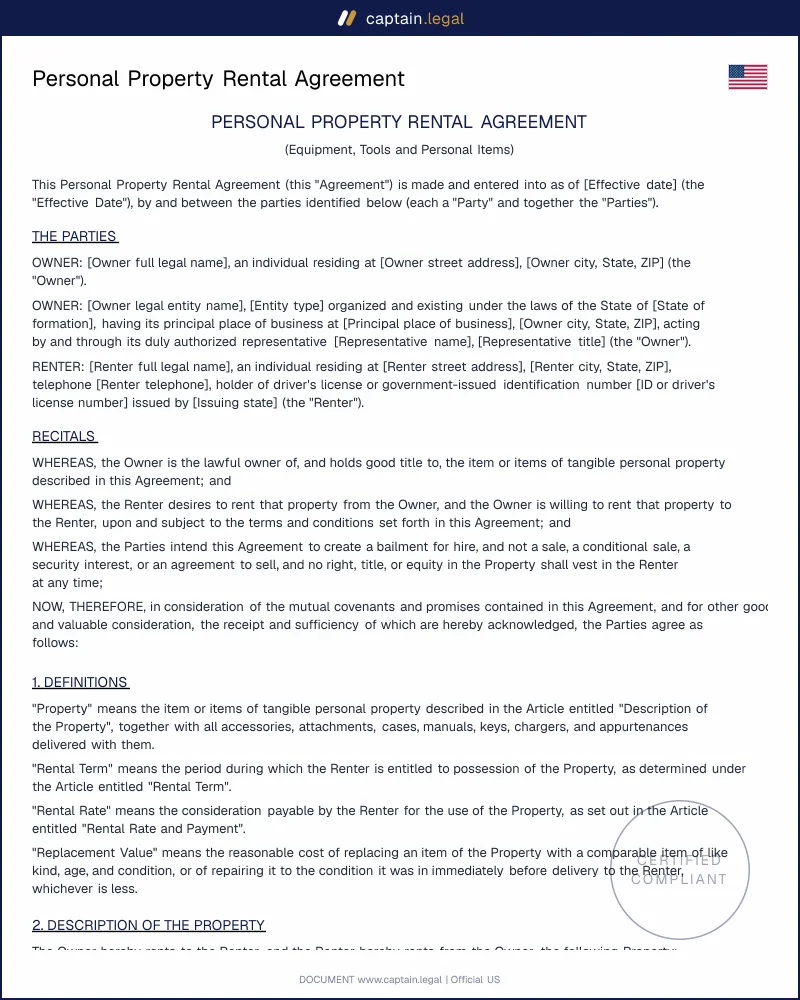
Personal Property Rental Agreement | UCC 2A-Compliant

Bailment for hire drafted to UCC Article 2A: §2A-201 statute of frauds, §2A-214 as-is disclaimer, state-aware demand clauses. Attorney-grade, all 50 states.
4.7/518 reviews50 000+ downloadsInstant download
Share

A personal property rental agreement is the written contract that governs the temporary hire of movable goods, from a chainsaw lent to a neighbour for a weekend to a trailer, a camera body, a generator, or a set of catering tables rented out between individuals. The document identifies the owner and the renter, describes the item in enough detail that nobody argues about it later, fixes the rental term and rate, and allocates the two things that actually cause litigation: damage and loss. Anyone who hires out equipment, tools, or household items occasionally, and every renter who wants a written record of the item's condition on pickup, needs this equipment rental agreement in place before the goods change hands.

The legal machinery underneath is older and more interesting than the paperwork suggests. American law has recognised the bailment for hire for centuries, and the Uniform Commercial Code layered a full leasing statute on top of it. Both matter for a private rental.

Compliant

2026 Legislation

50,000+ clients

trust us

Affordable

From $4.90 / doc

Secure payment

Instant download

Personal Property Rental Agreement | UCC 2A-Compliant

Secure payment

Fill in the template

What is a personal property rental agreement?

A personal property rental agreement is a bailment for hire reduced to writing. Ownership stays with the lessor. What transfers is possession and the right to use the item for an agreed period, in exchange for rent. That distinction drives everything else in the document: because title never moves, the renter has no power to sell, pledge, or encumber the goods, and the owner keeps the residual interest when the term ends. If the paperwork accidentally obliges the renter to pay through the full useful life of the item with no right to cancel, courts will recharacterise the deal as a disguised sale with a security interest, and Article 9 takes over instead of Article 2A. That is not a theoretical risk. It is the single most litigated question in personal property leasing.

Do not confuse this document with a bill of sale, which transfers title outright, or with a promissory note, which records a debt rather than a hire. If money is changing hands so that the other party keeps the item permanently, you want the DMV-ready bill of sale for vehicles, boats and personal property instead. If the goods are attached to land, you are outside personal property law entirely and into the state-aware real estate leases and notices category. The line is possession versus ownership, and every clause in the template respects it.

2

When do you need this document?

The classic scenario is the private tool or equipment hire: a homeowner who owns a rototiller, a scaffold tower, or a concrete mixer and rents it to neighbours a few weekends a year. The item has real replacement cost, the renter has no insurance covering it, and the only thing standing between the owner and a total loss is the security deposit and a damage clause. The second common case is event and hospitality gear, where tables, sound systems, marquees, and lighting rigs move between a private owner and a party host for a fixed weekend, and the whole risk sits in the return condition.

Photographers and videographers hiring out camera bodies, lenses, and drones peer-to-peer represent the fastest-growing use, and they raise a wrinkle worth flagging: an FAA-registered drone carries operator obligations that stay with the pilot, not the owner, and the rental agreement should say so explicitly. Trailers and towable equipment raise the same split. The owner holds title, but the renter tows, and liability for a highway incident rarely follows the paperwork alone.

Two edge cases legitimately justify a lawyer-grade template. First, rent-to-own framing. The moment the agreement lets the renter keep the item at the end for a nominal sum, you have created a security interest, Article 9 applies, and an unperfected owner can lose the goods to the renter's creditors in a bankruptcy. Second, long-term hire of titled goods. Certificate-of-title statutes for vehicles, boats, and trailers sit on top of Article 2A and can require separate registration steps. If your item has a title, treat the rental as a hybrid transaction and check the state DMV rules before signing.

3

Key clauses included in our template

  • The identification and description of the leased goods goes far beyond a name. The template captures serial number, model, condition on delivery, accessories included, and an optional photo schedule referenced into the contract body. Vague descriptions like "one generator" have defeated conversion claims in small claims courts across the country, because the owner could not prove which unit was returned or what condition it left in.
  • The term and return obligation fixes a pickup date, a return date, a return location, and a per-day holdover rate. Article 2A gives no automatic grace period. Once the term expires and the renter keeps possession, the retention is wrongful and the holdover rate is your liquidated remedy, provided it is reasonable in light of the anticipated harm.
  • The security deposit and damage allocation clause states the deposit amount, the permitted deductions, and the deadline for return. It also fixes the standard of care expressly, rather than leaving the renter to argue about what ordinary care meant, and it separates normal wear from damage with a concrete definition.
  • The risk of loss and insurance provision places risk on the renter from pickup to return, requires disclosure of any homeowner or renter policy that responds, and states that theft during the term is the renter's exposure. This is the clause owners most often omit and most often regret.
  • The as-is disclaimer of implied warranties is drafted to §2A-214, using the conspicuous language the statute requires. It disclaims merchantability and fitness for a particular purpose, but it carves out personal injury exposure, because the opposite drafting is unenforceable.
  • The default and repossession terms define what counts as default, whether the owner may retake the item peaceably, and what notice is required first. Self-help repossession without contractual authority is a trespass, and in several states a criminal one.
4

State-specific considerations

California treats bailment disputes under Civil Code §§1925 to 1955, the hiring provisions, which sit alongside its Article 2A enactment in Commercial Code Division 10. The hiring statutes impose an express duty on the hirer to use the thing with ordinary care and to repair deterioration caused by want of that care, which gives an owner a statutory hook independent of contract. California also polices liability waivers aggressively under Civil Code §1668, and any clause purporting to release the owner from their own gross negligence is void.

Texas enacted Article 2A at Business & Commerce Code Chapter 2A, and the writing threshold tracks the uniform $1,000 figure. What distinguishes Texas is the theft-of-service statute, Penal Code §31.04, which criminalises failure to return rented property after written demand once the value crosses statutory tiers. A properly drafted return demand under the agreement is therefore a predicate for criminal referral, not merely a civil step. Owners who skip the written demand lose that leverage entirely.

Florida codified Article 2A at Chapter 680, Florida Statutes, and adds an unusually potent remedy for equipment owners. §812.155 makes failure to redeliver hired personal property after the agreed term a criminal offence where the renter had intent to defraud, and it builds a rebuttable presumption of that intent from failure to return within five days of written demand sent by certified mail. The demand letter format matters in Florida: certified mail to the address on the rental agreement, which is why the template requires a return address from the renter at signing.

New York adopted Article 2A at UCC Article 2-A and applies a strict conspicuousness standard to warranty disclaimers under §2A-214. New York courts also read bailment liability through Dalton v. Hamilton Hotel, holding the bailee to a presumption of negligence once the owner proves delivery in good condition and return in damaged condition or non-return at all. That evidentiary presumption is the practical reason your condition record at pickup is worth more than any clause in the contract.

5

How to fill out this personal property rental agreement

You start by identifying the parties and stating whether either side is renting in the course of a business, because that answer decides whether Article 2A's consumer lease provisions attach and changes several clauses downstream. The form then asks you to describe the goods, and this is the step to slow down on: serial numbers, model designations, visible defects, fuel or battery level, and included accessories. From there you set the term, the rate, and the deposit, and the document builds the holdover rate and the deduction schedule from those figures automatically.

The state selector then adapts the demand and repossession language to your jurisdiction, pulling the Texas theft-of-service wording or the Florida certified-mail requirement into the notice clause where relevant. Warranty disclaimers are formatted to the conspicuousness standard your state applies. Finally you choose your output. Word gives you an editable file if you rent the same item repeatedly and want a reusable master; PDF gives you a clean signing copy for the pickup itself. Both parties sign, both keep a copy, and the condition record attaches as a schedule. If the transaction is actually a loan of money rather than of goods, use the UCC-compliant promissory note for personal loans and family advances instead.

6

Common mistakes to avoid

The most expensive mistake is renting without a condition record. Owners hand over a trailer, take a deposit, and then discover a bent axle three weeks later with no evidence of when it happened. The bailment presumption helps only if you can prove condition at delivery, so photograph the item at pickup and reference the photos in the agreement. The second mistake is drafting a rent-to-own arrangement by accident, usually by adding a friendly clause letting the renter apply payments toward purchase. That single sentence converts a lease into a secured sale, and an owner who has not filed a UCC-1 becomes an unsecured creditor if the renter files bankruptcy.

Third, owners routinely over-draft the waiver. A blanket release of all liability, including personal injury, is presumptively unconscionable under §2A-503(3) for consumer goods and gives a court an easy reason to strike the clause and look suspiciously at the rest of the document. Fourth, the security deposit is treated like a residential damage deposit, with no stated deduction rules and no return deadline, which invites a small claims action the owner will probably lose. Fifth, and most avoidable, is skipping written demand before escalating. In Texas and Florida the demand letter is what unlocks the statutory remedy, and an owner who calls the police first without one gets told it is a civil matter. Business owners renting out equipment as a service should be working from a proper master services agreement structure for recurring commercial work rather than a one-off consumer form.

Key takeaways

OWNERSHIP

This is a lease, not a sale

This agreement documents a bailment for hire: the owner keeps title, while the renter gets temporary possession and use for rent. That means the renter cannot sell, pledge, or otherwise encumber the item. If the terms effectively force payment for the item’s full useful life with no meaningful cancellation, a court may treat it as a disguised sale with a security interest, pushing the deal into UCC Article 9 instead of Article 2A.

UCC 2A

Writing matters once payments hit $1,000

UCC Article 2A supplies the default leasing rules in every state except Louisiana, and its statute of frauds can decide whether you can enforce the deal. Under UCC §2A-201, once total payments (excluding renewal or purchase options) reach $1,000 or more, the lease is unenforceable unless it is in writing and signed by the party you want to hold to it. Even under $1,000, written terms prevent “he said, she said” fights.

LIABILITY

Damage, loss, and misuse drive disputes

Most litigation is about what happened to the item and who pays. Bailment law generally requires the renter to use ordinary care and makes them responsible for damage caused by negligence or use outside the agreed scope. If the renter takes the goods beyond what was authorized, the conduct can be treated as conversion, and damages can jump from repair costs to the item’s full value. Document condition at pickup and allocate risk clearly.

Frequently Asked Questions

Yes. Notarisation is not a condition of enforceability for a bailment or an Article 2A lease anywhere in the United States. What the statute of frauds at §2A-201 requires is a writing signed by the party you want to enforce against, once total payments reach the $1,000 threshold. Below that figure even an oral agreement binds, though proving its terms is another matter. Notarisation adds evidentiary weight if authenticity is ever disputed, and it costs little, so owners renting high-value items sometimes do it. It is a belt-and-braces choice, not a legal requirement, and its absence gives a renter no defence.

Both formats are produced from the same completed questionnaire. The Word file is the right choice if you hire out the same item regularly and want to save a master copy, changing only the renter's details, dates, and deposit each time. The PDF is the signing version: it locks the layout, prints cleanly at the pickup point, and works with standard e-signature platforms without reflowing. Most owners keep the Word file as their template and generate a fresh PDF per rental. The condition schedule and photo references carry into both.

That depends on whether the term has expired. Once the agreed return date passes, retention is wrongful immediately and no notice period applies to your civil claim. The notice question really bites for statutory remedies. Florida's §812.155 builds its presumption of intent to defraud from failure to return within five days of a certified-mail demand, and Texas requires written demand under Penal Code §31.04 before theft-of-service applies. For an open-ended or renewable hire, send written demand and allow a reasonable period, typically the same length as one rental cycle, before treating it as default.

The deposit is a floor, not a cap, unless your agreement says otherwise. Under bailment principles the renter owes the reasonable cost of repair, or the fair market value of the item if repair is uneconomic, and the deposit simply offsets that figure. The template preserves the owner's right to pursue the balance, which is a clause many free forms omit. Where the damage flows from use outside the agreed scope, the claim converts to conversion, and the measure becomes full value rather than repair cost. Document the scope limits carefully at signing for exactly this reason.

For short private hires, yes, with a caveat. Vehicles, boats, and trailers carry certificate of title, registration, and insurance rules that sit on top of the rental contract, and Article 2A expressly defers to state certificate of title statutes. Your auto policy may exclude coverage while the vehicle is rented for a fee, which is a conversation to have with your insurer before, not after. For peer-to-peer car hire done as a business, most states require commercial registration. The agreement covers the contractual layer competently; it does not substitute for the registration layer.

Only if the contract says so and the condition falls outside normal wear. Ordinary wear from agreed use is the owner's cost, not the renter's, and a court will read a cleaning deduction narrowly unless the agreement defines the expected return condition. The template lets you state a return standard explicitly, for instance a fuel level, a cleaned condition, or a specific tool count, which converts a subjective argument into a factual one. Deductions must be itemised and supported by receipts or a reasonable estimate.

Send written demand first, always, and keep proof of delivery. Peaceable self-help repossession is available only if the agreement grants it and you can retake the item without breach of the peace, which in practice means no confrontation, no locked premises, and no threat. Otherwise the route is a civil claim in replevin or a small claims action for value. Depending on the state and the item's value, criminal statutes on theft of service or failure to redeliver may also apply once the demand has expired. Those statutes almost universally require the written demand as a precondition.

For a genuinely new hire, yes, because the condition record and the term change every time. For a repeat renter, many owners execute a short master agreement covering the standing terms, then attach a one-page schedule per rental with the item, dates, rate, and condition. That structure keeps the negotiated clauses stable while the transactional details move. The Word output supports this pattern directly, and it is how equipment owners with regular customers usually run it. Personal agreements affecting property between family members may need prenuptial provisions on separate property and pre-marital assets instead of a rental form.

4.7/5

18 verified reviews · 50 000+ downloads

Personal Property Rental Agreement | UCC 2A-Compliant
  • Immediate access to the document
  • PDF + Word download
  • Compliant with 2026 legislation
  • Reviewed by lawyers
Fill in the template
Secure payment
Updated on July 15, 2026

You might also like

Quit Claim Deed Template
Security Deposit Demand Letter