Personal

Temporary Guardianship Agreement | UPC 5-105 Compliant

Parental delegation drafted to Uniform Probate Code 5-105, Cal. Fam. Code 6550 and Tex. Fam. Code ch. 34. Term limits, HIPAA access and notary block included.
4.5/519 reviews50 000+ downloadsInstant download
Share

A temporary guardianship agreement for a minor child lets a parent hand day to day decision making authority to a grandparent, a relative or a trusted friend for a defined period, without a court hearing and without giving up parental rights. Schools, pediatricians, urgent care clinics and dentists all ask the same question when a non parent arrives with a child: who authorized you? A signed and notarized delegation answers it on paper the front desk can photocopy. Parents use it before a military deployment, a hospital stay, a long assignment abroad, or a school year at a relative's house. It is not a custody order and not adoption. It is a revocable authorization, limited in time and scope, that keeps a child's schooling and medical care moving while you are unavailable.

Compliant

2026 Legislation

50,000+ clients

trust us

Affordable

From $4.90 / doc

Secure payment

Instant download

Temporary Guardianship Agreement | UPC 5-105 Compliant

Secure payment

Fill in the template

What is a temporary guardianship agreement for a minor child?

The phrase covers two instruments that do the same job. The first is a parental delegation of authority, executed by power of attorney, transferring specific powers over the care, custody and education of a child to a named adult for a set period. The second is a statutory caregiver form written into a state code, such as the California caregiver's authorization affidavit or the Texas authorization agreement for a nonparent adult caregiver. Both are private, filed with no one.

A court appointed guardianship is a different animal. It suspends a parent's decision making authority, requires notice to every interested party, and cannot be undone with a signature. A temporary guardianship agreement does the opposite: the parent keeps legal custody, keeps the right to overrule the caregiver, and can revoke the paperwork the same afternoon it stops being useful. No private agreement transfers legal custody, terminates parental rights, or overrides an existing court order. What it does is give a caregiver written authority that third parties will actually rely on.

2

When do you need this document?

Military deployment is the classic trigger. Single service members and dual military couples keep a family care plan on file, and the delegation to the named caregiver is the civilian half of it. Extended medical treatment comes next: a parent facing surgery, chemotherapy or a psychiatric admission needs someone who can sign a permission slip and authorize a strep test. Assignments abroad, seasonal work and a school year at a grandparent's house create the same need, and immigration enforcement has become a common reason too. For a short trip where the child travels with another adult and no decisions are expected, a narrower child travel consent form for a minor fits better.

Two edge cases deserve attention. Where a custody order requires both parents to agree on schooling or health decisions, a delegation signed by one parent alone is worthless, and in New York it is expressly invalid under GOL §5-1551 unless both consent. If the child has an individualized education program, the caregiver also needs specific authority to consent at the committee on special education.

3

Key clauses included in our template

  • The identification of the parties and the child uses full legal names as they appear on identification and school records, with dates of birth and both addresses, since nicknames cause rejections at registration desks.
  • The scope of delegated authority is itemized rather than described in general terms. Routine and emergency medical care, dental care, mental health treatment where state law allows it, school enrollment and records, and domestic travel are addressed separately, so a provider can point to the line covering the decision in front of them. Consent to marriage and to adoption are carved out, because no state permits their delegation.
  • The term and expiration language states a start date and an end date on the face of the document, which Hawaii requires outright and which prevents an unintended lapse in six month states.
  • The records access clause authorizes disclosure of protected health information and of education records held under FERPA, naming the caregiver as the person entitled to receive them. A caregiver who can consent to treatment but cannot see the chart is only half authorized.
  • The revocation and notice clause confirms the parent may cancel at any time in writing, and lists who must be told: the caregiver, the school, the pediatrician and any other parent who signed.
4

State specific considerations

California runs on the caregiver's authorization affidavit at Family Code §6550. Any adult over eighteen with whom the child lives may complete items one through four and enroll the child in school; a qualifying relative who completes items one through eight gains the medical and dental consent rights Probate Code §2353 gives a guardian. No notarization, no court stamp, and Education Code §48204 makes it sufficient proof of residency. The Family Preparedness Plan Act of 2025 widened the definition of relative and revised the form, so older wording may draw questions. The parent's decision always supersedes the caregiver's on medical care, and the affidavit dies once the child stops living with the caregiver.

Texas is the most formal. An authorization agreement under Family Code Chapter 34 must be sworn before a notary, runs six months, and renews in six month terms unless an earlier date appears. The trap is §34.005: if only one parent signs, a copy goes to the other by certified mail with return receipt inside ten days, and the agreement is void without it. Enrollment is separate, since a student entitled to enroll under Education Code §25.001 cannot be turned away for lack of one.

Florida offers no self executing caregiver affidavit. Temporary or concurrent custody by an extended family member runs through the circuit court under Chapter 751, with a petition, notarized parental consent and a hearing. What works without a judge is a written power of attorney for medical consent, recognized at §743.0645.

New York uses the designation of a person in parental relation under GOL §5-1551, reaching school and health decisions for up to twelve months. The detail that catches families out sits in §5-1552: a designation signed but not notarized expires after thirty days, whatever end date the parent wrote in. Elsewhere, six months is the safe planning assumption, and when the need outlasts it, court appointed guardianship beats a stack of renewals. The family and divorce documents section covers the related custody paperwork.

5

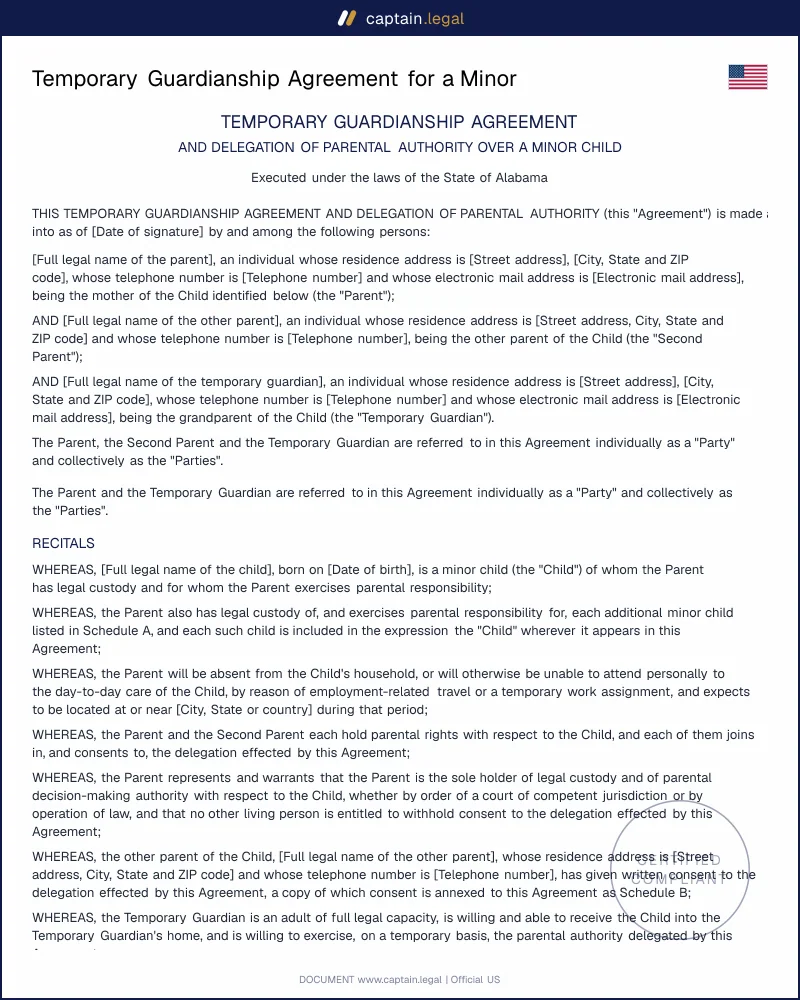
How to fill out this temporary guardianship agreement

You begin by selecting the state where the child lives, because that answer drives everything downstream. The template then produces the right instrument, whether a caregiver affidavit, a Chapter 34 authorization agreement, a designation of a person in parental relation or a probate code delegation, and applies the correct maximum term.

The scope questions follow. You decide whether the caregiver may authorize non emergency surgery, mental health treatment and dental work, whether they may enroll the child in a new school or only deal with the current one, and whether travel is included. You then set the effective and expiration dates, and the form warns you if the period exceeds what the state allows. The last screen assembles the execution block, with signature lines, an acceptance line for the caregiver and a notary jurat where required. Parents updating their estate plan often prepare a last will and testament that nominates a guardian at the same sitting.

6

Common mistakes to avoid

The most frequent failure is the open ended term. Parents write "until further notice" and assume the document lives on, when the statute caps it at six months and the school year runs longer. The second is skipping notarization in a state that conditions validity on it, which turns a twelve month New York designation into a thirty day one and voids a Texas agreement. Third, and most costly in Texas, is forgetting the certified mail copy to the other parent inside the ten day window. Fourth, parents delegate medical consent without authorizing records access, then find the hospital will treat the child but tell the caregiver nothing.

The other cluster of errors is about the wrong instrument. A private agreement cannot cut against a custody order, move a child out of state in defiance of a relocation clause, or substitute for guardianship when the arrangement is permanent. Some parents confuse it with a parenting plan and custody agreement, which allocates rights between two parents rather than delegating them to a third adult. Signing a delegation while a custody dispute is pending is a decision to raise with counsel first.

Key takeaways

Purpose

Delegate daily decisions without losing rights

This agreement lets a parent authorize a trusted adult to handle day-to-day care, schooling, and routine decisions for a defined period without a court hearing. It solves the practical question schools and clinics ask: who gave you permission? The parent keeps legal custody and can overrule the caregiver. It is not a custody order and not an adoption.

State law

Time limits and formalities vary by state

There is no federal rule for temporary parental delegation; the details depend on the state form you use. Many states follow Uniform Probate Code 5-105, commonly allowing delegation for up to six months, while others set different caps (for example, Massachusetts uses a 60-day limit). Some states use caregiver statutes: California’s affidavit is self-executing, while Texas requires a notarized, sworn agreement with six-month terms.

Medical access

Consent to care is not records access

Parents often assume medical decision-making automatically includes the right to obtain medical records, but it does not. The document should separately authorize disclosure so the caregiver can get records when needed, not just sign for treatment. Under HIPAA, a person with authority to make health decisions for a minor may be treated as a personal representative (45 CFR 164.502), and pairing the delegation with a HIPAA release avoids delays at registration.

Frequently Asked Questions

Yes, within its limits. A delegation executed under a state probate code or caregiver statute binds the parent who signed it and gives the caregiver authority that schools and providers may rely on, usually with statutory immunity for anyone accepting it in good faith. What it cannot do is bind a court: a judge deciding custody is not obliged to honor a private arrangement, and it carries no weight against an existing order.

The ceiling depends on the state. Six months is the common answer in Uniform Probate Code states, twelve months applies in New York and Hawaii, and Massachusetts allows sixty days. Texas runs six month terms that renew automatically unless an earlier date is set. Writing a specific expiration date is safer everywhere. If the arrangement will outlast the statutory limit, court appointed guardianship is the right tool.

Not always, but the exceptions bite. Where both parents hold legal decision making rights, two signatures make the document far harder to dispute. Where a custody order requires joint decisions on health or education, a single signature is invalid in New York under GOL §5-1551. Texas allows one parent to sign but requires a certified mail copy to the other within ten days. Where the second parent is deceased or has lost parental rights, one signature is enough and the document should say why.

It depends on the state and, in New York, on how long you want it to last. Texas requires the authorization agreement to be sworn before a notary. New York accepts an unnotarized designation but expires it after thirty days. California's caregiver affidavit needs neither. Notarizing anyway is the practical default, because a notarial certificate removes the easiest objection a front desk can raise.

Usually yes, though the mechanism varies. California treats the caregiver affidavit as proof of residency under Education Code §48204, New York's designation reaches education decisions through the Education Law, and Texas does not require an authorization agreement for a student otherwise entitled to enroll. Districts still apply their own residency and immunization rules, so send the document to the school office ahead of the first day.

Yes, and no state requires a reason. Put the revocation in writing, date it, and deliver copies to the caregiver, the school, the pediatrician and any other parent who signed. Delivery is what matters, because most statutes protect a provider who relies on the document in good faith before receiving notice of the cancellation.

You download the agreement in editable Word format and in PDF. Word is for adjusting the scope language before anyone signs, and for producing a fresh version when the term is about to expire. PDF is the signing copy, with the execution block and notary jurat where the state requires one. Related paperwork sits in the full catalogue of US legal document templates.

4.5/5

19 verified reviews · 50 000+ downloads

Temporary Guardianship Agreement | UPC 5-105 Compliant
  • Immediate access to the document
  • PDF + Word download
  • Compliant with 2026 legislation
  • Reviewed by lawyers
Fill in the template
Secure payment
Updated on September 2, 2026

You might also like

Revocation of Power of Attorney Template
Small Estate Affidavit Template