Personal

Firearm Bill of Sale | 18 U.S.C. 922(d) Compliant Form

Firearm bill of sale drafted to 18 U.S.C. 922(d) prohibited-person language, with CA, WA, CO and NY dealer-transfer rules. Word and PDF, all 50 states.
4.7/512 reviews50 000+ downloadsInstant download
Share

A firearm bill of sale is the written record two private parties sign when a rifle, shotgun, or handgun changes hands outside a dealer's books. It fixes the date, the serial number, the parties, and the condition of the gun when possession passes, which is what a detective or a civil plaintiff will ask about if that gun later turns up somewhere it should not be. Federal law imposes no recordkeeping duty on private sellers, and that is why the paperwork matters: absent a signed transfer record, the last name attached to the firearm is yours. This template covers private-party sales in all 50 states, with prohibited-person language tracking 18 U.S.C. §922(d) and prompts for the states that route transfers through a dealer.

Compliant

2026 Legislation

50,000+ clients

trust us

Affordable

From $4.90 / doc

Secure payment

Instant download

Firearm Bill of Sale | 18 U.S.C. 922(d) Compliant Form

Secure payment

Fill in the template

What is a firearm bill of sale?

A firearm bill of sale is a private contract recording the sale or trade of a gun between two people who are not federally licensed dealers. It names seller and buyer, describes the weapon by manufacturer, model, caliber or gauge, and serial number, states the consideration exchanged, and fixes the date of delivery. Most versions also carry a signed declaration by the buyer that no category in 18 U.S.C. §922(d) applies to him, plus an as-is disclaimer cutting off implied warranties under UCC §2-316.

Separate it from three things people confuse it with. An ATF Form 4473 is a federal record created by a licensed dealer, kept on the dealer's premises and never handed to the buyer; the bill of sale belongs to the parties, not the government. A gun trust is an estate-planning instrument for items regulated under the National Firearms Act, not a transfer receipt. And an ordinary general bill of sale for vehicles, boats, and household property carries no prohibited-person attestation and no acknowledgment of state transfer rules, which leaves the seller exposed on the only points that matter.

2

When do you need this document?

The core case is still the face-to-face sale between two residents of the same state, in the roughly half of the country where no dealer involvement is required. Nothing else in that transaction generates a paper trail, so the document is all that stands between the seller and an open question about who had the gun last. Estate transfers come second. When a shotgun passes to a son under a will, §922(a)(5) permits the interstate move as a bequest, but the executor still wants a dated instrument showing what left the estate and when, particularly where a last will and testament names the firearm as a specific gift.

Trades belong here too: two collectors swapping rifles at a club are each simultaneously seller and buyer, and one document signed both ways records both directions. Divorce is the fourth situation. Property settlements routinely assign firearms to one spouse, and judges handling divorce and marital property disputes want the handover documented. Never hand a firearm to a spouse subject to an active protective order, whatever the settlement says, because that transfer is a federal offense under §922(d)(8).

One edge case earns its own line. A Nevada seller dealing with a California buyer cannot close in person; the gun moves through a California dealer, and the bill of sale documents the seller-to-dealer leg that no dealer file describes.

3

Key clauses included in our template

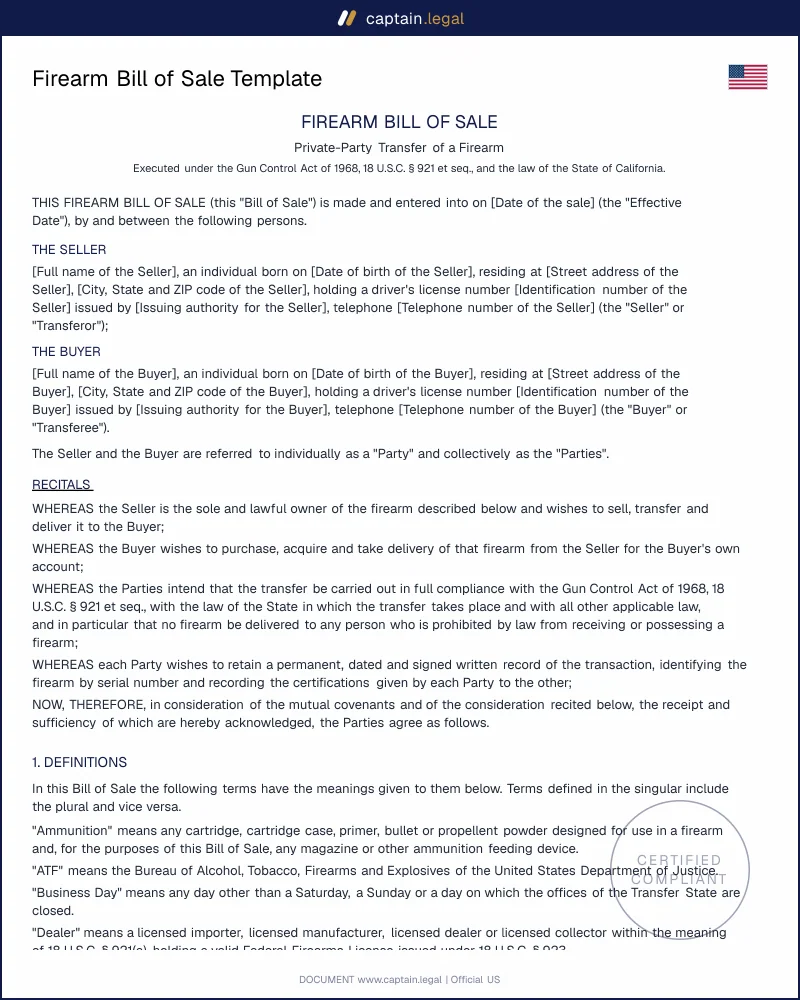
  • Full identification of both parties, with legal names as printed on a government photo ID, residential street addresses, and dates of birth. Post office boxes are excluded, since residency under §922(a)(5) turns on where each party actually lives.
  • A firearm description block covering manufacturer, importer where one appears, model, type, caliber or gauge, barrel length, and the serial number transcribed exactly as it reads on the receiver. Transposition errors are the commonest defect in homemade versions, and a wrong serial makes the document useless for tracing.
  • The buyer's prohibited-person certification, tracking the categories of §922(d) one by one rather than a blanket sentence saying the buyer may lawfully own a gun. Itemized denials are harder to retract later.
  • A residency and identification acknowledgment in which the buyer states the issuing state of the ID presented and the seller records that it was examined and matched. This answers the reasonable-cause question if a prosecutor asks what the seller knew.
  • An as-is, no-warranty disclaimer drafted to UCC §2-316, disclaiming merchantability and fitness for a particular purpose, with the buyer's acknowledgment of inspection and acceptance.
  • A dealer transfer block recording whether the transaction ran through a licensed dealer and, if so, the dealer's name, license number, and the date the check cleared. In dealer-transfer states this is the compliance record.
4

State-specific considerations

California routes essentially every private-party transfer through a licensed dealer under Cal. Penal Code §27545, using the Dealer's Record of Sale system run by the Department of Justice. The buyer needs a Firearm Safety Certificate, waits out the ten days imposed by §26815, and in most cases may acquire one handgun per 30-day period under §27535. A bill of sale substitutes for none of that; it sits alongside the DROS paperwork as the parties' own record of condition and date. A private California sale completed outside a dealer is a criminal offense for both parties, whatever the paperwork says.

Washington subjects every sale or transfer to a background check under RCW 9.41.113, sales between unlicensed persons included, with exemptions for gifts within the immediate family and short loans that stay in the transferor's presence. Ten days must pass before delivery. The permit-to-purchase system created by House Bill 1163 takes effect May 1, 2027, making a State Patrol permit a precondition to any dealer delivery.

Colorado requires the unlicensed seller to arrange a background check through a licensed dealer under C.R.S. §18-12-112, with exemptions for certain family transfers and loans under 72 hours, and imposes a three-day wait under C.R.S. §18-12-115. Senate Bill 25-003 now conditions the purchase or transfer of a specified semiautomatic firearm on a sheriff-issued eligibility card and a state-recognized safety course.

New York channels private sales through a dealer background check under General Business Law §898, exempting only spouses, domestic partners, children, and step-children. Handguns require a pistol license under Penal Law §400.00, which must then be amended to list the weapon, and since the Concealed Carry Improvement Act a license is also needed to take possession of a semiautomatic rifle.

5

How to fill out this firearm bill of sale

The form opens with the state where the transfer physically takes place, and that one answer reshapes everything after it. Choose California, Washington, Colorado, or New York and the template inserts the dealer transfer block, the waiting period, and the local citation; choose a state with no private-transfer statute and those fields drop away. Next come the parties, each side's state of residence asked separately so the interstate problem surfaces before anyone reaches a signature line.

The firearm description follows, one screen per gun, so a package sale of three rifles produces three blocks instead of a cramped single line. Serial entry is confirmed twice. You then pick the consideration: cash, straight trade, trade plus difference, or gift, and the as-is language adjusts to match. The last screen handles execution, with an optional notary jurat and a witness block for states where either adds evidentiary weight. Output arrives in Word and PDF, filed beside any other personal legal documents prepared for use in the United States.

6

Common mistakes to avoid

The most frequent error is treating the bill of sale as a background check. It is a record, not a screen, and in a dealer-transfer state, signing one and walking away is a crime however thorough the paperwork looks. Willful blindness comes second. Sellers who notice a buyer acting strangely, mentioning a recent arrest, or pushing hard for a fast cash deal sometimes decide not to ask, but §922(d) runs on reasonable cause, and a jury can find it in facts the seller ignored. Walking away from a sale that feels wrong costs nothing; completing it can cost ten years.

Serial number errors come third, and they are nearly always transcription problems: a zero read as the letter O, a five as an S. Photograph the serial, then type it. Fourth is the casual interstate sale at a gun show near a state line, where both parties assume the show's location settles residency. It does not. Businesses holding firearms as company property need a corporate resolution alongside the bill of sale, which is where company formation and corporate governance templates earn their place.

Key takeaways

922(d) RISK

You cannot sell to a prohibited person

18 U.S.C. 922(d) makes it a crime to sell or otherwise dispose of a firearm to someone you know, or have reasonable cause to believe, is prohibited (for example, a felon, unlawful drug user, or a person under a qualifying domestic-violence order). A signed buyer declaration helps, but it does not replace your judgment if red flags show up at the meet.

TRANSFER LIMITS

Same-state private sales are the baseline

Federal law is not a general paperwork system for private sellers, but it does draw bright lines on who you can transfer to. Under 18 U.S.C. 922(a)(5), you generally cannot transfer a firearm to someone you know or reasonably believe lives in another state, except narrow cases like bequests or temporary sporting loans. For handguns, 18 U.S.C. 922(x) blocks transfers to anyone under 18.

PAPER TRAIL

The bill of sale protects you later

Because federal law does not require private sellers to keep transfer records, the bill of sale often becomes the only proof you have that the gun left your possession on a specific date. It locks in the serial number, the parties, the consideration, and the condition at delivery, which matters if the firearm later appears in an investigation or a lawsuit. An as-is clause can also disclaim implied warranties under UCC 2-316.

Frequently Asked Questions

Yes. It is a contract for the sale of goods, governed by Article 2 of the Uniform Commercial Code, and it binds both sides once signed. What it cannot do is make an unlawful transfer lawful: if the sale breaches 18 U.S.C. §922(d) or a state dealer-transfer statute, the document records the violation rather than curing it. Used properly, it is strong evidence of the date possession changed, and that date decides whether a later crime committed with the gun becomes your problem or the buyer's.

Yes, for a reason most sellers miss. The dealer's ATF Form 4473 records the buyer and stays on the dealer's premises for at least twenty years. None of it is given to you, and none of it states what you were paid or how the gun functioned when it left you. A trace request reaches the dealer, then the buyer, and your position is reconstructed from memory unless something signed exists.

Not directly. 18 U.S.C. §922(a)(5) prohibits an unlicensed person from transferring a firearm to a resident of another state, with narrow exceptions for bequests and temporary loans during lawful sporting activity. The route that works is shipping to a federally licensed dealer in the buyer's state, who runs the check and completes the transfer. Handguns travel by common carrier rather than the Postal Service, and the bill of sale covers the seller-to-dealer leg.

Both. The completed document downloads as an editable Word file and a print-ready PDF. The Word version matters more than buyers expect, because serial numbers get mistyped, a second gun joins the deal late, or a dealer asks for the transfer block to be filled in afterward. Print two copies of the PDF so each party leaves with an original signature rather than a photograph of one. The full catalogue of United States legal document templates sits in the same account.

There is no fixed cutoff, because a trace request can arrive at any point in the life of the gun. Licensed dealers retain transfer records for twenty years under federal regulation, and a seller who keeps a copy for less ends up with a shorter memory than the system tracing it. Keep the signed original with your permanent papers, and a scan somewhere separate.

The certification is your evidence, not your immunity. If you had no reasonable cause to suspect the buyer was prohibited, a signed statement denying each disqualifying category one by one is what supports that position. If you did have reasonable cause and sold anyway, it helps nothing. That is why the identification acknowledgment carries equal weight: it records what you checked, at the moment you checked it.

4.7/5

12 verified reviews · 50 000+ downloads

Firearm Bill of Sale | 18 U.S.C. 922(d) Compliant Form
  • Immediate access to the document
  • PDF + Word download
  • Compliant with 2026 legislation
  • Reviewed by lawyers
Fill in the template
Secure payment
Updated on September 3, 2026

You might also like

Personal Care Agreement Template
Roommate Move-Out & Deposit Settlement Letter