Business

Deed of Trust & Note | 12 CFR 1026.36 Compliant

Seller carryback deed of trust and secured promissory note drafted to 12 CFR 1026.36, Civ. Code 2924 and Tex. Prop. Code 51.002. Word and PDF, all 50 states.
4.8/519 reviews50 000+ downloadsInstant download
Share

A deed of trust and secured promissory note are the two halves of one private home loan. The note carries the promise to repay: principal, rate, payment dates, acceleration on default. The deed of trust is the recordable half, the instrument that attaches that promise to the house and gives the lender something to foreclose. Sellers carrying paper for a buyer no bank will approve, parents lending against a child's first purchase, and private lenders funding a rehab all need both signed the same day and recorded where the property sits. A promissory note standing alone is an unsecured IOU. Recording is what turns it into a lien that survives a resale, a judgment creditor, or a bankruptcy filing.

Compliant

2026 Legislation

50,000+ clients

trust us

Affordable

From $4.90 / doc

Secure payment

Instant download

Deed of Trust & Note | 12 CFR 1026.36 Compliant

Secure payment

Fill in the template

What is a deed of trust and secured promissory note?

The promissory note is the debt. It is a negotiable instrument under Article 3 of the Uniform Commercial Code, and it can be sold or endorsed. It sets the amount borrowed, the rate, the amortization method, whether a balloon comes due, and what follows default. The deed of trust is the security. It conveys bare legal title to a neutral trustee, who holds it for the lender until the note is paid and then reconveys. Three parties sign: the trustor (buyer and borrower), the beneficiary (seller and lender), and the trustee, usually a title company or an attorney.

That third party is the whole point. Because the trustee already holds title with a power of sale, the lender reaches the collateral after default without a judge. Neither document resembles a contract for deed drafted to state executory contract statutes, where the seller keeps title until the final payment. Here the buyer owns the house from closing day and the seller holds a lien, which changes tax treatment, forfeiture rights, and the name on the tax roll.

2

When do you need this document?

The classic trigger is a buyer with a real down payment, verifiable income, and a credit file underwriting will not clear. Self-employed borrowers two years out from a restructuring, recent arrivals with thin credit files, and buyers of houses that will not appraise all end up here, and a carryback note bridges the gap. The second scenario is the intrafamily loan, where a parent funds a child's purchase and needs the transfer to read as a loan rather than a gift. The IRS treats an undocumented advance as a gift with unpleasant regularity, and a recorded lien plus a note bearing the applicable federal rate holds that line.

Investors use the pair constantly. Sellers of rental portfolios spread capital gain over an installment sale under IRC §453. Two edge cases matter. The wraparound, where the seller's bank loan stays in place and the new note wraps around it, is lawful in most states, tightly regulated in Texas, and exposed to acceleration. A seller taking back a junior lien behind a new institutional first holds a lien that a senior foreclosure will wipe out, so the terms must price that risk.

3

Key clauses included in our template

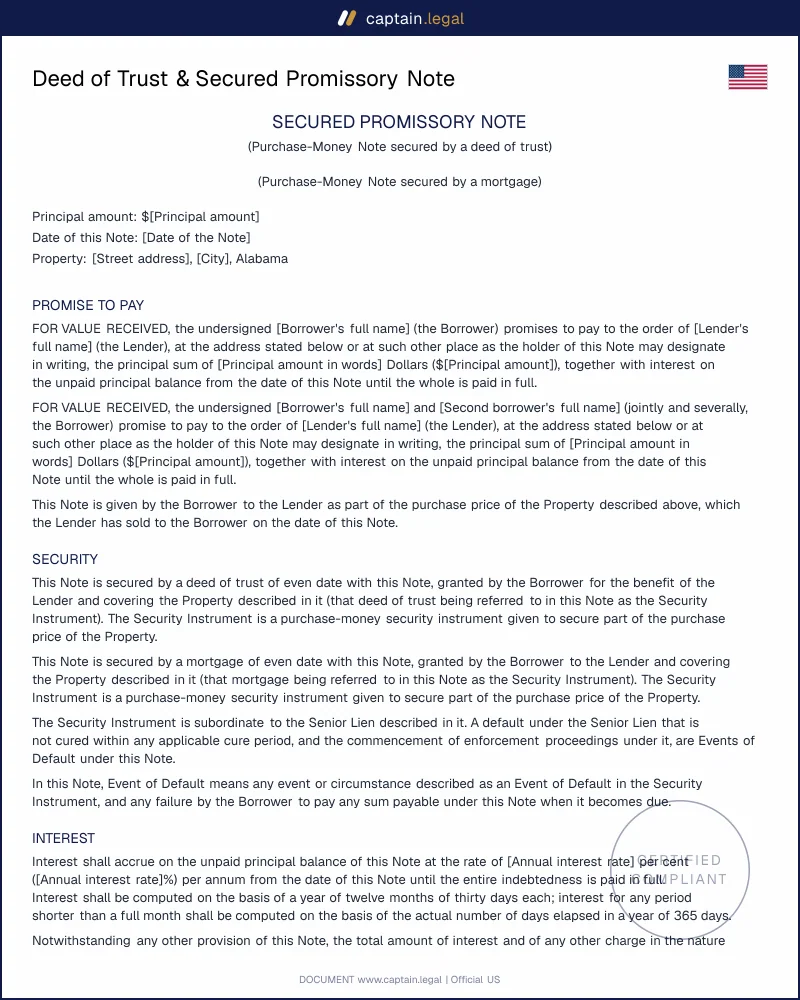
  • The note terms open with principal, interest rate, first payment date, maturity, and amortization method. The template separates a fully amortizing schedule from an interest-only or balloon structure and flags the §1026.36(a)(4) condition when you report a second financed property.
  • The granting clause and trustee designation name the three parties and convey the property in trust with power of sale. The legal description carries over from the warranty deed that conveys title at closing, because a description that misses the deed of record is the most common recording rejection.
  • The acceleration and power of sale clause tracks the notice architecture of your state: cure period, notice of default, notice of sale, manner of service.
  • The escrow, tax, and insurance covenants require the borrower to keep taxes current and hazard coverage in force with the beneficiary named as loss payee. A lender who never verifies the endorsement discovers the omission after the house burns.
  • The due-on-sale and due-on-encumbrance clause allows acceleration if the borrower conveys the property or records a junior lien without written consent, mirroring Garn-St Germain so exempt family transfers stay exempt.
4

State-specific considerations

California runs the nonjudicial sale through Cal. Civ. Code §2924: a recorded notice of default, a three-month wait, then a notice of sale recorded and published at least twenty days before the auction. Code Civ. Proc. §580b bars any deficiency on a purchase money instrument given to the vendor, and §580d bars one after any nonjudicial sale, so a California carryback is functionally nonrecourse. That protection cannot be waived in the note. Carryback sales also fall under Civ. Code §§2956 to 2967, and §2966 makes the holder warn the borrower between 90 and 150 days before a balloon falls due.

Texas pairs a fast trustee's sale with strict paperwork. Tex. Prop. Code §51.002 requires a 20-day notice of default and opportunity to cure on debt secured by a borrower's residence, then 21 days' written notice of sale, with the auction held on the first Tuesday of the month at the county courthouse. Deficiency survives under §51.003 for two years, subject to a fair market value offset. A seller financing a house that still carries a bank lien must deliver the seven-day disclosure to the buyer and every lienholder under §5.016, and wraparound loans fall under Chapter 159 of the Texas Finance Code.

Florida uses mortgages rather than deeds of trust, and foreclosure runs through the circuit court under Fla. Stat. Chapter 702. The tax trap catches nearly every private lender: documentary stamp tax is due on the note under Fla. Stat. §201.08 and on the recorded instrument, and most District Courts of Appeal hold the instrument unenforceable until the tax is paid, as in Klein v. Royale Group.

New York is judicial only. Foreclosure proceeds under RPAPL Article 13, a residential home loan triggers the 90-day pre-foreclosure notice of RPAPL §1304 plus the filing under §1306, and RPAPL §1301 forces an election of remedies, so suing on the note forfeits foreclosure without leave of court. Where a revocable living trust holds title, confirm the trustee powers before the instrument reaches the clerk and budget for mortgage recording tax under Article 11 of the Tax Law.

5

How to fill out this deed of trust and secured promissory note

You start by selecting the state where the property sits, and the form branches at once: pick Florida or New York and it produces a mortgage with judicial foreclosure language, pick California or Texas and it produces a deed of trust with a power of sale and the local notice periods. Next you identify every party who will hold title and paste the legal description exactly as it appears on the recorded deed. The financing screen asks for principal, rate, term, payment frequency, and whether a balloon applies; report a second financed property inside twelve months and the form warns you about the Regulation Z amortization condition. You then name the trustee, set the tax and insurance obligations, and decide whether prepayment is permitted. The last screen builds the acknowledgment blocks your county recorder expects.

6

Common mistakes to avoid

The most expensive mistake is signing the note and never recording the security instrument. Sellers do this out of misplaced courtesy toward a buyer they know, and the lien then loses to a later mortgage, a mechanic's lien, or an IRS filing. A close second is copying the legal description from a tax bill instead of the recorded deed, which produces an instrument the recorder rejects or records against the wrong parcel. Third, sellers write a balloon into a note that cannot carry one, having financed a second property in the same twelve months.

The remaining errors cluster around the underlying loan and the selling entity. Leaving a bank mortgage in place without disclosure invites acceleration and, in Texas, a statutory violation. Naming a seller personally when a company holds title breaks the chain, and an entity carrying a note should have the deal authorized in its LLC operating agreement first. Many lenders also skip the request for notice of default and hear about a senior foreclosure from the auction results.

Key takeaways

Two documents

The note is debt; the deed secures

A secured private home loan needs both pieces: the promissory note (principal, interest rate, payment dates, and what happens on default) and the deed of trust (the recordable instrument that ties that promise to the house). Sign them the same day. If you only have a note, you usually have an unsecured IOU, not a claim against the property.

Recording

Recording creates the lien and priority

Recording the deed of trust in the county where the property is located is what turns the loan into a lien that can survive resale pressure, competing judgment creditors, or a bankruptcy filing. Priority generally runs from the date of recording, so an unrecorded deed of trust can lose to a later good-faith purchaser. Treat recording as a closing requirement, not an afterthought.

Compliance

Dodd-Frank limits seller-financed deals

Seller carryback on a home can trigger federal and state rules, including Regulation Z and SAFE Act licensing. Under 12 C.F.R. 1026.36, a natural person, estate, or trust can finance one property in a 12-month period with conditions (including no negative amortization). Financing up to three or fewer in 12 months requires a fully amortizing note and a good-faith ability-to-repay finding under 12 C.F.R. 1026.43(c).

Frequently Asked Questions

Yes, once the borrower signs and the security instrument is acknowledged before a notary and recorded. The note is enforceable as a contract and as a negotiable instrument under UCC Article 3. The lien binds the parties on execution, but priority against third parties dates from recording. What defeats these documents is rarely the drafting: it is a defective legal description, a missing acknowledgment, unpaid recording tax, or a structure that breaches federal originator rules.

Recording is not required to bind the borrower, but it is required to bind everyone else, and no grace period applies. Under most notice and race-notice acts, a later buyer or lender without knowledge of your unrecorded lien takes ahead of you. Record it the same day as the deed. A title company handling the closing normally records both instruments as one package, in sequence, so the lien attaches right after the buyer takes title.

It depends on the federal exclusion you rely on. A natural person, estate, or trust financing a single property in a twelve-month period under 12 C.F.R. §1026.36(a)(5) may write a balloon, so long as the note does not negatively amortize. Anyone using the three-property exclusion in §1026.36(a)(4) must offer a fully amortizing note, so a balloon is off the table. California adds the warning requirement of Civ. Code §2966 on top.

Both documents download as an editable Microsoft Word file and a print ready PDF, and you can edit either before signing. The Word version matters more here than with most templates, because county recorders impose rules on margins, blank space for the recording stamp, and font size. The security instrument must be signed before a notary, and some states require witnesses as well. You will find related instruments in the catalogue of US legal document templates.

Name a neutral third party eligible under state law, typically a title insurance company, a trustee services company, or a licensed attorney in the county where the property sits. Some states restrict who may serve, and a few require a resident or licensed entity. Do not name yourself as both beneficiary and trustee: courts have set aside sales run by a trustee who was effectively the lender, and a title insurer will hesitate to cover the buyer at that sale.

The bank may accelerate. Garn-St Germain makes those clauses enforceable on residential property with fewer than five units, and a sale to an unrelated buyer falls outside all nine statutory exceptions. Lenders enforce selectively, and the risk climbs when market rates climb. If an existing loan stays behind your new note, disclose it to the buyer in writing and price the deal for that risk. Texas requires a seven-day disclosure to the buyer and each lienholder.

4.8/5

19 verified reviews · 50 000+ downloads

Deed of Trust & Note | 12 CFR 1026.36 Compliant
  • Immediate access to the document
  • PDF + Word download
  • Compliant with 2026 legislation
  • Reviewed by lawyers
Fill in the template
Secure payment
Updated on September 4, 2026

You might also like

Settlement Agreement & Mutual Release Template
Distribution & Reseller Agreement Template